AQA · A-Level · Physical Education
Course version: 7582 · Version from Sept 2016
Principles and theories of learning and performance: Cognitive theories.
Cognitive theories of learning, such as Gestalt theory, emphasise that athletes learn best by understanding the whole problem rather than practising isolated sub-routines.
Checked against the AQA 7582 specification (opens in a new tab) on .
- Point 5 of 12
- 4 key terms
Study notes
From the checked teaching notes for this specification point.
The idea
Cognitive theories of learning, such as Gestalt theory, emphasise that athletes learn best by understanding the whole problem rather than practising isolated sub-routines. This relies on insight learning, where performers draw upon past experiences and use intervening variables—like perception and mental reasoning—to solve tactical problems. For instance, a hockey midfielder might analyse a shifting defence and use insight to execute a disguised pass. Cognitive theories support whole practice, allowing learners to appreciate the full context of a skill. Unlike behaviourist approaches, cognitive learning focuses on internal understanding and adapting to novel sporting situations rather than relying on rote stimulus-response conditioning.
What earns the marks
- Defines cognitive theories as focusing on insight learning and understanding the whole problem (Gestalt principles).
- Explains that performers draw upon past experiences to solve current tactical or technical problems in sport.
- Describes the role of intervening variables, such as perception and mental reasoning, in the decision-making process.
- Applies cognitive theory to a specific sporting example, such as a player adapting their tactics to overcome a novel defensive strategy.
- Contrasts cognitive learning with behaviourist approaches, highlighting that it involves internal understanding rather than stimulus-response conditioning.
Common mistakes and how to put them right
Confusing cognitive learning theory with information processing models.
Put it right: Focus on insight, whole practice and problem-solving rather than memory stores.
Assuming cognitive learning relies on trial and error.
Put it right: Recognise that it relies on mental reasoning and understanding the whole problem.
Believing cognitive theory is ideal for absolute beginners.
Put it right: Note that it often requires some past experience to draw upon for insight.
Exam tips
- Use key terminology such as 'insight learning', 'Gestalt' and 'intervening variables' when describing cognitive theories.
- Provide a clear sporting example where a performer adapts to a novel situation using understanding rather than a rehearsed drill.
- Link cognitive theory to 'whole practice' methods, explaining how the performer experiences the full context of the skill.
Try the lesson
The start of the Principles and theories of learning and performance: Cognitive theories. lesson, made from checked teaching notes for this specification point.
Have a go first
In cognitive theories of learning, what is the learner primarily doing when acquiring a new motor skill?
Listen
Cognitive theories of learning, such as Gestalt theory, emphasise that athletes learn best by understanding the whole problem rather than practising isolated sub-routines. This relies on insight learning, where performers draw upon past experiences and use intervening variables—like perception and mental reasoning—to solve tactical problems. For instance, a hockey midfielder might analyse a shifting defence and use insight to execute a disguised pass. Cognitive theories support whole practice, allowing learners to appreciate the full context of a skill. Unlike behaviourist approaches, cognitive learning focuses on internal understanding and adapting to novel sporting situations rather than relying on rote stimulus-response conditioning. A strong answer earns marks for these points. Defines cognitive theories as focusing on insight learning and understanding the whole problem (Gestalt principles). Explains that performers draw upon past experiences to solve current tactical or technical problems in sport. Describes the role of intervening variables, such as perception and mental reasoning, in the decision-making process. Applies cognitive theory to a specific sporting example, such as a player adapting their tactics to overcome a novel defensive strategy. A common slip: Confusing cognitive learning theory with information processing models. Instead, focus on insight, whole practice and problem-solving rather than memory stores. Exam tip: Use key terminology such as 'insight learning', 'Gestalt' and 'intervening variables' when describing cognitive theories.
See it
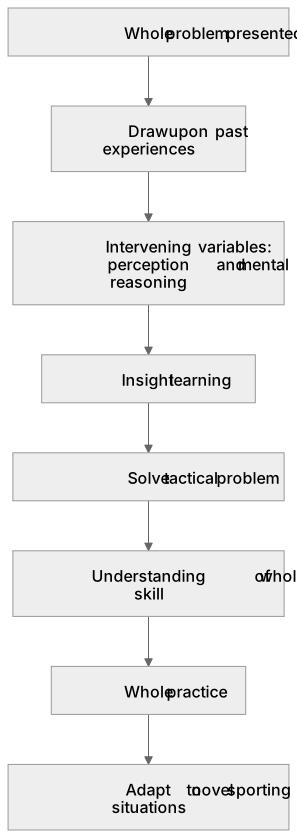
Put it in order
Put these steps in the order they happen.
- 1. Solve tactical problem
- 2. Adapt to novel sporting situations
- 3. Understanding of whole skill
- 4. Whole problem presented
- 5. Draw upon past experiences
- 6. Whole practice
- 7. Intervening variables: perception and mental reasoning
- 8. Insight learning
Watch it explained
What is the one idea the video explains? Say it in a sentence.
Read the described scene instead
Cognitive theories of learning, such as Gestalt theory, emphasise that athletes learn best by understanding the whole problem rather than practising isolated sub-routines. This lesson introduces insight learning and the mental processes that support tactical problem-solving. At the centre is insight learning: performers draw on past experiences and use intervening variables, such as perception and mental reasoning, to solve tactical problems. These internal processes help them understand what a situation demands. In a cognitive view, the performer draws on past experience, perceives the current problem, and uses mental reasoning to decide how to respond. The response is adapted to the situation rather than produced by rote stimulus-response conditioning. Before the example, pause to think how past experience might help a player understand a novel defence. A hockey midfielder might analyse a shifting defence and use insight to execute a disguised pass. The midfielder is not following a rehearsed drill; they are adapting to the whole tactical picture. Do not confuse cognitive learning theory with information processing models; focus on insight, whole practice and problem-solving rather than memory stores. Cognitive learning does not rely on trial and error; it relies on mental reasoning and understanding the whole problem. It is also not ideal for absolute beginners, because insight often requires some past experience to draw upon. Cognitive theories support whole practice, allowing learners to appreciate the full context of a skill. Unlike behaviourist approaches, cognitive learning focuses on internal understanding and adapting to novel sporting situations rather than relying on rote stimulus-response conditioning. Use terms such as insight learning, Gestalt and intervening variables when describing it.
Key words
Say what each word means before you turn the card.
Insight learning and Gestalt theory
Try answering aloud or in your head before turning the card.
Problem-solving and intervening variables
Try answering aloud or in your head before turning the card.
The role of past experience in learning
Try answering aloud or in your head before turning the card.
Whole practice and contextual understanding
Try answering aloud or in your head before turning the card.
See every definition
- Insight learning and Gestalt theory
- Cognitive theories of learning, such as Gestalt theory, emphasise that athletes learn best by understanding the whole problem rather than practising isolated sub-routines.
- Problem-solving and intervening variables
- Performers use intervening variables—like perception and mental reasoning—to solve tactical problems.
- The role of past experience in learning
- Insight learning relies on performers drawing upon past experiences to solve tactical problems.
- Whole practice and contextual understanding
- Cognitive theories support whole practice, allowing learners to appreciate the full context of a skill.
Label the diagram
Some boxes have lost their names. Pick the right name for each number.
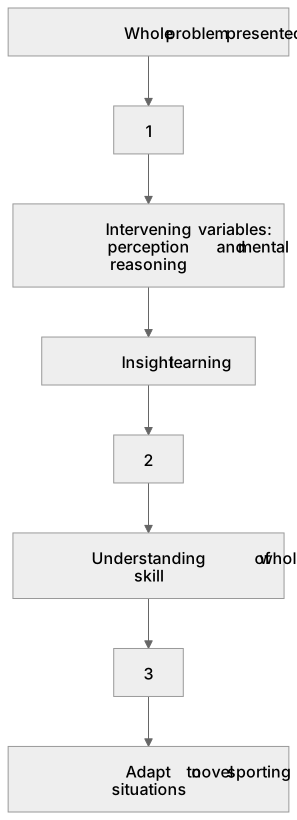
1Box 1
2Box 2
3Box 3
There is more to this lesson
The full lesson goes on to check your understanding and help you earn the marks. Create a free account to carry on, with your progress saved.
A week of Premium from your first lesson · Then the free plan continues · No card, no charge
Test your understanding of Principles and theories of learning and performance: Cognitive theories.
Active recall beats re-reading. Take an instant quiz now to test what you’ve learned and lock it into long-term memory.
A week of Premium from your first lesson · Then the free plan continues · No card, no charge