AQA · A-Level · Physical Education
Course version: 7582 · Version from Sept 2016
Insight learning (Gestalt).
Full specification wording
Principles and theories of learning and performance: Insight learning (Gestalt).
Insight learning is a cognitive theory associated with Gestalt psychology.
Checked against the AQA 7582 specification (opens in a new tab) on .
- Point 6 of 12
- 4 key terms
Study notes
From the checked teaching notes for this specification point.
The idea
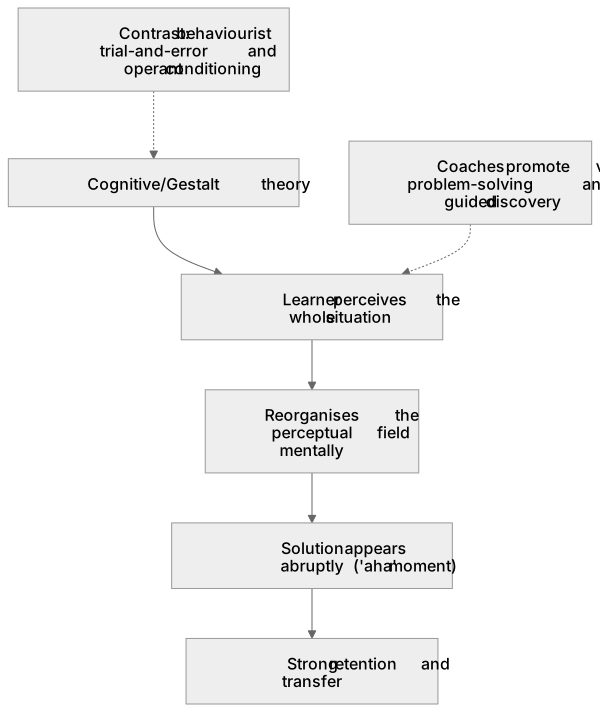
Insight learning is a cognitive theory associated with Gestalt psychology. It explains skill acquisition as a sudden, whole-pattern understanding of a problem rather than a gradual build-up of stimulus-response links. The learner perceives the total situation, reorganises the elements mentally, and the solution appears abruptly, often described as the 'aha' moment. A coach might set a games-based problem, such as creating space in a small-sided game, and let the performer restructure their understanding without step-by-step instruction. Once the insight occurs, the new movement pattern is usually retained well and transfers to similar situations. Insight learning contrasts with behaviourist trial-and-error and operant conditioning, because the change is internal and cognitive rather than dependent on reinforcement.
What earns the marks
- Insight learning is a cognitive/Gestalt theory of learning.
- Learning occurs as a sudden, whole understanding of a problem rather than gradual conditioning.
- The learner perceives the whole situation and reorganises the perceptual field.
- The solution appears abruptly, often called the 'aha' moment.
- Retention and transfer of the learned skill are often strong once insight is achieved.
- Coaches can promote it through problem-solving and guided discovery tasks.
Common mistakes and how to put them right
Thinking insight learning is the same as trial-and-error.
Put it right: Trial-and-error is gradual and behaviourist, whereas insight is a sudden cognitive restructuring of the whole problem.
Believing insight learning requires reinforcement after every attempt.
Put it right: Reinforcement belongs to operant conditioning, while insight depends on the learner perceiving and reorganising the situation.
Assuming insight learning only applies to cognitive subjects and not to physical skills.
Put it right: It can explain sudden improvements in games, gymnastics or racket sports when a performer grasps the whole tactical pattern.
Exam tips
- Link the term 'Gestalt' to 'whole pattern' so the examiner sees you understand the cognitive basis.
- Contrast insight learning with one behaviourist theory in a sentence to show precise conceptual boundaries.
- Use a short practical example, such as a footballer suddenly seeing the passing angle, to make the abstract theory concrete.
Try the lesson
The start of the Principles and theories of learning and performance: Insight learning (Gestalt). lesson, made from checked teaching notes for this specification point.
Have a go first
Which description best matches insight learning as explained by Gestalt psychologists?
Listen
Insight learning is a cognitive theory associated with Gestalt psychology. It explains skill acquisition as a sudden, whole-pattern understanding of a problem rather than a gradual build-up of stimulus-response links. The learner perceives the total situation, reorganises the elements mentally, and the solution appears abruptly, often described as the 'aha' moment. A coach might set a games-based problem, such as creating space in a small-sided game, and let the performer restructure their understanding without step-by-step instruction. Once the insight occurs, the new movement pattern is usually retained well and transfers to similar situations. Insight learning contrasts with behaviourist trial-and-error and operant conditioning, because the change is internal and cognitive rather than dependent on reinforcement. A strong answer earns marks for these points. Insight learning is a cognitive/Gestalt theory of learning. Learning occurs as a sudden, whole understanding of a problem rather than gradual conditioning. The learner perceives the whole situation and reorganises the perceptual field. The solution appears abruptly, often called the 'aha' moment. Exam tip: Link the term 'Gestalt' to 'whole pattern' so the examiner sees you understand the cognitive basis.
See it
Watch it explained
What is the one idea the video explains? Say it in a sentence.
Read the described scene instead
Insight learning is a cognitive theory of learning, closely associated with Gestalt psychology. Instead of building skills through gradual stimulus-response links, it explains learning as a sudden, whole-pattern understanding of a problem. The learner grasps the situation as a complete pattern rather than as separate pieces. The Gestalt view says the learner perceives the total situation, then reorganises the elements mentally. This is an internal, cognitive change in the perceptual field. The problem is not solved by adding one response at a time; the learner restructures how the parts relate to the whole. The solution then appears abruptly, often described as the 'aha' moment. This is different from a gradual build-up of stimulus-response links. Once the insight occurs, the new movement pattern is usually retained well and transfers to similar situations. Pause to think how a coach might set up this problem. A coach might set a games-based problem, such as creating space in a small-sided game. The performer is allowed to restructure their understanding without step-by-step instruction. For example, a footballer may suddenly see the passing angle that creates space. The coach guides discovery rather than dictating every movement. Insight learning is not the same as trial-and-error. Trial-and-error is gradual and behaviourist, whereas insight is a sudden cognitive restructuring of the whole problem. It also does not require reinforcement after every attempt; reinforcement belongs to operant conditioning. Insight depends on the learner perceiving and reorganising the situation. To summarise, insight learning is a cognitive and Gestalt theory. It explains sudden whole-pattern understanding, often called the 'aha' moment. Coaches can promote it through problem-solving and guided discovery tasks. Once insight is achieved, retention and transfer are often strong, and it contrasts with behaviourist trial-and-error and operant conditioning.
Key words
Say what each word means before you turn the card.
Cognitive theories of learning
Try answering aloud or in your head before turning the card.
Gestalt psychology and whole-pattern perception
Try answering aloud or in your head before turning the card.
Sudden versus gradual learning
Try answering aloud or in your head before turning the card.
Problem-solving and guided discovery in coaching
Try answering aloud or in your head before turning the card.
See every definition
- Cognitive theories of learning
- Explanations of skill acquisition in which the change is internal and cognitive rather than dependent on reinforcement.
- Gestalt psychology and whole-pattern perception
- The approach with which insight learning is associated, in which the learner perceives the total situation and reorganises the elements mentally.
- Sudden versus gradual learning
- Learning that occurs as a sudden, whole understanding of a problem, rather than a gradual build-up of stimulus-response links.
- Problem-solving and guided discovery in coaching
- Tasks through which a coach can promote insight learning, letting the performer restructure their understanding without step-by-step instruction.
Label the diagram
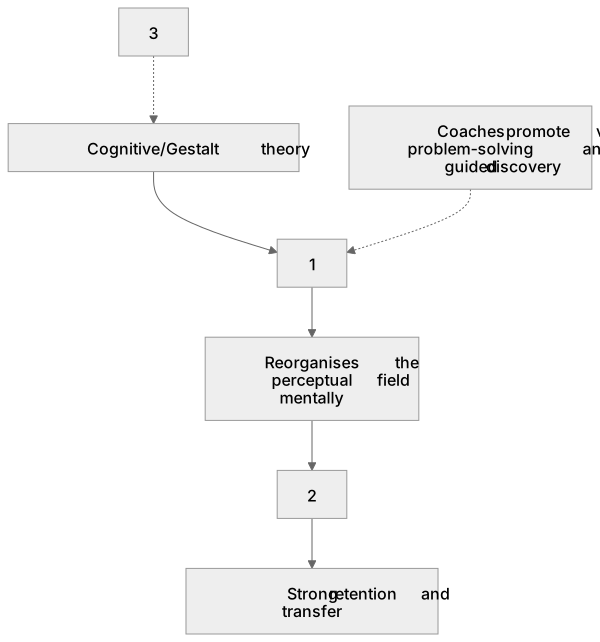
Some boxes have lost their names. Pick the right name for each number.
1Box 1
2Box 2
3Box 3
There is more to this lesson
The full lesson goes on to check your understanding and help you earn the marks. Create a free account to carry on, with your progress saved.
A week of Premium from your first lesson · Then the free plan continues · No card, no charge
Test your understanding of Principles and theories of learning and performance: Insight learning (Gestalt).
Active recall beats re-reading. Take an instant quiz now to test what you’ve learned and lock it into long-term memory.
A week of Premium from your first lesson · Then the free plan continues · No card, no charge