AQA · A-Level · Physical Education
Course version: 7582 · Version from Sept 2016
Observational learning (Bandura).
Full specification wording
Principles and theories of learning and performance: Observational learning (Bandura).
Bandura's observational learning explains how a performer acquires a skill by watching a model and then reproducing what was seen.
Checked against the AQA 7582 specification (opens in a new tab) on .
- Point 10 of 12
- 4 key terms
Study notes
From the checked teaching notes for this specification point.
The idea
Bandura's observational learning explains how a performer acquires a skill by watching a model and then reproducing what was seen. Learning depends on four linked processes: attention, so the learner notices the relevant cues; retention, so the demonstration is stored in memory; motor reproduction, so the learner has the physical capability to copy it; and motivation, so the learner has a reason to perform it. Coaches apply this by using a competent, high-status model, giving clear demonstrations, allowing practice and feedback, and reinforcing successful attempts.
For example: A gymnast watches a coach perform a vault, rehearses the sequence mentally, then attempts it and is praised for matching the key positions.
What earns the marks
- Attention: the learner must observe and focus on the relevant cues in the demonstration.
- Retention: the observed skill must be stored in memory, often helped by rehearsal or mental practice.
- Motor reproduction: the learner must possess the physical capability and coordination to copy the modelled action.
- Motivation: the learner needs a reason or incentive to reproduce the skill, such as reinforcement or perceived value.
- A model is more effective when competent, high status and similar to the learner, and demonstration quality affects imitation.
Common mistakes and how to put them right
Thinking observational learning means simply copying a demonstration.
Put it right: It requires attention, retention, motor reproduction and motivation, not just watching.
Confusing retention with motivation.
Put it right: Retention is storing the skill in memory, while motivation is the reason to perform it.
Assuming any model works equally well.
Put it right: A competent, high-status or similar model is generally more effective for the learner.
Believing observational learning removes the need for practice.
Put it right: Motor reproduction and feedback still require physical rehearsal.
Exam tips
- Learn the four processes as a chain and be ready to apply each one to a sporting example.
- When a question gives a scenario, name the process being shown rather than just describing the scene.
- Use precise terms such as attention, retention, motor reproduction and motivation instead of vague phrases like 'watching and doing'.
Try the lesson
The start of the Principles and theories of learning and performance: Observational learning (Bandura). lesson, made from checked teaching notes for this specification point.
Have a go first
In Bandura's theory of observational learning, what is the term for the process in which a learner mentally rehearses a demonstrated skill so that it can later be reproduced?
Listen
Bandura's observational learning explains how a performer acquires a skill by watching a model and then reproducing what was seen. Learning depends on four linked processes: attention, so the learner notices the relevant cues; retention, so the demonstration is stored in memory; motor reproduction, so the learner has the physical capability to copy it; and motivation, so the learner has a reason to perform it. Coaches apply this by using a competent, high-status model, giving clear demonstrations, allowing practice and feedback, and reinforcing successful attempts. For example, a gymnast watches a coach perform a vault, rehearses the sequence mentally, then attempts it and is praised for matching the key positions. A strong answer earns marks for these points. Attention: the learner must observe and focus on the relevant cues in the demonstration. Retention: the observed skill must be stored in memory, often helped by rehearsal or mental practice. Motor reproduction: the learner must possess the physical capability and coordination to copy the modelled action. Motivation: the learner needs a reason or incentive to reproduce the skill, such as reinforcement or perceived value. A common slip: Thinking observational learning means simply copying a demonstration. Instead, it requires attention, retention, motor reproduction and motivation, not just watching. Exam tip: Learn the four processes as a chain and be ready to apply each one to a sporting example.
See it
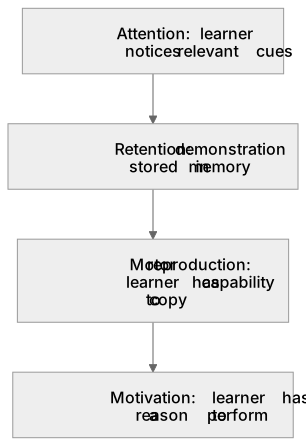
Put it in order
Put these steps in the order they happen.
- 1. Motor reproduction: learner has capability to copy
- 2. Motivation: learner has a reason to perform
- 3. Retention: demonstration stored in memory
- 4. Attention: learner notices relevant cues
Watch it explained
What is the one idea the video explains? Say it in a sentence.
Read the described scene instead
Bandura's observational learning explains how a performer acquires a skill by watching a model and then reproducing what was seen. The model demonstrates the action, and the learner attempts to match it. Bandura describes four linked processes: attention, retention, motor reproduction and motivation. They form a chain, so each process supports the next. First, attention means the learner notices the relevant cues in the demonstration. Second, retention means the demonstration is stored in memory, often helped by rehearsal or mental practice. Third, motor reproduction means the learner has the physical capability and coordination to copy the modelled action. Fourth, motivation gives a reason or incentive to reproduce the skill. Consider a gymnast watching a coach perform a vault. Pause briefly: which process is involved when the gymnast rehearses the sequence mentally? Now map it. Watching the coach supports attention. Rehearsing the sequence mentally supports retention. Attempting the vault requires motor reproduction, and praise for matching key positions supports motivation. Observational learning is not simply copying a demonstration. It requires attention, retention, motor reproduction and motivation. Retention is storing the skill in memory, not the reason to perform it. A competent, high-status or similar model is generally more effective, and motor reproduction and feedback still require physical rehearsal. To apply Bandura, learn the four processes as a chain and name the process shown in a scenario. Use precise terms: attention, retention, motor reproduction and motivation. A coach can use a competent model, clear demonstrations, practice, feedback and reinforcement.
Key words
Say what each word means before you turn the card.
Observational learning
Try answering aloud or in your head before turning the card.
Attention
Try answering aloud or in your head before turning the card.
Retention
Try answering aloud or in your head before turning the card.
Motor reproduction
Try answering aloud or in your head before turning the card.
See every definition
- Observational learning
- Bandura's theory explaining how a performer acquires a skill by watching a model and then reproducing what was seen.
- Attention
- The learner must observe and focus on the relevant cues in the demonstration.
- Retention
- The observed skill must be stored in memory, often helped by rehearsal or mental practice.
- Motor reproduction
- The learner must possess the physical capability and coordination to copy the modelled action.
Label the diagram
Some boxes have lost their names. Pick the right name for each number.
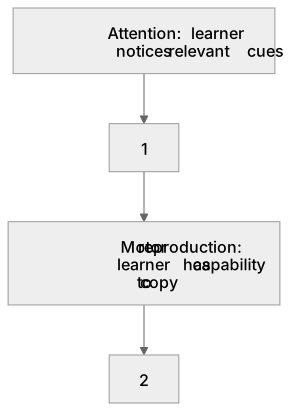
1Box 1
2Box 2
There is more to this lesson
The full lesson goes on to check your understanding and help you earn the marks. Create a free account to carry on, with your progress saved.
A week of Premium from your first lesson · Then the free plan continues · No card, no charge
Test your understanding of Principles and theories of learning and performance: Observational learning (Bandura).
Active recall beats re-reading. Take an instant quiz now to test what you’ve learned and lock it into long-term memory.
A week of Premium from your first lesson · Then the free plan continues · No card, no charge