AQA · A-Level · Physical Education
Course version: 7582 · Version from Sept 2016
Principles and theories of learning and performance: Constructivism.
Constructivism in physical education is heavily influenced by Vygotsky’s Social Development Theory, which posits that learning is a social process where knowledge is actively constructed.
Checked against the AQA 7582 specification (opens in a new tab) on .
- Point 11 of 12
- 4 key terms
Study notes
From the checked teaching notes for this specification point.
The idea
Constructivism in physical education is heavily influenced by Vygotsky’s Social Development Theory, which posits that learning is a social process where knowledge is actively constructed. Performers learn skills through interaction with others before internalising them. A key concept is the More Knowledgeable Other (MKO), such as a coach or an experienced teammate, who provides guidance. Learning takes place in the Zone of Proximal Development (ZPD), which is the gap between what a learner can achieve independently and what they can achieve with the help of an MKO. Through social interaction, collaborative learning and scaffolding, the learner builds upon prior experiences to develop new sporting skills and tactical understanding.
What earns the marks
- Identifies Vygotsky's Social Development Theory as a key constructivist approach.
- Explains that learning occurs socially through interaction before being internalised (inter-psychological to intra-psychological).
- Defines the More Knowledgeable Other (MKO) as someone with a higher level of understanding, such as a coach or peer.
- Describes the Zone of Proximal Development (ZPD) as the area of learning where a performer needs guidance to progress.
- Applies constructivism to sport by describing how an MKO uses scaffolding to help a learner acquire a new skill.
Common mistakes and how to put them right
Discussing generic constructivism without naming Vygotsky or his specific concepts.
Put it right: Explicitly use terms like MKO and ZPD.
Confusing the MKO with only being a coach.
Put it right: Recognise that peers, teammates or even video analysis can act as an MKO.
Misunderstanding the ZPD; the correction is to define it accurately as the next stage of learning achievable only with support, not what the learner can already do alone.
Exam tips
- Always link constructivism to Vygotsky's Social Development Theory in your answers.
- Use the acronyms MKO and ZPD, but ensure you define them clearly in your first use.
- Provide a practical example, such as a novice gymnast being physically supported and verbally guided by a coach (MKO) to achieve a vault (ZPD).
Try the lesson
The start of the Principles and theories of learning and performance: Constructivism. lesson, made from checked teaching notes for this specification point.
Have a go first
In constructivist learning theory, how is new knowledge primarily acquired by a learner?
Listen
Constructivism in physical education is heavily influenced by Vygotsky’s Social Development Theory, which posits that learning is a social process where knowledge is actively constructed. Performers learn skills through interaction with others before internalising them. A key concept is the More Knowledgeable Other (MKO), such as a coach or an experienced teammate, who provides guidance. Learning takes place in the Zone of Proximal Development (ZPD), which is the gap between what a learner can achieve independently and what they can achieve with the help of an MKO. Through social interaction, collaborative learning and scaffolding, the learner builds upon prior experiences to develop new sporting skills and tactical understanding. A strong answer earns marks for these points. Identifies Vygotsky's Social Development Theory as a key constructivist approach. Explains that learning occurs socially through interaction before being internalised (inter-psychological to intra-psychological). Defines the More Knowledgeable Other (MKO) as someone with a higher level of understanding, such as a coach or peer. Describes the Zone of Proximal Development (ZPD) as the area of learning where a performer needs guidance to progress. A common slip: Discussing generic constructivism without naming Vygotsky or his specific concepts. Instead, explicitly use terms like MKO and ZPD. Exam tip: Always link constructivism to Vygotsky's Social Development Theory in your answers.
See it
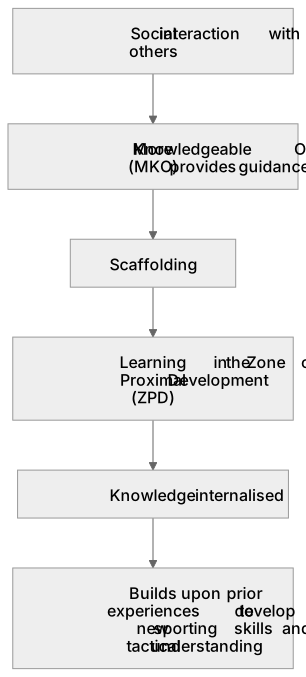
Put it in order
Put these steps in the order they happen.
- 1. Scaffolding
- 2. More Knowledgeable Other (MKO) provides guidance
- 3. Social interaction with others
- 4. Builds upon prior experiences to develop new sporting skills and tactical understanding
- 5. Knowledge internalised
- 6. Learning in the Zone of Proximal Development (ZPD)
Key words
Say what each word means before you turn the card.
Vygotsky's Social Development Theory
Try answering aloud or in your head before turning the card.
The More Knowledgeable Other (MKO)
Try answering aloud or in your head before turning the card.
The Zone of Proximal Development (ZPD)
Try answering aloud or in your head before turning the card.
Social interaction and scaffolding
Try answering aloud or in your head before turning the card.
See every definition
- Vygotsky's Social Development Theory
- A theory positing that learning is a social process where knowledge is actively constructed, with performers learning skills through interaction with others before internalising them.
- The More Knowledgeable Other (MKO)
- Someone with a higher level of understanding, such as a coach or an experienced teammate, who provides guidance.
- The Zone of Proximal Development (ZPD)
- The gap between what a learner can achieve independently and what they can achieve with the help of an MKO.
- Social interaction and scaffolding
- Collaborative learning through which the learner builds upon prior experiences to develop new sporting skills and tactical understanding.
Label the diagram
Some boxes have lost their names. Pick the right name for each number.
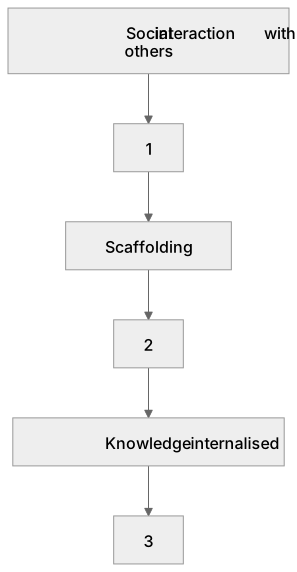
1Box 1
2Box 2
3Box 3
There is more to this lesson
The full lesson goes on to check your understanding and help you earn the marks. Create a free account to carry on, with your progress saved.
A week of Premium from your first lesson · Then the free plan continues · No card, no charge
Test your understanding of Principles and theories of learning and performance: Constructivism.
Active recall beats re-reading. Take an instant quiz now to test what you’ve learned and lock it into long-term memory.
A week of Premium from your first lesson · Then the free plan continues · No card, no charge