AQA · A-Level · Physical Education
Course version: 7582 · Version from Sept 2016
Operant conditioning (Skinner).
Full specification wording
Principles and theories of learning and performance: Operant conditioning (Skinner).
Operant conditioning, associated with Skinner, explains learning as a change in behaviour produced by the consequences that follow it.
Checked against the AQA 7582 specification (opens in a new tab) on .
- Point 8 of 12
- 4 key terms
Study notes
From the checked teaching notes for this specification point.
The idea
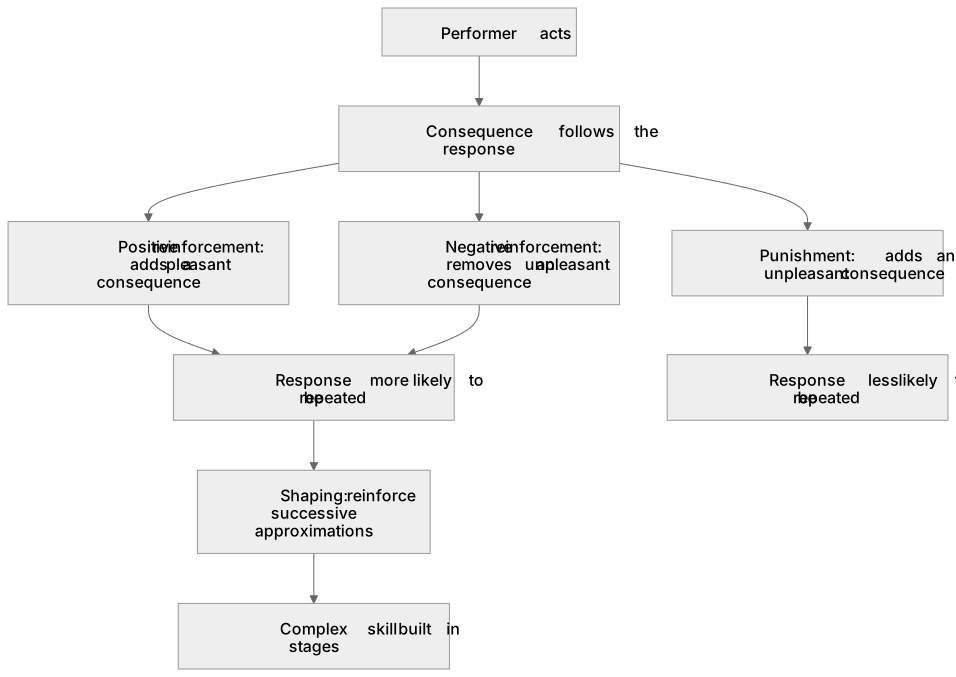
Operant conditioning, associated with Skinner, explains learning as a change in behaviour produced by the consequences that follow it. A performer acts, the response is reinforced or punished, and the likelihood of repeating that response alters. Positive reinforcement adds a pleasant consequence, such as praise or a reward, so a netball shooter who lands a shot and is praised is more likely to repeat the technique. Negative reinforcement removes an unpleasant consequence, for example a coach stops criticism once the correct footwork is shown. Punishment decreases a response by adding an unpleasant consequence. Coaches shape behaviour by reinforcing successive approximations, building a complex skill in stages.
What earns the marks
- Operant conditioning links a response to its consequence, so future behaviour is strengthened or weakened.
- Skinner is the theorist associated with operant conditioning.
- Positive reinforcement adds a pleasant consequence after the desired response, increasing repetition.
- Negative reinforcement removes an unpleasant consequence after the desired response, increasing repetition.
- Punishment decreases the likelihood of a response by adding an unpleasant consequence.
- Shaping reinforces successive approximations of a target skill so a complex action is built in stages.
- Reinforcement should follow the response closely and consistently for learning to be effective.
Common mistakes and how to put them right
Confusing negative reinforcement with punishment.
Put it right: Negative reinforcement removes an unpleasant consequence and increases behaviour, whereas punishment decreases behaviour.
Believing reinforcement must be a physical reward.
Put it right: Praise, feedback, approval and removal of criticism all act as reinforcement.
Thinking operant conditioning explains only simple actions.
Put it right: Shaping reinforces successive approximations so complex sporting skills can be built.
Assuming punishment teaches the correct technique.
Put it right: Punishment suppresses a response but does not by itself show the performer what to do instead.
Exam tips
- Name Skinner and state that consequences shape the likelihood of a response being repeated.
- Distinguish positive reinforcement, negative reinforcement and punishment with a separate sporting example for each.
- Use shaping to explain staged skill progress, such as reinforcing a correct arm action before adding the full movement.
- Check the direction of the effect: reinforcement increases behaviour, punishment decreases it.
Try the lesson
The start of the Principles and theories of learning and performance: Operant conditioning (Skinner). lesson, made from checked teaching notes for this specification point.
Have a go first
In Skinner's operant conditioning, what is the name for a consequence that increases the likelihood that a performer will repeat a skill?
Listen
Operant conditioning, associated with Skinner, explains learning as a change in behaviour produced by the consequences that follow it. A performer acts, the response is reinforced or punished, and the likelihood of repeating that response alters. Positive reinforcement adds a pleasant consequence, such as praise or a reward, so a netball shooter who lands a shot and is praised is more likely to repeat the technique. Negative reinforcement removes an unpleasant consequence, for example a coach stops criticism once the correct footwork is shown. Punishment decreases a response by adding an unpleasant consequence. Coaches shape behaviour by reinforcing successive approximations, building a complex skill in stages. A strong answer earns marks for these points. Operant conditioning links a response to its consequence, so future behaviour is strengthened or weakened. Skinner is the theorist associated with operant conditioning. Positive reinforcement adds a pleasant consequence after the desired response, increasing repetition. Negative reinforcement removes an unpleasant consequence after the desired response, increasing repetition. Exam tip: Name Skinner and state that consequences shape the likelihood of a response being repeated.
See it
Watch it explained
What is the one idea the video explains? Say it in a sentence.
Read the described scene instead
Operant conditioning is associated with Skinner. It explains learning as a change in behaviour produced by the consequences that follow it. A performer acts, the response is reinforced or punished, and the likelihood of repeating that response alters. This lesson unpacks reinforcement, punishment and shaping. Two forms of reinforcement increase the chance of repetition. Positive reinforcement adds a pleasant consequence after the desired response, such as praise or a reward. Negative reinforcement removes an unpleasant consequence after the desired response, such as a coach stopping criticism once correct footwork is shown. Punishment is different: it decreases a response by adding an unpleasant consequence. Operant conditioning links a response to its consequence. The performer acts, producing a response. That response is followed by reinforcement or punishment. Reinforcement should follow the response closely and consistently for learning to be effective. The consequence then changes the likelihood that the performer repeats the response. Connect each consequence to a sporting action. Pause here to think: is something pleasant added, something unpleasant removed, or something unpleasant added? A netball shooter who lands a shot and is praised experiences positive reinforcement, so the technique is more likely to repeat. If a coach stops criticism once correct footwork is shown, that is negative reinforcement. Punishment adds an unpleasant consequence and decreases a response. Do not confuse negative reinforcement with punishment. Negative reinforcement removes an unpleasant consequence and increases behaviour, whereas punishment decreases behaviour. Reinforcement need not be a physical reward: praise, feedback, approval and removal of criticism can all reinforce. Also, punishment suppresses a response but does not by itself show the performer what to do instead. To recap: Skinner's operant conditioning says consequences shape future behaviour. Positive reinforcement adds a pleasant consequence and increases repetition. Negative reinforcement removes an unpleasant consequence and also increases repetition. Punishment adds an unpleasant consequence and decreases a response. Shaping reinforces successive approximations, building a complex skill in stages.
Key words
Say what each word means before you turn the card.
Operant conditioning
Try answering aloud or in your head before turning the card.
Positive reinforcement
Try answering aloud or in your head before turning the card.
Negative reinforcement
Try answering aloud or in your head before turning the card.
Punishment
Try answering aloud or in your head before turning the card.
See every definition
- Operant conditioning
- Learning explained as a change in behaviour produced by the consequences that follow a response, associated with Skinner.
- Positive reinforcement
- Adding a pleasant consequence, such as praise or a reward, after the desired response so repetition is increased.
- Negative reinforcement
- Removing an unpleasant consequence after the desired response, which increases the likelihood of repetition.
- Punishment
- Adding an unpleasant consequence, which decreases the likelihood of a response.
Label the diagram
Some boxes have lost their names. Pick the right name for each number.
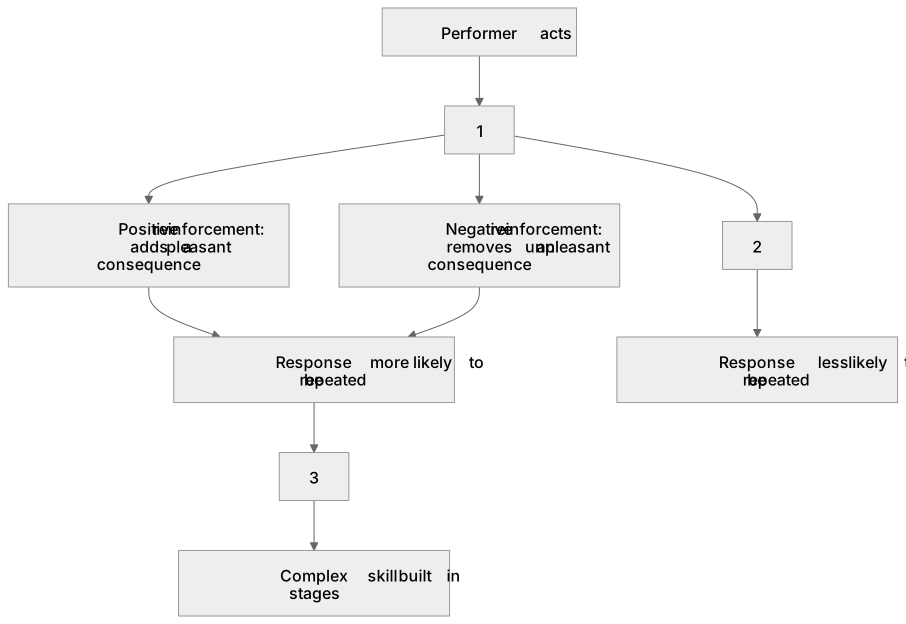
1Box 1
2Box 2
3Box 3
There is more to this lesson
The full lesson goes on to check your understanding and help you earn the marks. Create a free account to carry on, with your progress saved.
A week of Premium from your first lesson · Then the free plan continues · No card, no charge
Test your understanding of Principles and theories of learning and performance: Operant conditioning (Skinner).
Active recall beats re-reading. Take an instant quiz now to test what you’ve learned and lock it into long-term memory.
A week of Premium from your first lesson · Then the free plan continues · No card, no charge