AQA · A-Level · Physical Education
Course version: 7582 · Version from Sept 2016
Principles and theories of learning and performance: Behaviourism.
Behaviourism explains learning as a change in observable behaviour shaped by environmental stimuli, primarily applied in sport through operant conditioning.
Checked against the AQA 7582 specification (opens in a new tab) on .
- Point 7 of 12
- 4 key terms
Study notes
From the checked teaching notes for this specification point.
The idea
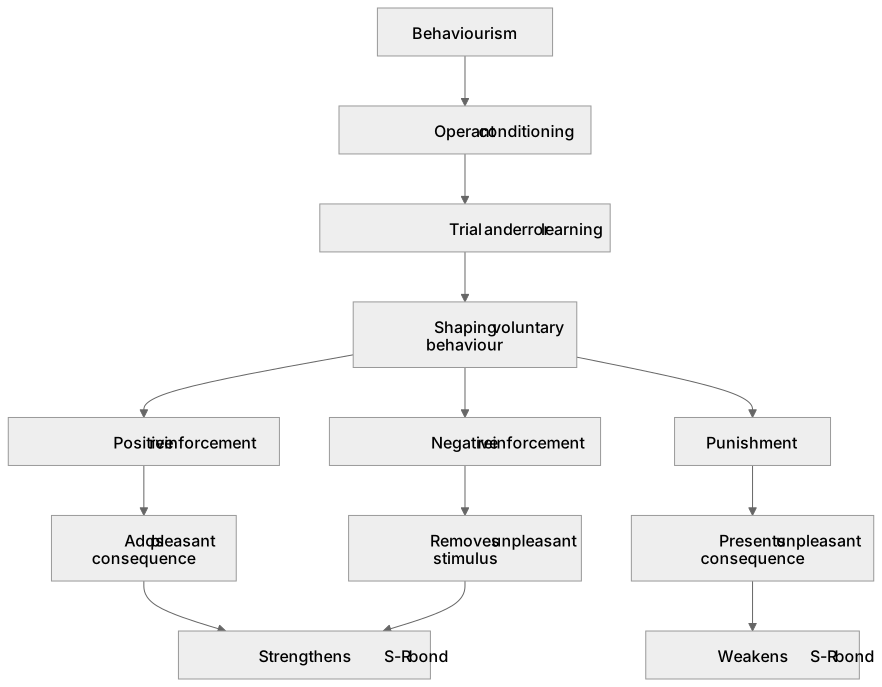
Behaviourism explains learning as a change in observable behaviour shaped by environmental stimuli, primarily applied in sport through operant conditioning. It posits that voluntary responses are strengthened or weakened by their outcomes. Learning occurs through trial and error, with coaches shaping behaviour using reinforcement. Positive reinforcement adds a pleasant consequence, such as praising a successful serve, increasing the likelihood of the behaviour recurring. Negative reinforcement removes an unpleasant stimulus, like a coach stopping criticism once the correct technique is shown. Punishment presents an unpleasant consequence to decrease a behaviour. Behaviourism underpins repetitive drills but ignores internal cognitive processes.
What earns the marks
- Defines behaviourism as learning through association and operant conditioning.
- Explains that learning occurs through trial and error, shaping voluntary sporting behaviour.
- Describes positive reinforcement as adding a pleasant stimulus to strengthen a stimulus-response (S-R) bond.
- Describes negative reinforcement as removing an unpleasant stimulus to strengthen a stimulus-response (S-R) bond.
- Explains punishment as presenting an unpleasant consequence to weaken a stimulus-response (S-R) bond.
- Identifies a limitation of behaviourism, such as its failure to account for cognitive processes, decision-making or understanding.
Common mistakes and how to put them right
Confusing negative reinforcement with punishment.
Put it right: Remember that negative reinforcement strengthens a behaviour by removing a negative stimulus, while punishment weakens a behaviour.
Including classical conditioning in answers.
Put it right: Focus exclusively on operant conditioning, which shapes voluntary sporting movements.
Believing behaviourism accounts for decision-making.
Put it right: State that it ignores internal mental processes and focuses only on observable responses.
Exam tips
- Always specify whether a consequence strengthens or weakens the stimulus-response (S-R) bond when discussing operant conditioning.
- Use a clear, sport-specific example for positive reinforcement, negative reinforcement and punishment to demonstrate application.
- Remember the phrase 'trial and error learning' when describing how operant conditioning occurs in practical coaching.
Try the lesson
The start of the Principles and theories of learning and performance: Behaviourism. lesson, made from checked teaching notes for this specification point.
Have a go first
Which statement best describes the behaviourist view of how skills are learned?
Listen
Behaviourism explains learning as a change in observable behaviour shaped by environmental stimuli, primarily applied in sport through operant conditioning. It posits that voluntary responses are strengthened or weakened by their outcomes. Learning occurs through trial and error, with coaches shaping behaviour using reinforcement. Positive reinforcement adds a pleasant consequence, such as praising a successful serve, increasing the likelihood of the behaviour recurring. Negative reinforcement removes an unpleasant stimulus, like a coach stopping criticism once the correct technique is shown. Punishment presents an unpleasant consequence to decrease a behaviour. Behaviourism underpins repetitive drills but ignores internal cognitive processes. A strong answer earns marks for these points. Defines behaviourism as learning through association and operant conditioning. Explains that learning occurs through trial and error, shaping voluntary sporting behaviour. Describes positive reinforcement as adding a pleasant stimulus to strengthen a stimulus-response (S-R) bond. Describes negative reinforcement as removing an unpleasant stimulus to strengthen a stimulus-response (S-R) bond. A common slip: Confusing negative reinforcement with punishment. Instead, remember that negative reinforcement strengthens a behaviour by removing a negative stimulus, while punishment weakens a behaviour. Exam tip: Always specify whether a consequence strengthens or weakens the stimulus-response (S-R) bond when discussing operant conditioning.
See it
Watch it explained
What is the one idea the video explains? Say it in a sentence.
Read the described scene instead
Behaviourism explains learning as a change in observable behaviour shaped by environmental stimuli. In sport, it is mainly applied through operant conditioning. Operant conditioning says voluntary responses are strengthened or weakened by their outcomes. Learning occurs through trial and error, and repeated outcomes build stimulus-response, or S-R, bonds. Positive reinforcement adds a pleasant consequence, such as praising a successful serve, so the behaviour is more likely to recur. Negative reinforcement removes an unpleasant stimulus, like a coach stopping criticism once the correct technique is shown. Punishment presents an unpleasant consequence to decrease a behaviour. Pause briefly and decide whether each consequence strengthens or weakens the S-R bond. A coach praises a successful serve: positive reinforcement adds a pleasant consequence and strengthens the bond. A coach stops criticism when technique is correct: negative reinforcement removes an unpleasant stimulus and strengthens the bond. A coach gives an unpleasant consequence to reduce a behaviour: punishment weakens the bond. Do not confuse negative reinforcement with punishment. Negative reinforcement strengthens a behaviour by removing a negative stimulus, while punishment weakens a behaviour. Also, focus on operant conditioning for voluntary sporting movements, not classical conditioning. Behaviourism underpins repetitive drills and shaping behaviour with reinforcement. It explains trial and error learning through outcomes. Its limitation is that it ignores internal cognitive processes, decision-making and understanding.
Key words
Say what each word means before you turn the card.
Operant conditioning and trial and error
Try answering aloud or in your head before turning the card.
Positive and negative reinforcement
Try answering aloud or in your head before turning the card.
Punishment and shaping behaviour
Try answering aloud or in your head before turning the card.
Stimulus-response (S-R) bonds
Try answering aloud or in your head before turning the card.
See every definition
- Operant conditioning and trial and error
- Learning in which voluntary responses are strengthened or weakened by their outcomes, occurring through trial and error.
- Positive and negative reinforcement
- Positive reinforcement adds a pleasant consequence, while negative reinforcement removes an unpleasant stimulus, both increasing the likelihood of the behaviour recurring.
- Punishment and shaping behaviour
- Punishment presents an unpleasant consequence to decrease a behaviour, while coaches shape behaviour using reinforcement.
- Stimulus-response (S-R) bonds
- Links between a stimulus and a response that reinforcement strengthens and punishment weakens.
Label the diagram
Some boxes have lost their names. Pick the right name for each number.
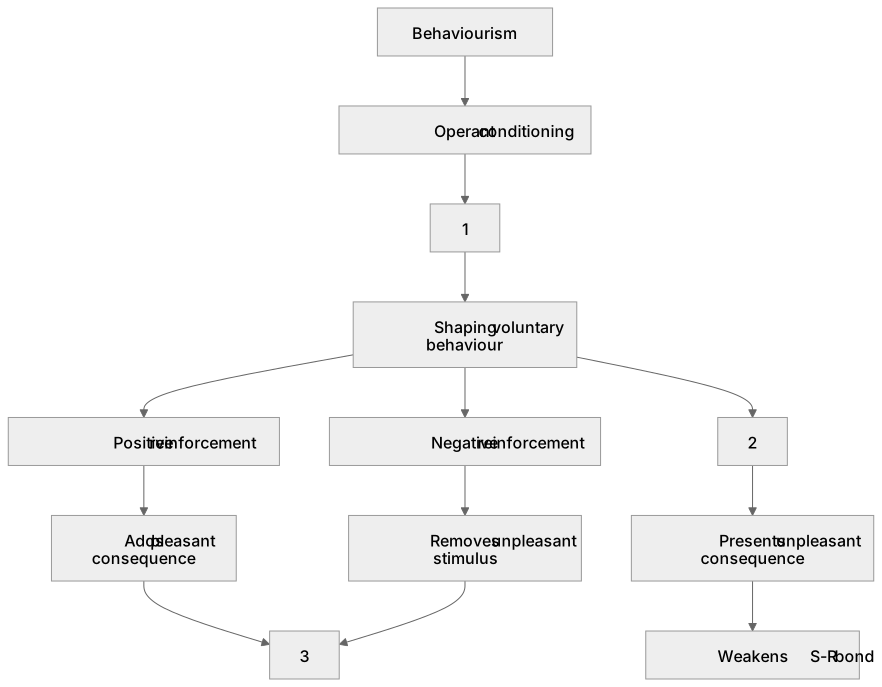
1Box 1
2Box 2
3Box 3
There is more to this lesson
The full lesson goes on to check your understanding and help you earn the marks. Create a free account to carry on, with your progress saved.
A week of Premium from your first lesson · Then the free plan continues · No card, no charge
Test your understanding of Principles and theories of learning and performance: Behaviourism.
Active recall beats re-reading. Take an instant quiz now to test what you’ve learned and lock it into long-term memory.
A week of Premium from your first lesson · Then the free plan continues · No card, no charge