AQA · A-Level · Physical Education
Course version: 7582 · Version from Sept 2016
Self-efficacy and confidence: Vealey’s Model of self-confidence.
Vealey's model explains self-confidence in sport as a dynamic interaction between the performer and their environment.
Checked against the AQA 7582 specification (opens in a new tab) on .
- Point 4 of 6
- 4 key terms
Study notes
From the checked teaching notes for this specification point.
The idea
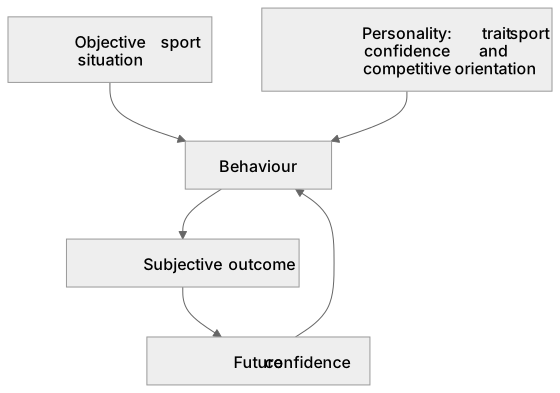
Vealey's model explains self-confidence in sport as a dynamic interaction between the performer and their environment. Objective sport situations, such as the level of opposition or the importance of the event, combine with the performer's personality, including their trait confidence and competitive orientation, to shape the behaviour shown. That behaviour produces a subjective outcome, meaning the performer's own perception of how well they performed, and this perception feeds back to influence future confidence. The model also distinguishes trait sport confidence, a stable general tendency, from state sport confidence, the belief felt in a particular moment. A tennis player facing a higher-ranked opponent may enter with lower state confidence, but winning a close set produces a positive subjective outcome that raises confidence for the next match.
What earns the marks
- The model links the objective sport situation and the performer's personality as inputs to confidence and behaviour.
- Objective sport situation includes factors such as the level of competition and the importance of the event.
- Personality includes trait sport confidence and competitive orientation, which influence how the performer responds.
- Behaviour produces a subjective outcome, the performer's perception of performance, which feeds back to shape future confidence.
- The model distinguishes trait sport confidence, a stable disposition, from state sport confidence, the confidence experienced in a specific moment.
Common mistakes and how to put them right
Treating the model as a one-way sequence from situation to confidence.
Put it right: The subjective outcome feeds back to influence future confidence, so the process is cyclical.
Confusing trait and state sport confidence.
Put it right: Trait confidence is a stable general tendency, while state confidence is the belief felt in a particular situation, so the two should not be used interchangeably.
Assuming the objective situation alone determines confidence.
Put it right: The performer's personality, including competitive orientation, also shapes how the situation is interpreted.
Exam tips
- Use a labelled diagram or clear sequence when describing the model, showing the feedback loop from subjective outcome back to confidence.
- Define trait and state sport confidence before applying them, so the distinction is explicit in your answer.
- Apply the model to one named sport and situation, such as a footballer taking a penalty, to show how each component interacts.
Try the lesson
The start of the Self-efficacy and confidence: Vealey’s Model of self-confidence. lesson, made from checked teaching notes for this specification point.
Have a go first
In Vealey’s Model of self-confidence, which two factors combine to produce the performer’s level of state sport confidence?
Listen
Vealey's model explains self-confidence in sport as a dynamic interaction between the performer and their environment. Objective sport situations, such as the level of opposition or the importance of the event, combine with the performer's personality, including their trait confidence and competitive orientation, to shape the behaviour shown. That behaviour produces a subjective outcome, meaning the performer's own perception of how well they performed, and this perception feeds back to influence future confidence. The model also distinguishes trait sport confidence, a stable general tendency, from state sport confidence, the belief felt in a particular moment. A tennis player facing a higher-ranked opponent may enter with lower state confidence, but winning a close set produces a positive subjective outcome that raises confidence for the next match. A strong answer earns marks for these points. The model links the objective sport situation and the performer's personality as inputs to confidence and behaviour. Objective sport situation includes factors such as the level of competition and the importance of the event. Personality includes trait sport confidence and competitive orientation, which influence how the performer responds. Behaviour produces a subjective outcome, the performer's perception of performance, which feeds back to shape future confidence. Exam tip: Use a labelled diagram or clear sequence when describing the model, showing the feedback loop from subjective outcome back to confidence.
See it
Key words
Say what each word means before you turn the card.
Self-confidence in sport
Try answering aloud or in your head before turning the card.
Interaction of performer and environment
Try answering aloud or in your head before turning the card.
Trait and state sport confidence
Try answering aloud or in your head before turning the card.
Feedback from subjective outcomes
Try answering aloud or in your head before turning the card.
See every definition
- Self-confidence in sport
- A dynamic interaction between the performer and their environment, shaped by the objective sport situation and the performer's personality.
- Interaction of performer and environment
- Objective sport situations combine with the performer's personality to shape the behaviour shown.
- Trait and state sport confidence
- A stable general tendency is distinguished from the belief felt in a particular moment.
- Feedback from subjective outcomes
- The performer's own perception of how well they performed feeds back to influence future confidence.
Label the diagram
Some boxes have lost their names. Pick the right name for each number.
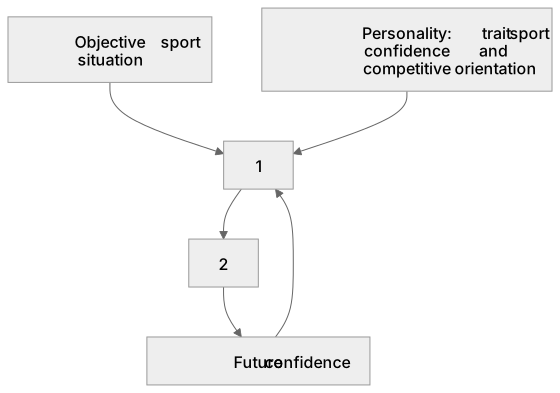
1Box 1
2Box 2
There is more to this lesson
The full lesson goes on to check your understanding and help you earn the marks. Create a free account to carry on, with your progress saved.
A week of Premium from your first lesson · Then the free plan continues · No card, no charge
Test your understanding of Self-efficacy and confidence: Vealey’s Model of self-confidence.
Active recall beats re-reading. Take an instant quiz now to test what you’ve learned and lock it into long-term memory.
A week of Premium from your first lesson · Then the free plan continues · No card, no charge