AQA · A-Level · Physical Education
Course version: 7582 · Version from Sept 2016
Discrete – serial – continuous.
Full specification wording
Skill, skill continuums and transfer of skills: Discrete – serial – continuous.
The discrete–serial–continuous continuum classifies skills by how clearly the movement has a beginning and end.
Checked against the AQA 7582 specification (opens in a new tab) on .
- Point 4 of 14
- 4 key terms
Study notes
From the checked teaching notes for this specification point.
The idea
The discrete–serial–continuous continuum classifies skills by how clearly the movement has a beginning and end. A discrete skill has a clear start and finish, such as a tennis serve or a penalty kick. A serial skill chains several discrete skills together in a sequence, such as a gymnastics floor routine or a triple jump. A continuous skill has no obvious beginning or end and repeats cyclically, such as running, swimming or cycling. The continuum helps performers and coaches decide how to break down, practise and assess movement. Skills can be placed along the continuum; for example, a basketball free throw is discrete, a lay-up is serial, and jogging is continuous. Understanding this classification supports effective practice design and skill analysis.
What earns the marks
- Discrete skills have a clear beginning and end, such as a tennis serve or a penalty kick.
- Serial skills combine several discrete skills in a sequence, such as a gymnastics floor routine or a triple jump.
- Continuous skills have no obvious beginning or end and repeat cyclically, such as running, swimming or cycling.
- The discrete–serial–continuous continuum classifies skills by the clarity of their start and finish points.
- Skills can be placed along the continuum; for example, a basketball free throw is discrete, a lay-up is serial, and jogging is continuous.
Common mistakes and how to put them right
Thinking that serial skills are the same as continuous skills.
Put it right: Serial skills are a sequence of discrete skills with a clear start and end, while continuous skills repeat without a clear beginning or end.
Believing that a skill must be either discrete or continuous with no middle ground.
Put it right: Serial skills sit between discrete and continuous on the continuum.
Confusing a discrete skill with a simple skill.
Put it right: Discrete skills can be complex, such as a tennis serve, but they have a clear start and finish.
Assuming that continuous skills cannot be broken down for practice.
Put it right: Coaches often break continuous skills into parts for training, even though the skill itself is continuous.
Exam tips
- When classifying a skill, identify whether it has a clear start and end, a sequence of parts, or a repeating cycle.
- Use a specific sporting example and explain how the beginning and end points determine its position on the continuum.
- Avoid saying a skill is 'just' discrete or continuous; explain its position relative to the other categories.
Try the lesson
The start of the Skill, skill continuums and transfer of skills: Discrete – serial – continuous. lesson, made from checked teaching notes for this specification point.
Have a go first
A hockey player receives a pass, dribbles the ball a short distance and then pushes it into the goal. The three actions are performed in a fixed order as one combined movement pattern. How should this combined movement pattern be classified on the discrete–serial–continuous continuum?
Listen
The discrete–serial–continuous continuum classifies skills by how clearly the movement has a beginning and end. A discrete skill has a clear start and finish, such as a tennis serve or a penalty kick. A serial skill chains several discrete skills together in a sequence, such as a gymnastics floor routine or a triple jump. A continuous skill has no obvious beginning or end and repeats cyclically, such as running, swimming or cycling. The continuum helps performers and coaches decide how to break down, practise and assess movement. Skills can be placed along the continuum; for example, a basketball free throw is discrete, a lay-up is serial, and jogging is continuous. Understanding this classification supports effective practice design and skill analysis. A strong answer earns marks for these points. Discrete skills have a clear beginning and end, such as a tennis serve or a penalty kick. Serial skills combine several discrete skills in a sequence, such as a gymnastics floor routine or a triple jump. Continuous skills have no obvious beginning or end and repeat cyclically, such as running, swimming or cycling. The discrete–serial–continuous continuum classifies skills by the clarity of their start and finish points. A common slip: Thinking that serial skills are the same as continuous skills. Instead, serial skills are a sequence of discrete skills with a clear start and end, while continuous skills repeat without a clear beginning or end. Exam tip: When classifying a skill, identify whether it has a clear start and end, a sequence of parts, or a repeating cycle.
See it

Key words
Say what each word means before you turn the card.
Discrete skill
Try answering aloud or in your head before turning the card.
Serial skill
Try answering aloud or in your head before turning the card.
Continuous skill
Try answering aloud or in your head before turning the card.
Discrete–serial–continuous continuum
Try answering aloud or in your head before turning the card.
See every definition
- Discrete skill
- A skill that has a clear start and finish, such as a tennis serve or a penalty kick.
- Serial skill
- A skill that chains several discrete skills together in a sequence, such as a gymnastics floor routine or a triple jump.
- Continuous skill
- A skill that has no obvious beginning or end and repeats cyclically, such as running, swimming or cycling.
- Discrete–serial–continuous continuum
- Classifies skills by how clearly the movement has a beginning and end, helping performers and coaches decide how to break down, practise and assess movement.
Label the diagram
Some boxes have lost their names. Pick the right name for each number.
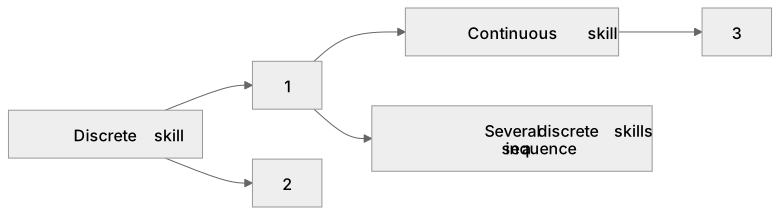
1Box 1
2Box 2
3Box 3
There is more to this lesson
The full lesson goes on to check your understanding and help you earn the marks. Create a free account to carry on, with your progress saved.
A week of Premium from your first lesson · Then the free plan continues · No card, no charge
Test your understanding of Skill, skill continuums and transfer of skills: Discrete – serial – continuous.
Active recall beats re-reading. Take an instant quiz now to test what you’ve learned and lock it into long-term memory.
A week of Premium from your first lesson · Then the free plan continues · No card, no charge