AQA · A-Level · Physical Education
Course version: 7582 · Version from Sept 2016
Skill, skill continuums and transfer of skills: Open – closed.
The open–closed continuum classifies skills by how much the environment influences their execution.
Checked against the AQA 7582 specification (opens in a new tab) on .
- Point 3 of 14
- 3 key terms
Study notes
From the checked teaching notes for this specification point.
The idea
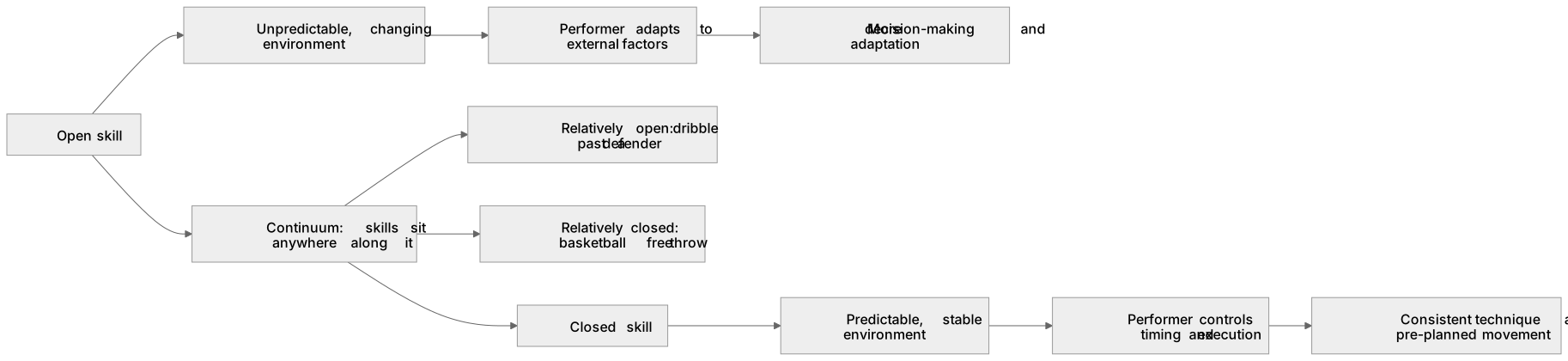
The open–closed continuum classifies skills by how much the environment influences their execution. An open skill is performed in an unpredictable, changing environment where the performer must adapt to external factors such as opponents, teammates, weather or surface; a closed skill is performed in a predictable, stable environment where the performer controls the timing and execution. For example, a pass in a football match is open because opponents move and pressure varies, whereas a gymnastic vault is closed because the apparatus and conditions remain constant. Skills can sit anywhere along the continuum rather than only at the extremes, so a free throw in basketball is relatively closed while a dribble past a defender is relatively open. The continuum helps performers and coaches select appropriate practice types and decision-making demands.
What earns the marks
- Open skills occur in unpredictable, changing environments where the performer must adapt to external stimuli.
- Closed skills occur in predictable, stable environments where the performer controls the timing and execution.
- The open–closed continuum classifies skills by the degree of environmental influence, not as two separate categories.
- Skills can be placed along the continuum; for example, a basketball free throw is relatively closed, while a pass in a game is relatively open.
- Open skills typically require more decision-making and adaptation; closed skills typically require consistent technique and pre-planned movement.
Common mistakes and how to put them right
Thinking that open skills are only team sports and closed skills are only individual sports.
Put it right: The classification depends on the predictability of the environment, not the number of participants.
Believing a skill is either completely open or completely closed.
Put it right: Skills lie on a continuum and can be relatively open or relatively closed.
Confusing closed skills with skills that are easy or simple.
Put it right: Closed skills can be highly complex, such as a gymnastic routine, but the environment is stable.
Assuming that a closed skill never involves decisions.
Put it right: The performer still makes decisions, but they are pre-planned and not forced by a changing environment.
Exam tips
- When classifying a skill, state the environmental conditions first, then explain why that makes it open or closed.
- Use a specific sporting example and explain how the environment affects the performer's decisions or technique.
- Avoid absolute language such as 'always' or 'never'; refer to the skill's position on the continuum.
Try the lesson
The start of the Skill, skill continuums and transfer of skills: Open – closed. lesson, made from checked teaching notes for this specification point.
Have a go first
Which of these skills is placed nearest the open end of the open–closed continuum?
Listen
The open–closed continuum classifies skills by how much the environment influences their execution. An open skill is performed in an unpredictable, changing environment where the performer must adapt to external factors such as opponents, teammates, weather or surface; a closed skill is performed in a predictable, stable environment where the performer controls the timing and execution. For example, a pass in a football match is open because opponents move and pressure varies, whereas a gymnastic vault is closed because the apparatus and conditions remain constant. Skills can sit anywhere along the continuum rather than only at the extremes, so a free throw in basketball is relatively closed while a dribble past a defender is relatively open. The continuum helps performers and coaches select appropriate practice types and decision-making demands. A strong answer earns marks for these points. Open skills occur in unpredictable, changing environments where the performer must adapt to external stimuli. Closed skills occur in predictable, stable environments where the performer controls the timing and execution. The open–closed continuum classifies skills by the degree of environmental influence, not as two separate categories. Skills can be placed along the continuum; for example, a basketball free throw is relatively closed, while a pass in a game is relatively open. A common slip: Thinking that open skills are only team sports and closed skills are only individual sports. Instead, the classification depends on the predictability of the environment, not the number of participants. Exam tip: When classifying a skill, state the environmental conditions first, then explain why that makes it open or closed.
See it
Key words
Say what each word means before you turn the card.
Open skill
Try answering aloud or in your head before turning the card.
Closed skill
Try answering aloud or in your head before turning the card.
Open–closed continuum
Try answering aloud or in your head before turning the card.
See every definition
- Open skill
- A skill performed in an unpredictable, changing environment where the performer must adapt to external factors such as opponents, teammates, weather or surface.
- Closed skill
- A skill performed in a predictable, stable environment where the performer controls the timing and execution.
- Open–closed continuum
- Classifies skills by how much the environment influences their execution, with skills sitting anywhere along it rather than only at the extremes.
Label the diagram
Some boxes have lost their names. Pick the right name for each number.
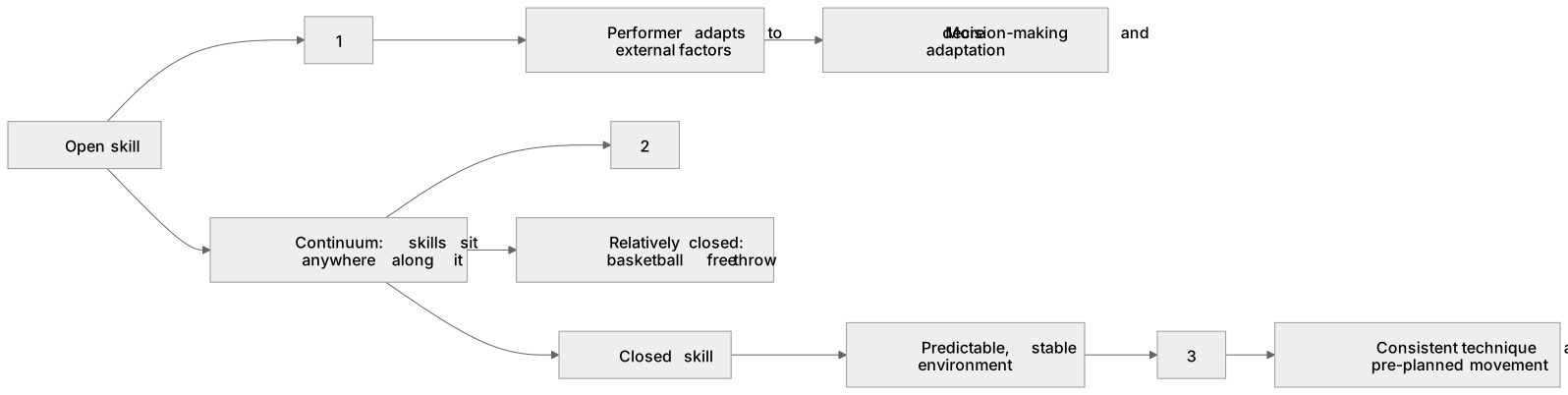
1Box 1
2Box 2
3Box 3
There is more to this lesson
The full lesson goes on to check your understanding and help you earn the marks. Create a free account to carry on, with your progress saved.
A week of Premium from your first lesson · Then the free plan continues · No card, no charge
Test your understanding of Skill, skill continuums and transfer of skills: Open – closed.
Active recall beats re-reading. Take an instant quiz now to test what you’ve learned and lock it into long-term memory.
A week of Premium from your first lesson · Then the free plan continues · No card, no charge