AQA · A-Level · Physical Education
Course version: 7582 · Version from Sept 2016
Skill, skill continuums and transfer of skills: High – low.
The high–low organisation continuum classifies skills based on how closely linked their sub-routines are.
Checked against the AQA 7582 specification (opens in a new tab) on .
- Point 7 of 14
- 4 key terms
Study notes
From the checked teaching notes for this specification point.
The idea
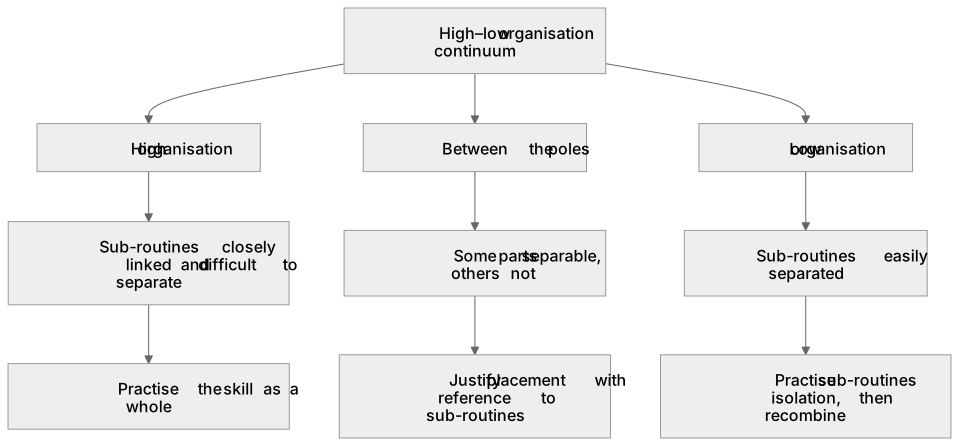
The high–low organisation continuum classifies skills based on how closely linked their sub-routines are. A highly organised skill has sub-routines that are very difficult to separate, meaning the skill must be practised as a whole. An example is a golf swing or a cartwheel, where breaking the movement down disrupts its flow. A skill with low organisation has sub-routines that are easily separated and can be practised in isolation before being recombined, such as a tennis serve (toss, backswing, strike) or a front crawl swimming stroke. When classifying, ask whether the movement can be easily broken down into parts. If it cannot, place it high; if it can, place it low. Many skills sit between the poles, so justify your placement with evidence from the skill's sub-routines.
What earns the marks
- High organisation skills have sub-routines that are closely linked and difficult to separate.
- Low organisation skills have sub-routines that are easily separated and practised in isolation.
- The continuum describes the relationship between sub-routines, not consistency or predictability.
- A skill can be placed between the poles when some parts can be separated but others cannot.
- Classification must be justified with reference to the ease of separating the skill's sub-routines.
Common mistakes and how to put them right
Confusing high–low organisation with consistency or predictability.
Put it right: The continuum is strictly about how easily sub-routines can be separated.
Assuming high organisation means a complex skill.
Put it right: A simple skill can be highly organised if its parts cannot be separated (e.g., a forward roll).
Treating the continuum as two fixed boxes.
Put it right: Many skills sit between the poles, so a skill with some separable parts should be placed along the continuum with justification.
Exam tips
- Define the continuum in terms of sub-routines before applying it to the skill in the question.
- Use the phrase 'difficult to separate' for high organisation, and 'easily separated' for low organisation.
- Justify placement with a specific example of the skill's sub-routines, such as the ball toss and racket swing in a tennis serve.
Try the lesson
The start of the Skill, skill continuums and transfer of skills: High – low. lesson, made from checked teaching notes for this specification point.
Have a go first
On the high to low organisation continuum, which skill is placed at the high organisation end?
Listen
The high–low organisation continuum classifies skills based on how closely linked their sub-routines are. A highly organised skill has sub-routines that are very difficult to separate, meaning the skill must be practised as a whole. An example is a golf swing or a cartwheel, where breaking the movement down disrupts its flow. A skill with low organisation has sub-routines that are easily separated and can be practised in isolation before being recombined, such as a tennis serve (toss, backswing, strike) or a front crawl swimming stroke. When classifying, ask whether the movement can be easily broken down into parts. If it cannot, place it high; if it can, place it low. Many skills sit between the poles, so justify your placement with evidence from the skill's sub-routines. A strong answer earns marks for these points. High organisation skills have sub-routines that are closely linked and difficult to separate. Low organisation skills have sub-routines that are easily separated and practised in isolation. The continuum describes the relationship between sub-routines, not consistency or predictability. A skill can be placed between the poles when some parts can be separated but others cannot. Exam tip: Define the continuum in terms of sub-routines before applying it to the skill in the question.
See it
Key words
Say what each word means before you turn the card.
High and low organisation
Try answering aloud or in your head before turning the card.
Sub-routines of a skill
Try answering aloud or in your head before turning the card.
Whole and part practice methods
Try answering aloud or in your head before turning the card.
Placement along a continuum
Try answering aloud or in your head before turning the card.
See every definition
- High and low organisation
- A continuum that classifies skills based on how closely linked their sub-routines are.
- Sub-routines of a skill
- The parts of a skill, which may be closely linked and difficult to separate or easily separated and practised in isolation.
- Whole and part practice methods
- Practising a skill as a whole when its sub-routines are difficult to separate, or practising sub-routines in isolation before recombining them when they are easily separated.
- Placement along a continuum
- Positioning a skill high, low or between the poles, justified with evidence from the skill's sub-routines.
Label the diagram
Some boxes have lost their names. Pick the right name for each number.
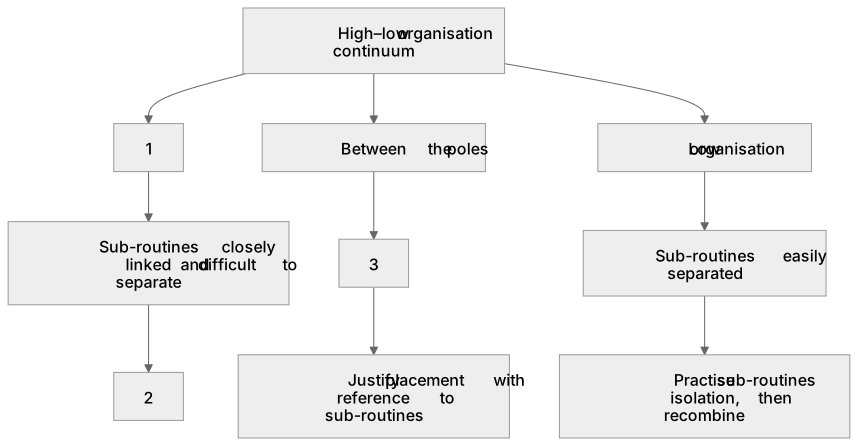
1Box 1
2Box 2
3Box 3
There is more to this lesson
The full lesson goes on to check your understanding and help you earn the marks. Create a free account to carry on, with your progress saved.
A week of Premium from your first lesson · Then the free plan continues · No card, no charge
Test your understanding of Skill, skill continuums and transfer of skills: High – low.
Active recall beats re-reading. Take an instant quiz now to test what you’ve learned and lock it into long-term memory.
A week of Premium from your first lesson · Then the free plan continues · No card, no charge