AQA · A-Level · Physical Education
Course version: 7582 · Version from Sept 2016
Skill, skill continuums and transfer of skills: Simple – complex.
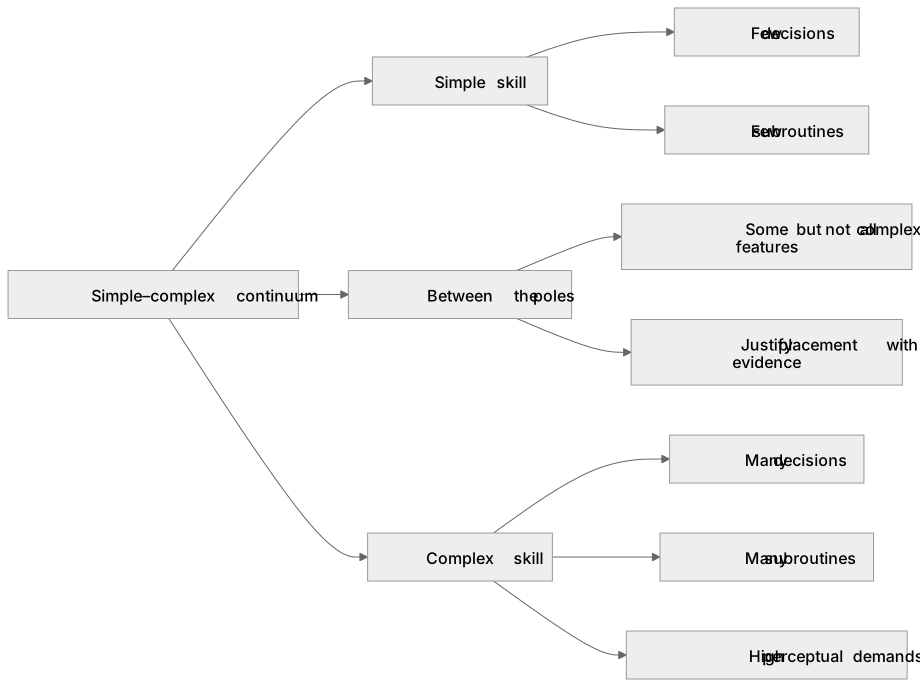
The simple–complex continuum classifies skills by the amount of information to process, the number of decisions to make and the number of subroutines to coordinate.
Checked against the AQA 7582 specification (opens in a new tab) on .
- Point 8 of 14
- 4 key terms
Study notes
From the checked teaching notes for this specification point.
The idea
The simple–complex continuum classifies skills by the amount of information to process, the number of decisions to make and the number of subroutines to coordinate. A simple skill has few decisions and few parts, such as a sprint start or a basic chest pass in isolation. A complex skill has many decisions, many subroutines and high perceptual demands, such as a gymnastics floor routine or a pass under pressure in hockey. Complexity is not the same as difficulty for a particular performer; a skill can be simple in structure but hard to execute well. When classifying, count the decisions and the parts. If both are few, place it simple; if both are many, place it complex. Many skills sit between the poles, so justify your placement with evidence.
What earns the marks
- Simple skills involve few decisions and few subroutines to coordinate.
- Complex skills involve many decisions, many subroutines or high perceptual demands.
- The continuum describes information processing and coordination demands, not difficulty for one performer.
- A skill can be placed between the poles when it has some but not all complex features.
- Classification must be justified by counting decisions and subroutines in the skill.
Common mistakes and how to put them right
Equating complex with difficult.
Put it right: A skill can be structurally simple but hard for a beginner, so complexity is about decisions and parts, not personal difficulty.
Assuming all sports skills are complex.
Put it right: A single closed action such as a sprint start has few decisions and parts, so it is simple.
Ignoring the number of subroutines.
Put it right: A skill with many coordinated parts, such as a tennis serve, is complex even if it looks smooth.
Treating the continuum as two fixed boxes.
Put it right: Many skills sit between the poles, so a skill with some complex features should be placed along the continuum with justification.
Exam tips
- Count the decisions and the subroutines before choosing a placement.
- Use the words decisions and subroutines in your justification to show you are applying the correct criteria.
- If a skill has some complex features, place it between the poles and explain which features make it more or less complex.
Try the lesson
The start of the Skill, skill continuums and transfer of skills: Simple – complex. lesson, made from checked teaching notes for this specification point.
Have a go first
On the simple–complex continuum, which of these skills is placed at the simple end because it involves few decisions and little reliance on other performers?
Listen
The simple–complex continuum classifies skills by the amount of information to process, the number of decisions to make and the number of subroutines to coordinate. A simple skill has few decisions and few parts, such as a sprint start or a basic chest pass in isolation. A complex skill has many decisions, many subroutines and high perceptual demands, such as a gymnastics floor routine or a pass under pressure in hockey. Complexity is not the same as difficulty for a particular performer; a skill can be simple in structure but hard to execute well. When classifying, count the decisions and the parts. If both are few, place it simple; if both are many, place it complex. Many skills sit between the poles, so justify your placement with evidence. A strong answer earns marks for these points. Simple skills involve few decisions and few subroutines to coordinate. Complex skills involve many decisions, many subroutines or high perceptual demands. The continuum describes information processing and coordination demands, not difficulty for one performer. A skill can be placed between the poles when it has some but not all complex features. Exam tip: Count the decisions and the subroutines before choosing a placement.
See it
Key words
Say what each word means before you turn the card.
Information processing demands
Try answering aloud or in your head before turning the card.
Number of decisions
Try answering aloud or in your head before turning the card.
Number of subroutines
Try answering aloud or in your head before turning the card.
Placement along a continuum
Try answering aloud or in your head before turning the card.
See every definition
- Information processing demands
- The amount of information a skill requires the performer to process, with high demands making a skill complex.
- Number of decisions
- How many choices a skill requires the performer to make, with few decisions indicating a simple skill.
- Number of subroutines
- How many parts a skill requires the performer to coordinate, with many subroutines indicating a complex skill.
- Placement along a continuum
- Locating a skill between the simple and complex poles, justified by counting the decisions and the parts.
Label the diagram
Some boxes have lost their names. Pick the right name for each number.
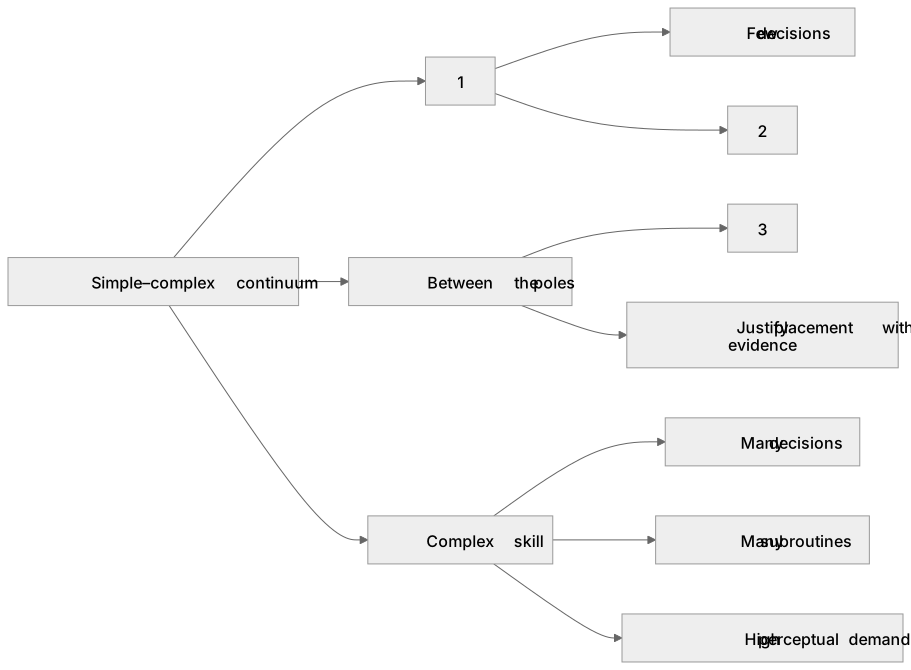
1Box 1
2Box 2
3Box 3
There is more to this lesson
The full lesson goes on to check your understanding and help you earn the marks. Create a free account to carry on, with your progress saved.
A week of Premium from your first lesson · Then the free plan continues · No card, no charge
Test your understanding of Skill, skill continuums and transfer of skills: Simple – complex.
Active recall beats re-reading. Take an instant quiz now to test what you’ve learned and lock it into long-term memory.
A week of Premium from your first lesson · Then the free plan continues · No card, no charge