AQA · A-Level · Physical Education
Course version: 7582 · Version from Sept 2016
Understanding of how transfer of learning impacts on skill development.
Full specification wording
Skill, skill continuums and transfer of skills: Understanding of how transfer of learning impacts on skill development.
Transfer of learning describes how prior experience of one skill affects the learning or performance of another.
Checked against the AQA 7582 specification (opens in a new tab) on .
- Point 14 of 14
- 4 key terms
Study notes
From the checked teaching notes for this specification point.
The idea
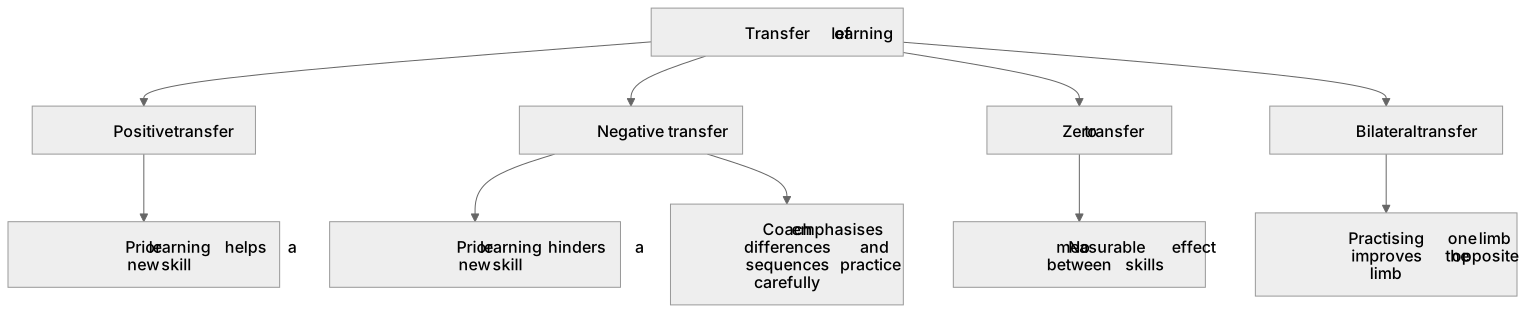
Transfer of learning describes how prior experience of one skill affects the learning or performance of another. Positive transfer helps skill development: a tennis serve may aid a badminton overhead clear because both require a similar swing path and timing. Negative transfer hinders learning: a badminton player may mistime a tennis shot because the flexible wrist action differs from the firm wrist needed in tennis. Zero transfer means no measurable effect occurs between unrelated skills, like swimming and darts. Bilateral transfer happens when practising with one limb improves the opposite limb, such as a right-footed pass improving left-footed control. Coaches aim to maximise positive transfer.
What earns the marks
- Defines transfer of learning as the influence of previous learning on the acquisition of a new skill.
- Identifies positive transfer: prior learning helps a new skill, for example a tennis serve aiding a badminton overhead clear.
- Identifies negative transfer: prior learning hinders a new skill, for example a badminton wrist action disrupting a tennis shot.
- Identifies zero transfer: no measurable effect of one skill on another, such as swimming and darts.
- Explains bilateral transfer: practising one limb improves performance in the opposite limb.
- Applies strategies to reduce negative transfer, such as emphasising differences between skills and sequencing practice carefully.
Common mistakes and how to put them right
Confusing negative transfer with simply finding a skill difficult.
Put it right: Negative transfer requires an existing skill actively interfering with the new one, not general difficulty.
Treating all transfer as positive.
Put it right: Transfer can be positive, negative or zero, and each has different coaching implications.
Assuming bilateral transfer only works from dominant to non-dominant limb.
Put it right: It can occur in either direction, though it is often stronger from dominant to non-dominant.
Exam tips
- Read the scenario carefully and name the type of transfer before explaining its effect on skill development.
- Use a specific sporting example to show the direction of transfer, for example which skill is learned first and which is affected.
- When asked how a coach can manage transfer, link the strategy directly to reducing negative transfer or promoting positive transfer.
Try the lesson
The start of the Skill, skill continuums and transfer of skills: Understanding of how transfer of learning impacts on skill development. lesson, made from checked teaching notes for this specification point.
Have a go first
A tennis player who has learned the overhead smash in tennis then learns the badminton overhead clear. The badminton clear improves quickly because the two actions share a similar striking pattern. Which type of transfer does this describe?
Listen
Transfer of learning describes how prior experience of one skill affects the learning or performance of another. Positive transfer helps skill development: a tennis serve may aid a badminton overhead clear because both require a similar swing path and timing. Negative transfer hinders learning: a badminton player may mistime a tennis shot because the flexible wrist action differs from the firm wrist needed in tennis. Zero transfer means no measurable effect occurs between unrelated skills, like swimming and darts. Bilateral transfer happens when practising with one limb improves the opposite limb, such as a right-footed pass improving left-footed control. Coaches aim to maximise positive transfer. A strong answer earns marks for these points. Defines transfer of learning as the influence of previous learning on the acquisition of a new skill. Identifies positive transfer: prior learning helps a new skill, for example a tennis serve aiding a badminton overhead clear. Identifies negative transfer: prior learning hinders a new skill, for example a badminton wrist action disrupting a tennis shot. Identifies zero transfer: no measurable effect of one skill on another, such as swimming and darts. A common slip: Confusing negative transfer with simply finding a skill difficult. Instead, negative transfer requires an existing skill actively interfering with the new one, not general difficulty. Exam tip: Read the scenario carefully and name the type of transfer before explaining its effect on skill development.
See it
Key words
Say what each word means before you turn the card.
Transfer of learning
Try answering aloud or in your head before turning the card.
Positive transfer
Try answering aloud or in your head before turning the card.
Negative transfer
Try answering aloud or in your head before turning the card.
Bilateral transfer
Try answering aloud or in your head before turning the card.
See every definition
- Transfer of learning
- Describes how prior experience of one skill affects the learning or performance of another.
- Positive transfer
- Prior learning helps a new skill, for example a tennis serve aiding a badminton overhead clear.
- Negative transfer
- Prior learning hinders a new skill, for example a badminton wrist action disrupting a tennis shot.
- Bilateral transfer
- Practising with one limb improves the opposite limb, such as a right-footed pass improving left-footed control.
Label the diagram
Some boxes have lost their names. Pick the right name for each number.
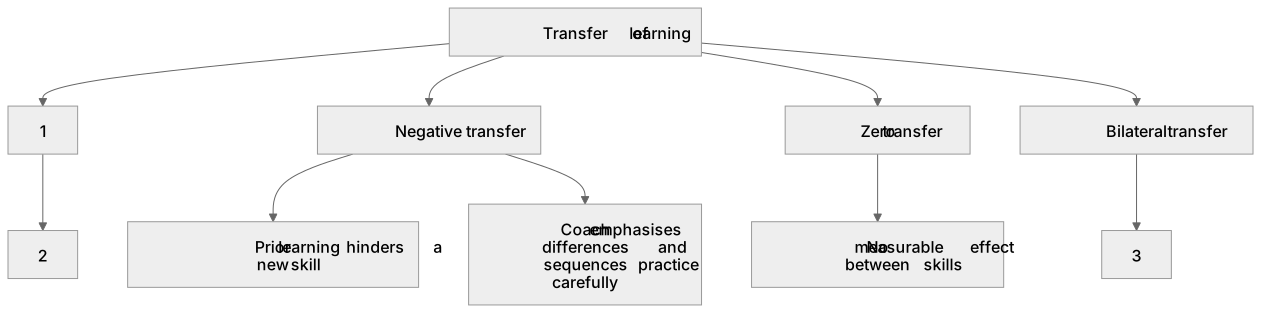
1Box 1
2Box 2
3Box 3
There is more to this lesson
The full lesson goes on to check your understanding and help you earn the marks. Create a free account to carry on, with your progress saved.
A week of Premium from your first lesson · Then the free plan continues · No card, no charge
Test your understanding of Skill, skill continuums and transfer of skills: Understanding of how transfer of learning impacts on skill development.
Active recall beats re-reading. Take an instant quiz now to test what you’ve learned and lock it into long-term memory.
A week of Premium from your first lesson · Then the free plan continues · No card, no charge