AQA · A-Level · Physical Education
Course version: 7582 · Version from Sept 2016
Skill, skill continuums and transfer of skills: Bilateral.
Bilateral transfer describes the effect of learning or performing a skill with one limb on the same skill performed with the opposite limb.
Checked against the AQA 7582 specification (opens in a new tab) on .
- Point 13 of 14
Study notes
From the checked teaching notes for this specification point.
The idea
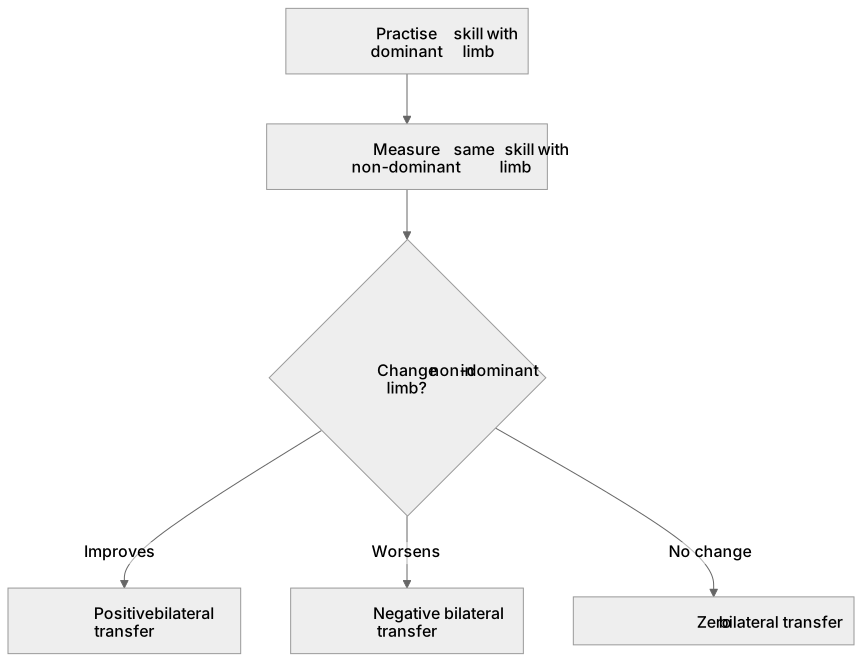
Bilateral transfer describes the effect of learning or performing a skill with one limb on the same skill performed with the opposite limb. A common method is to practise a task such as dribbling or throwing with the dominant arm or leg and then measure performance with the non-dominant limb; improvement in the non-dominant limb indicates bilateral transfer. The transfer can be positive, where the second limb improves, or negative, where it is hindered, and it can also be zero if no change occurs. In an AQA A-Level Physical Education multiple-choice question, you may be asked to identify bilateral transfer from a description or to distinguish it from other transfer types such as proactive and retroactive transfer, so read the stem carefully for the words limb, hand, foot or side.
What earns the marks
- Defines bilateral transfer as the effect of learning or performing a skill with one limb on performance of the same skill with the opposite limb.
- Recognises that bilateral transfer can be positive, negative or zero depending on whether the second limb improves, worsens or is unchanged.
- Applies the concept to a practical example by comparing performance of the same skill with dominant and non-dominant limbs.
- Distinguishes bilateral transfer from proactive and retroactive transfer, which concern the order in which skills are learned rather than which limb is used.
Common mistakes and how to put them right
Confusing bilateral transfer with proactive or retroactive transfer.
Put it right: Bilateral transfer concerns opposite limbs, whereas proactive and retroactive transfer concern the sequence of learning different skills.
Assuming bilateral transfer is always positive.
Put it right: It can be negative or zero, so check the stem for the direction of any change.
Describing transfer between two different skills rather than the same skill performed with the opposite limb, which is the defining feature of bilateral transfer.
Overlooking the word same in the definition.
Put it right: Bilateral transfer refers to the same skill performed on the other side, not a different skill.
Exam tips
- Look for limb words such as hand, foot, arm, leg or side in the stem to identify bilateral transfer.
- Check whether the stem describes the same skill on the opposite side, because that is the key feature of bilateral transfer.
- Eliminate options about the order of learning different skills, as those describe proactive or retroactive transfer instead.
Try the lesson
The start of the Skill, skill continuums and transfer of skills: Bilateral. lesson, made from checked teaching notes for this specification point.
Have a go first
In skill classification, what does the term 'bilateral transfer' describe?
Listen
Bilateral transfer describes the effect of learning or performing a skill with one limb on the same skill performed with the opposite limb. A common method is to practise a task such as dribbling or throwing with the dominant arm or leg and then measure performance with the non-dominant limb; improvement in the non-dominant limb indicates bilateral transfer. The transfer can be positive, where the second limb improves, or negative, where it is hindered, and it can also be zero if no change occurs. In an AQA A-Level Physical Education multiple-choice question, you may be asked to identify bilateral transfer from a description or to distinguish it from other transfer types such as proactive and retroactive transfer, so read the stem carefully for the words limb, hand, foot or side. A strong answer earns marks for these points. Defines bilateral transfer as the effect of learning or performing a skill with one limb on performance of the same skill with the opposite limb. Recognises that bilateral transfer can be positive, negative or zero depending on whether the second limb improves, worsens or is unchanged. Applies the concept to a practical example by comparing performance of the same skill with dominant and non-dominant limbs. Distinguishes bilateral transfer from proactive and retroactive transfer, which concern the order in which skills are learned rather than which limb is used. Exam tip: Look for limb words such as hand, foot, arm, leg or side in the stem to identify bilateral transfer.
See it
Label the diagram
Some boxes have lost their names. Pick the right name for each number.
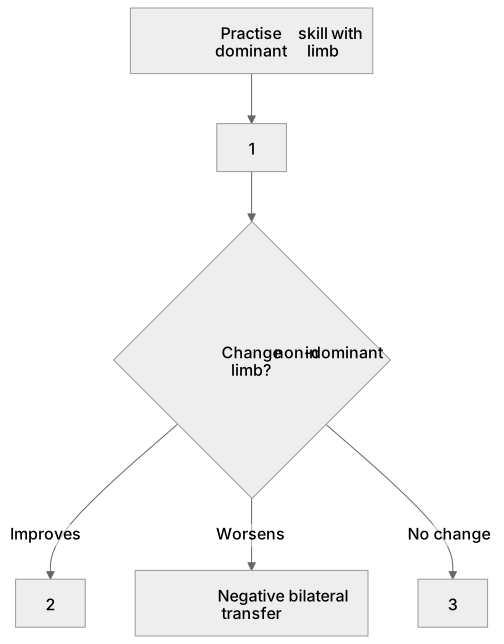
1Box 1
2Box 2
3Box 3
There is more to this lesson
The full lesson goes on to check your understanding and help you earn the marks. Create a free account to carry on, with your progress saved.
A week of Premium from your first lesson · Then the free plan continues · No card, no charge
Test your understanding of Skill, skill continuums and transfer of skills: Bilateral.
Active recall beats re-reading. Take an instant quiz now to test what you’ve learned and lock it into long-term memory.
A week of Premium from your first lesson · Then the free plan continues · No card, no charge