AQA · A-Level · Physical Education
Course version: 7582 · Version from Sept 2016
Social facilitation: Social facilitation and inhibition.
Social facilitation is the tendency for the presence of others to improve performance, while social inhibition is the tendency for their presence to worsen it.
Checked against the AQA 7582 specification (opens in a new tab) on .
- Point 1 of 4
- 4 key terms
Study notes
From the checked teaching notes for this specification point.
The idea
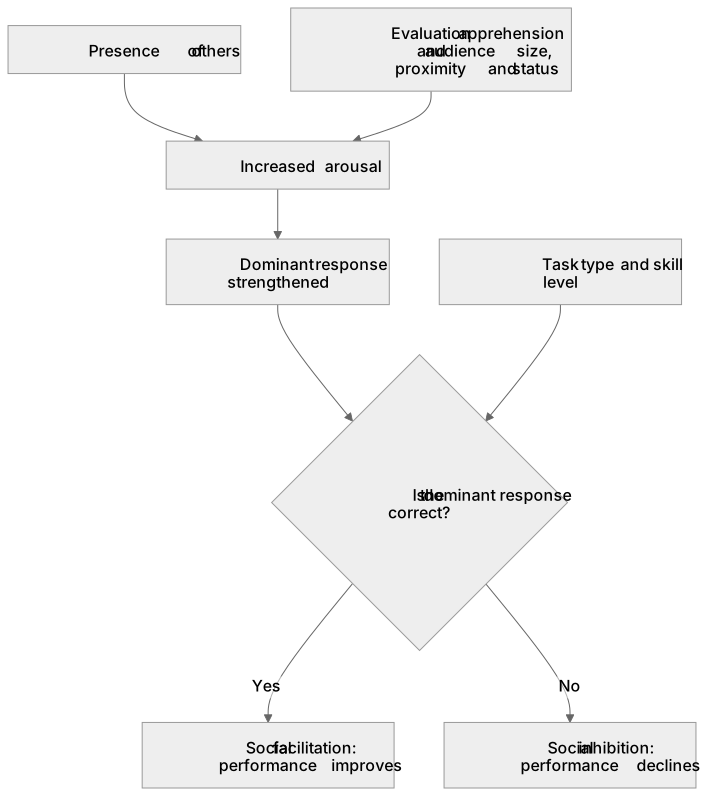
Social facilitation is the tendency for the presence of others to improve performance, while social inhibition is the tendency for their presence to worsen it. The effect depends on the task, the performer and the audience. A well-learned simple or gross skill is often performed better in front of an audience, whereas a newly learned or finely controlled skill is often performed worse. Drive theory explains this through increased arousal strengthening the dominant response: if the dominant response is correct, performance improves; if it is incorrect, performance declines. Evaluation apprehension, the fear of being judged, and the audience's proximity, size and status also influence the effect.
For example: A netball player may shoot more accurately in a familiar routine but misplace a new passing pattern when watched.
What earns the marks
- Social facilitation is the improvement of performance caused by the presence of others.
- Social inhibition is the worsening of performance caused by the presence of others.
- The effect depends on task type, skill level and the nature of the audience.
- Well-learned simple or gross skills are more likely to be facilitated; newly learned or finely controlled skills are more likely to be inhibited.
- Drive theory explains the effect through increased arousal strengthening the dominant response.
- Evaluation apprehension, and audience size, proximity and status, can increase the effect.
- Performers can manage the effect through familiar routines, simulation of competition conditions and arousal control.
Common mistakes and how to put them right
Defining social facilitation as any effect of an audience.
Put it right: It is specifically the improvement of performance, while inhibition is the worsening.
Assuming an audience always improves performance.
Put it right: The effect depends on task difficulty, skill level and the audience.
Confusing social facilitation with social loafing.
Put it right: Loafing is reduced effort in a group, whereas facilitation concerns the effect of an audience on an individual's performance.
Ignoring evaluation apprehension: correction — the fear of being judged is a key reason why an audience can inhibit performance.
Exam tips
- State the direction of the effect first, then explain the task and performer conditions that produce it.
- Use drive theory to link arousal, the dominant response and the resulting performance change.
- Apply the concept to a named skill and audience, such as a novice serving in front of a large crowd, to show understanding.
Try the lesson
The start of the Social facilitation: Social facilitation and inhibition. lesson, made from checked teaching notes for this specification point.
Have a go first
What does social facilitation describe in sport?
Listen
Social facilitation is the tendency for the presence of others to improve performance, while social inhibition is the tendency for their presence to worsen it. The effect depends on the task, the performer and the audience. A well-learned simple or gross skill is often performed better in front of an audience, whereas a newly learned or finely controlled skill is often performed worse. Drive theory explains this through increased arousal strengthening the dominant response: if the dominant response is correct, performance improves; if it is incorrect, performance declines. Evaluation apprehension, the fear of being judged, and the audience's proximity, size and status also influence the effect. For example, a netball player may shoot more accurately in a familiar routine but misplace a new passing pattern when watched. A strong answer earns marks for these points. Social facilitation is the improvement of performance caused by the presence of others. Social inhibition is the worsening of performance caused by the presence of others. The effect depends on task type, skill level and the nature of the audience. Well-learned simple or gross skills are more likely to be facilitated; newly learned or finely controlled skills are more likely to be inhibited. A common slip: Defining social facilitation as any effect of an audience. Instead, it is specifically the improvement of performance, while inhibition is the worsening. Exam tip: State the direction of the effect first, then explain the task and performer conditions that produce it.
See it
Key words
Say what each word means before you turn the card.
Social facilitation
Try answering aloud or in your head before turning the card.
Social inhibition
Try answering aloud or in your head before turning the card.
Drive theory and the dominant response
Try answering aloud or in your head before turning the card.
Evaluation apprehension
Try answering aloud or in your head before turning the card.
See every definition
- Social facilitation
- The tendency for the presence of others to improve performance.
- Social inhibition
- The tendency for the presence of others to worsen performance.
- Drive theory and the dominant response
- Explains the effect through increased arousal strengthening the dominant response, so performance improves if the dominant response is correct and declines if it is incorrect.
- Evaluation apprehension
- The fear of being judged, which along with the audience's proximity, size and status also influences the effect.
Label the diagram
Some boxes have lost their names. Pick the right name for each number.
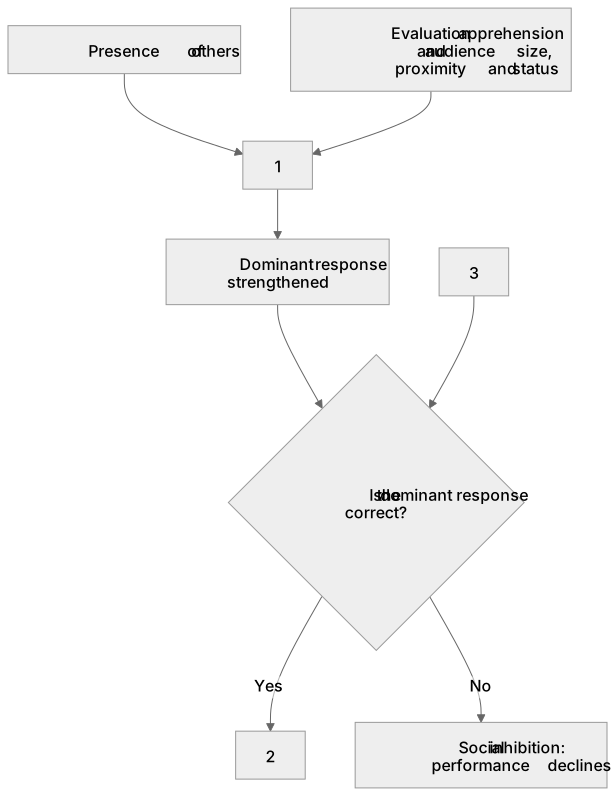
1Box 1
2Box 2
3Box 3
There is more to this lesson
The full lesson goes on to check your understanding and help you earn the marks. Create a free account to carry on, with your progress saved.
A week of Premium from your first lesson · Then the free plan continues · No card, no charge
Test your understanding of Social facilitation: Social facilitation and inhibition.
Active recall beats re-reading. Take an instant quiz now to test what you’ve learned and lock it into long-term memory.
A week of Premium from your first lesson · Then the free plan continues · No card, no charge