AQA · A-Level · Physical Education
Course version: 7582 · Version from Sept 2016
Social facilitation: Zajonc’s model.
Zajonc’s model explains how the presence of others changes performance.
Checked against the AQA 7582 specification (opens in a new tab) on .
- Point 2 of 4
- 4 key terms
Study notes
From the checked teaching notes for this specification point.
The idea
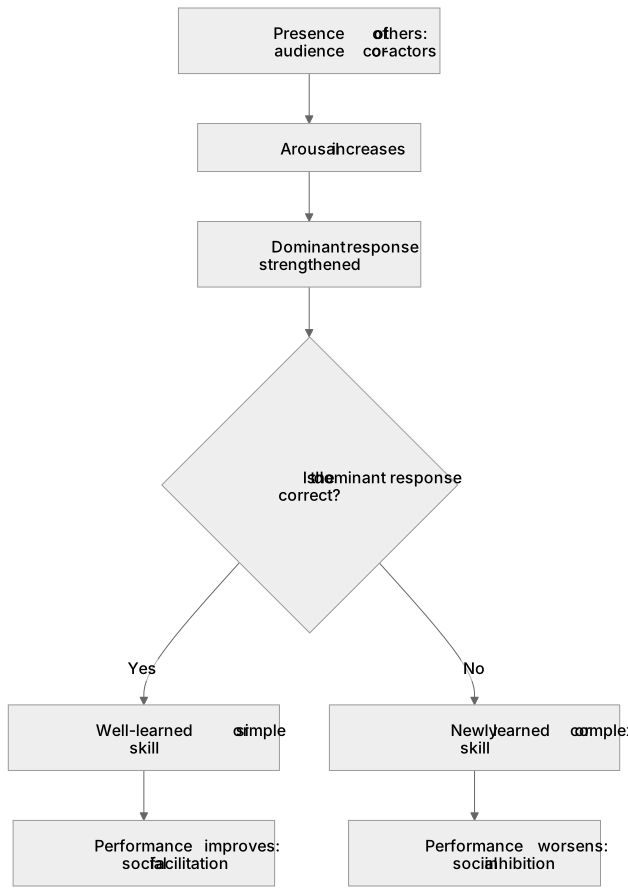
Zajonc’s model explains how the presence of others changes performance. It begins with the idea that an audience or co-actors raise arousal. Increased arousal strengthens the performer’s dominant response, meaning the action most likely to be produced in that situation. If the skill is well learned, the dominant response is usually correct, so performance improves; this is social facilitation. If the skill is still being learned, the dominant response is often incorrect, so performance worsens; this is social inhibition. The model therefore links arousal, task difficulty and stage of learning. For example, a confident rugby player may kick more accurately in front of a crowd, while a novice may miss under the same conditions. The model does not claim that an audience always helps or always harms; it predicts an effect that depends on whether the dominant response is correct.
What earns the marks
- The presence of others increases arousal in the performer.
- Heightened arousal strengthens the dominant response, the most likely response in that situation.
- If the dominant response is correct, typically for a well-learned or simple skill, performance improves and this is social facilitation.
- If the dominant response is incorrect, typically for a newly learned or complex skill, performance worsens and this is social inhibition.
- The model links arousal, stage of learning and task difficulty rather than predicting a single universal effect of an audience.
Common mistakes and how to put them right
Misunderstanding: the model says an audience always improves performance.
Put it right: It predicts improvement only when the dominant response is correct, so a novice may perform worse.
Misunderstanding: arousal weakens the dominant response.
Put it right: Arousal strengthens the dominant response, making the most likely action more probable.
Misunderstanding: the model applies only to team games.
Put it right: It applies to individual and team performances whenever others are present as an audience or co-actors.
Misunderstanding: social facilitation and social inhibition are the same thing.
Put it right: Social facilitation is improved performance and social inhibition is worsened performance, both explained by the same arousal mechanism.
Exam tips
- In a multiple-choice question, identify whether the scenario describes a well-learned or a newly learned skill before choosing between facilitation and inhibition.
- Check whether the option correctly states that arousal strengthens the dominant response, not that it creates a new response.
- Use the terms social facilitation and social inhibition precisely, matching each to improved or worsened performance.
Try the lesson
The start of the Social facilitation: Zajonc’s model. lesson, made from checked teaching notes for this specification point.
Have a go first
According to Zajonc's model of social facilitation, what happens to a performer's level of arousal when other people are present?
Listen
Zajonc’s model explains how the presence of others changes performance. It begins with the idea that an audience or co-actors raise arousal. Increased arousal strengthens the performer’s dominant response, meaning the action most likely to be produced in that situation. If the skill is well learned, the dominant response is usually correct, so performance improves; this is social facilitation. If the skill is still being learned, the dominant response is often incorrect, so performance worsens; this is social inhibition. The model therefore links arousal, task difficulty and stage of learning. For example, a confident rugby player may kick more accurately in front of a crowd, while a novice may miss under the same conditions. The model does not claim that an audience always helps or always harms; it predicts an effect that depends on whether the dominant response is correct. A strong answer earns marks for these points. The presence of others increases arousal in the performer. Heightened arousal strengthens the dominant response, the most likely response in that situation. If the dominant response is correct, typically for a well-learned or simple skill, performance improves and this is social facilitation. If the dominant response is incorrect, typically for a newly learned or complex skill, performance worsens and this is social inhibition. A common slip: Misunderstanding: the model says an audience always improves performance. Instead, it predicts improvement only when the dominant response is correct, so a novice may perform worse. Exam tip: In a multiple-choice question, identify whether the scenario describes a well-learned or a newly learned skill before choosing between facilitation and inhibition.
See it
Key words
Say what each word means before you turn the card.
Arousal and performance
Try answering aloud or in your head before turning the card.
Dominant response
Try answering aloud or in your head before turning the card.
Social facilitation and social inhibition
Try answering aloud or in your head before turning the card.
Stage of learning and task difficulty
Try answering aloud or in your head before turning the card.
See every definition
- Arousal and performance
- The presence of others raises arousal, and this increased arousal strengthens the performer's dominant response, which changes performance.
- Dominant response
- The action most likely to be produced in that situation, which increased arousal strengthens.
- Social facilitation and social inhibition
- Performance improves when the dominant response is usually correct, which is social facilitation, and worsens when it is often incorrect, which is social inhibition.
- Stage of learning and task difficulty
- The model links arousal, task difficulty and stage of learning, since a well-learned skill usually has a correct dominant response while a skill still being learned often has an incorrect one.
Label the diagram
Some boxes have lost their names. Pick the right name for each number.
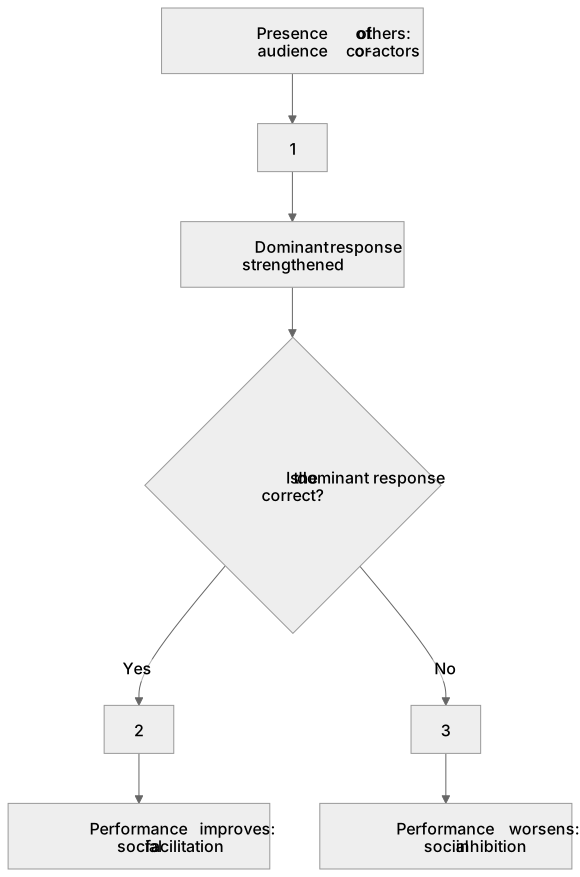
1Box 1
2Box 2
3Box 3
There is more to this lesson
The full lesson goes on to check your understanding and help you earn the marks. Create a free account to carry on, with your progress saved.
A week of Premium from your first lesson · Then the free plan continues · No card, no charge
Test your understanding of Social facilitation: Zajonc’s model.
Active recall beats re-reading. Take an instant quiz now to test what you’ve learned and lock it into long-term memory.
A week of Premium from your first lesson · Then the free plan continues · No card, no charge