AQA · A-Level · Physical Education
Course version: 7582 · Version from Sept 2016
Strategies to eliminate the adverse effects of social facilitation and…
Full specification wording
Social facilitation: Strategies to eliminate the adverse effects of social facilitation and social inhibition.
Social facilitation is the tendency for performance to improve when others are present, typically on well-learned or simple skills; social inhibition is the opposite, where the presence of an…
Checked against the AQA 7582 specification (opens in a new tab) on .
- Point 4 of 4
- 4 key terms
Study notes
From the checked teaching notes for this specification point.
The idea
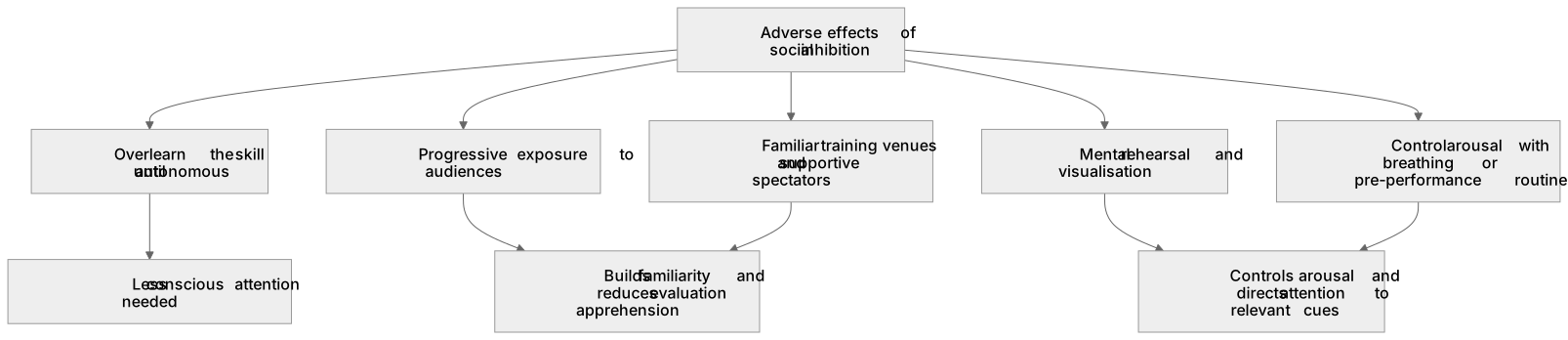
Social facilitation is the tendency for performance to improve when others are present, typically on well-learned or simple skills; social inhibition is the opposite, where the presence of an audience or co-actors worsens performance, especially on complex or newly learned skills. The adverse effects are the drops in performance caused by inhibition, raised arousal and evaluation apprehension. Strategies to eliminate them include overlearning the skill until it is autonomous, so it needs less conscious attention; progressive exposure to audiences, starting with a small friendly group and building to larger crowds; mental rehearsal and visualisation of successful performance; and controlling arousal with breathing or pre-performance routines. Coaches can also reduce evaluation pressure by using familiar training venues and supportive spectators.
What earns the marks
- Social facilitation: the presence of others raises arousal and can improve performance of well-learned or simple skills.
- Social inhibition: the presence of others raises arousal and can worsen performance of complex or newly learned skills.
- Overlearning to the autonomous phase reduces conscious processing, so an audience is less likely to disrupt the skill.
- Progressive or graded exposure to an audience builds familiarity and reduces evaluation apprehension.
- Mental rehearsal, visualisation and pre-performance routines control arousal and direct attention to relevant cues.
- Coaches can reduce adverse effects by using familiar environments and supportive, low-pressure audiences.
Common mistakes and how to put them right
Confusing the two terms.
Put it right: Link facilitation to simple or well-learned skills and inhibition to complex or new skills.
Believing that an audience always harms performance.
Put it right: The effect depends on the difficulty of the skill and the performer's stage of learning.
Thinking that elimination means removing all arousal.
Put it right: Strategies manage arousal to an optimal level rather than removing it.
Assuming only elite performers are affected.
Put it right: Beginners are often more susceptible to inhibition on complex skills.
Exam tips
- Read the stem carefully to identify whether the scenario describes improved or worsened performance before choosing a strategy.
- Eliminate options that confuse facilitation with inhibition, since these are the most common distractors.
- Match each strategy to the mechanism it targets, such as overlearning for automaticity or graded exposure for evaluation apprehension.
Try the lesson
The start of the Social facilitation: Strategies to eliminate the adverse effects of social facilitation and social inhibition. lesson, made from checked teaching notes for this specification point.
Have a go first
A netball coach notices that a player performs well in training but makes more errors in front of a large crowd. Which strategy is most likely to reduce the adverse effect of the crowd on this player?
Listen
Social facilitation is the tendency for performance to improve when others are present, typically on well-learned or simple skills; social inhibition is the opposite, where the presence of an audience or co-actors worsens performance, especially on complex or newly learned skills. The adverse effects are the drops in performance caused by inhibition, raised arousal and evaluation apprehension. Strategies to eliminate them include overlearning the skill until it is autonomous, so it needs less conscious attention; progressive exposure to audiences, starting with a small friendly group and building to larger crowds; mental rehearsal and visualisation of successful performance; and controlling arousal with breathing or pre-performance routines. Coaches can also reduce evaluation pressure by using familiar training venues and supportive spectators. A strong answer earns marks for these points. Social facilitation: the presence of others raises arousal and can improve performance of well-learned or simple skills. Social inhibition: the presence of others raises arousal and can worsen performance of complex or newly learned skills. Overlearning to the autonomous phase reduces conscious processing, so an audience is less likely to disrupt the skill. Progressive or graded exposure to an audience builds familiarity and reduces evaluation apprehension. A common slip: Confusing the two terms: social facilitation is the improvement in performance with others present, while social inhibition is the worsening of performance. Instead, link facilitation to simple or well-learned skills and inhibition to complex or new skills. Exam tip: Read the stem carefully to identify whether the scenario describes improved or worsened performance before choosing a strategy.
See it
Key words
Say what each word means before you turn the card.
Social facilitation
Try answering aloud or in your head before turning the card.
Social inhibition
Try answering aloud or in your head before turning the card.
Overlearning
Try answering aloud or in your head before turning the card.
Evaluation apprehension
Try answering aloud or in your head before turning the card.
See every definition
- Social facilitation
- The presence of others raises arousal and can improve performance of well-learned or simple skills.
- Social inhibition
- The presence of others raises arousal and can worsen performance of complex or newly learned skills.
- Overlearning
- Learning the skill until it is autonomous, so it needs less conscious attention and an audience is less likely to disrupt it.
- Evaluation apprehension
- A raised concern about being judged that the presence of others can cause, which progressive exposure to audiences reduces.
Label the diagram
Some boxes have lost their names. Pick the right name for each number.
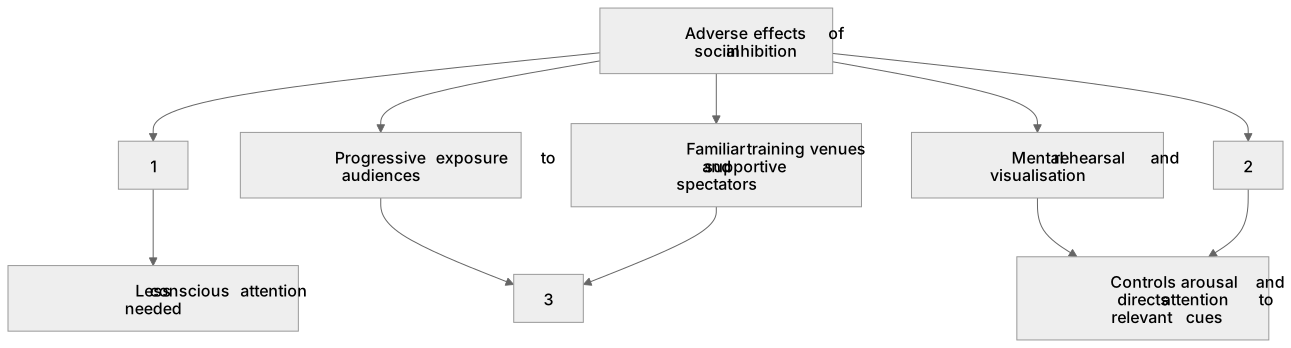
1Box 1
2Box 2
3Box 3
There is more to this lesson
The full lesson goes on to check your understanding and help you earn the marks. Create a free account to carry on, with your progress saved.
A week of Premium from your first lesson · Then the free plan continues · No card, no charge
Test your understanding of Social facilitation: Strategies to eliminate the adverse effects of social facilitation and social inhibition.
Active recall beats re-reading. Take an instant quiz now to test what you’ve learned and lock it into long-term memory.
A week of Premium from your first lesson · Then the free plan continues · No card, no charge