AQA · A-Level · Physical Education
Course version: 7582 · Version from Sept 2016
Social facilitation: Evaluation apprehension.
Evaluation apprehension is the concern a performer feels about being judged by others.
Checked against the AQA 7582 specification (opens in a new tab) on .
- Point 3 of 4
- 4 key terms
Study notes
From the checked teaching notes for this specification point.
The idea
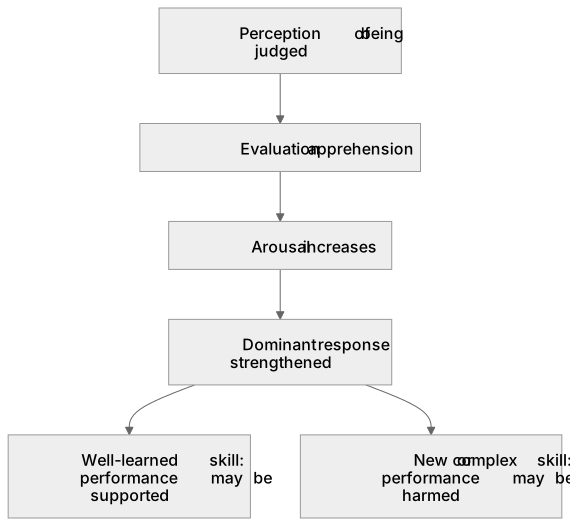
Evaluation apprehension is the concern a performer feels about being judged by others. It is not simply the presence of people but the perception that those people are assessing ability, appearance or outcome. This perceived judgement raises arousal, which can then strengthen the dominant response. If the skill is well learned, the raised arousal may support performance; if the skill is new or complex, it may harm performance. Evaluation apprehension also helps explain why performance can change when a crowd is perceived as expert, when a coach is watching, or when a performer believes they are being compared with others. For example, a gymnast may feel more nervous in front of selectors than in an empty hall. The key idea is that the performer’s interpretation of the audience matters, not just the audience’s physical presence.
What earns the marks
- Evaluation apprehension is the perceived fear or concern about being judged by others.
- The perception of judgement increases arousal.
- Raised arousal strengthens the dominant response, so the effect on performance depends on whether that response is correct.
Common mistakes and how to put them right
Misunderstanding: evaluation apprehension is the same as the mere presence of others.
Put it right: It is the perception of being judged, so an audience that the performer does not see as evaluative may have little effect.
Misunderstanding: evaluation apprehension always harms performance.
Put it right: It raises arousal, which may help a well-learned dominant response and harm a poorly learned one.
Misunderstanding: evaluation apprehension is a personality trait that cannot change.
Put it right: It depends on the situation and the performer’s interpretation, so it can vary between events and audiences.
Misunderstanding: only large crowds cause evaluation apprehension.
Put it right: Even one evaluative observer, such as a coach or selector, can create it.
Exam tips
- In a multiple-choice question, look for the option that mentions perceived judgement rather than simple presence.
- Link evaluation apprehension to arousal and then to the dominant response before deciding whether performance improves or worsens.
- Reject options that treat evaluation apprehension as a fixed personality characteristic or as always negative.
Try the lesson
The start of the Social facilitation: Evaluation apprehension. lesson, made from checked teaching notes for this specification point.
Have a go first
What does evaluation apprehension mean in the context of performing in front of others?
Listen
Evaluation apprehension is the concern a performer feels about being judged by others. It is not simply the presence of people but the perception that those people are assessing ability, appearance or outcome. This perceived judgement raises arousal, which can then strengthen the dominant response. If the skill is well learned, the raised arousal may support performance; if the skill is new or complex, it may harm performance. Evaluation apprehension also helps explain why performance can change when a crowd is perceived as expert, when a coach is watching, or when a performer believes they are being compared with others. For example, a gymnast may feel more nervous in front of selectors than in an empty hall. The key idea is that the performer’s interpretation of the audience matters, not just the audience’s physical presence. A strong answer earns marks for these points. Evaluation apprehension is the perceived fear or concern about being judged by others. The perception of judgement increases arousal. Raised arousal strengthens the dominant response, so the effect on performance depends on whether that response is correct. A common slip: Misunderstanding: evaluation apprehension is the same as the mere presence of others. Instead, it is the perception of being judged, so an audience that the performer does not see as evaluative may have little effect. Exam tip: In a multiple-choice question, look for the option that mentions perceived judgement rather than simple presence.
See it
Key words
Say what each word means before you turn the card.
Evaluation apprehension
Try answering aloud or in your head before turning the card.
Perceived judgement
Try answering aloud or in your head before turning the card.
Arousal and the dominant response
Try answering aloud or in your head before turning the card.
Audience interpretation
Try answering aloud or in your head before turning the card.
See every definition
- Evaluation apprehension
- The concern a performer feels about being judged by others, based on the perception that those people are assessing ability, appearance or outcome.
- Perceived judgement
- The performer's perception that others are assessing ability, appearance or outcome, rather than simply the presence of people.
- Arousal and the dominant response
- Perceived judgement raises arousal, which can then strengthen the dominant response, so the effect on performance depends on whether the skill is well learned or new or complex.
- Audience interpretation
- The performer's interpretation of the audience matters, not just the audience's physical presence, which helps explain why performance can change when a crowd is perceived as expert.
Label the diagram
Some boxes have lost their names. Pick the right name for each number.
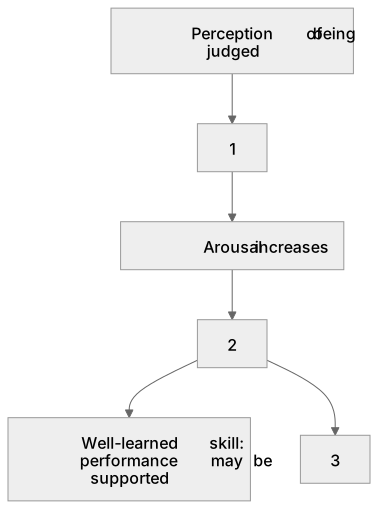
1Box 1
2Box 2
3Box 3
There is more to this lesson
The full lesson goes on to check your understanding and help you earn the marks. Create a free account to carry on, with your progress saved.
A week of Premium from your first lesson · Then the free plan continues · No card, no charge
Test your understanding of Social facilitation: Evaluation apprehension.
Active recall beats re-reading. Take an instant quiz now to test what you’ve learned and lock it into long-term memory.
A week of Premium from your first lesson · Then the free plan continues · No card, no charge