AQA · A-Level · Physical Education
Course version: 7582 · Version from Sept 2016
Sociological theory applied to equal opportunities: Gender.
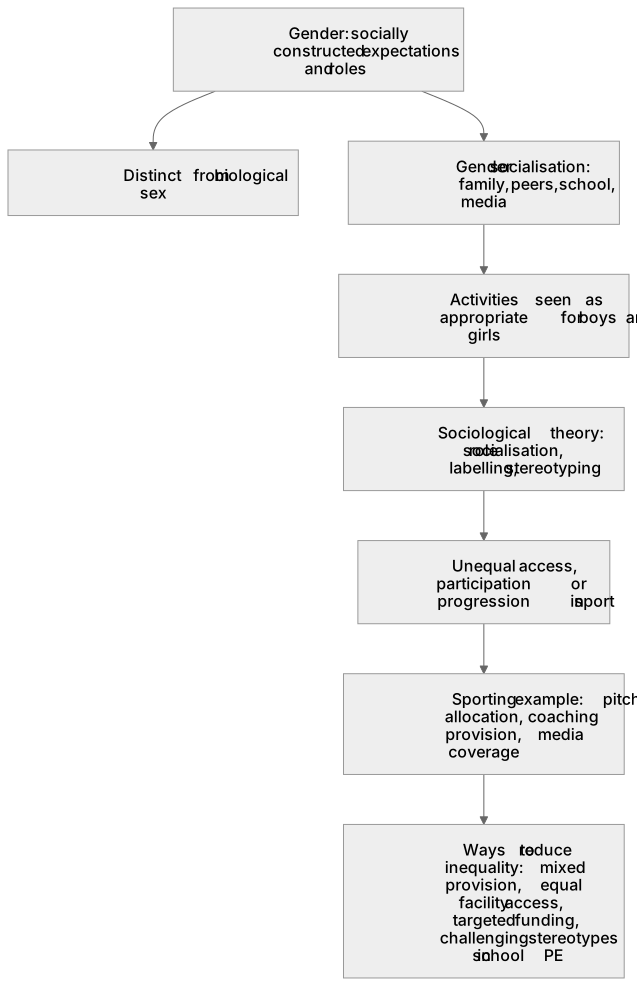
Gender, in this sociological topic, means the socially constructed expectations attached to being male or female, not simply biological sex.
Checked against the AQA 7582 specification (opens in a new tab) on .
- Point 9 of 18
- 3 key terms
Study notes
From the checked teaching notes for this specification point.
The idea
Gender, in this sociological topic, means the socially constructed expectations attached to being male or female, not simply biological sex. Sociological theory applied to equal opportunities asks you to explain how those expectations shape access, participation and progression in physical activity and sport. For example, a local club may schedule boys' football on the main pitch at peak times while girls' teams train on a shared surface at less convenient times; the difference is a social arrangement, not a natural fact. A strong answer links a theoretical idea, such as role socialisation or labelling, to a concrete sporting outcome, then considers how opportunity could be made more equal. You should be able to define gender, distinguish it from sex, and apply it to participation patterns.
What earns the marks
- Defines gender as socially constructed expectations and roles associated with masculinity and femininity, distinct from biological sex.
- Explains that gender socialisation, including family, peers, school and media, influences which activities are seen as appropriate for boys and girls.
- Applies a sociological theory, such as role socialisation, labelling or stereotyping, to explain unequal access, participation or progression in sport.
- Uses a concrete sporting example, such as differences in pitch allocation, coaching provision or media coverage, to show how gender shapes equal opportunities.
- Evaluates ways to reduce gender inequality, such as mixed provision, equal facility access, targeted funding or challenging stereotypes in school PE.
Common mistakes and how to put them right
Treating gender as identical to biological sex.
Put it right by defining gender as socially constructed expectations and roles, while sex refers to biological characteristics.
Assuming that gender inequality in sport is natural or inevitable.
Put it right by explaining how social processes such as socialisation, labelling and resource allocation produce unequal opportunities.
Describing a participation difference without linking it to a sociological concept.
Put it right by naming the theoretical idea and showing how it explains the sporting outcome.
Ignoring the equal opportunities focus and writing only about individual choice.
Put it right by analysing structural and cultural barriers and possible interventions.
Exam tips
- Read the question stem carefully to identify whether it asks for a definition, an application or an evaluation of gender and equal opportunities.
- Eliminate options that confuse sex with gender or that present inequality as biologically fixed.
- When two options seem plausible, choose the one that links a sociological concept to a specific sporting context rather than a general statement.
Try the lesson
The start of the Sociological theory applied to equal opportunities: Gender. lesson, made from checked teaching notes for this specification point.
Have a go first
In the sociology of sport, what does the term 'gender' refer to?
Listen
Gender, in this sociological topic, means the socially constructed expectations attached to being male or female, not simply biological sex. Sociological theory applied to equal opportunities asks you to explain how those expectations shape access, participation and progression in physical activity and sport. For example, a local club may schedule boys' football on the main pitch at peak times while girls' teams train on a shared surface at less convenient times; the difference is a social arrangement, not a natural fact. A strong answer links a theoretical idea, such as role socialisation or labelling, to a concrete sporting outcome, then considers how opportunity could be made more equal. You should be able to define gender, distinguish it from sex, and apply it to participation patterns. A strong answer earns marks for these points. Defines gender as socially constructed expectations and roles associated with masculinity and femininity, distinct from biological sex. Explains that gender socialisation, including family, peers, school and media, influences which activities are seen as appropriate for boys and girls. Applies a sociological theory, such as role socialisation, labelling or stereotyping, to explain unequal access, participation or progression in sport. Uses a concrete sporting example, such as differences in pitch allocation, coaching provision or media coverage, to show how gender shapes equal opportunities. A common slip: Treating gender as identical to biological sex. Instead, defining gender as socially constructed expectations and roles, while sex refers to biological characteristics. Exam tip: Read the question stem carefully to identify whether it asks for a definition, an application or an evaluation of gender and equal opportunities.
See it
Key words
Say what each word means before you turn the card.
Gender
Try answering aloud or in your head before turning the card.
Gender socialisation
Try answering aloud or in your head before turning the card.
Role socialisation
Try answering aloud or in your head before turning the card.
See every definition
- Gender
- Socially constructed expectations and roles associated with masculinity and femininity, distinct from biological sex.
- Gender socialisation
- Influence from family, peers, school and media on which activities are seen as appropriate for boys and girls.
- Role socialisation
- A sociological theory, alongside labelling and stereotyping, used to explain unequal access, participation or progression in sport.
Label the diagram
Some boxes have lost their names. Pick the right name for each number.
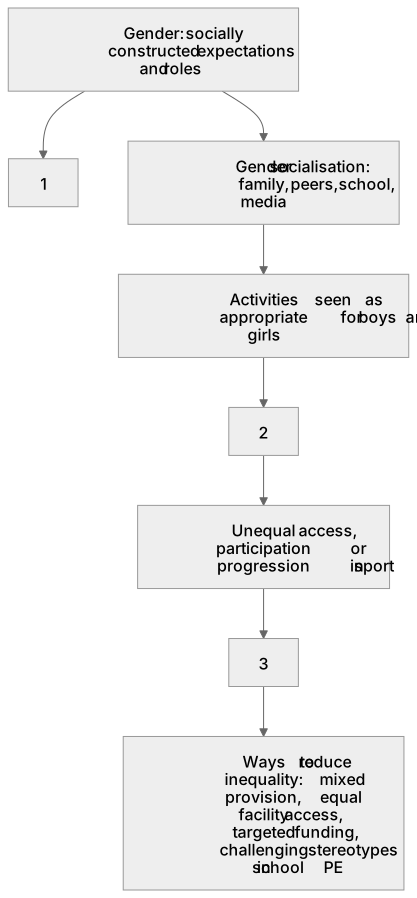
1Box 1
2Box 2
3Box 3
There is more to this lesson
The full lesson goes on to check your understanding and help you earn the marks. Create a free account to carry on, with your progress saved.
A week of Premium from your first lesson · Then the free plan continues · No card, no charge
Test your understanding of Sociological theory applied to equal opportunities: Gender.
Active recall beats re-reading. Take an instant quiz now to test what you’ve learned and lock it into long-term memory.
A week of Premium from your first lesson · Then the free plan continues · No card, no charge