AQA · A-Level · Physical Education
Course version: 7582 · Version from Sept 2016
Sociological theory applied to equal opportunities: Disadvantaged.
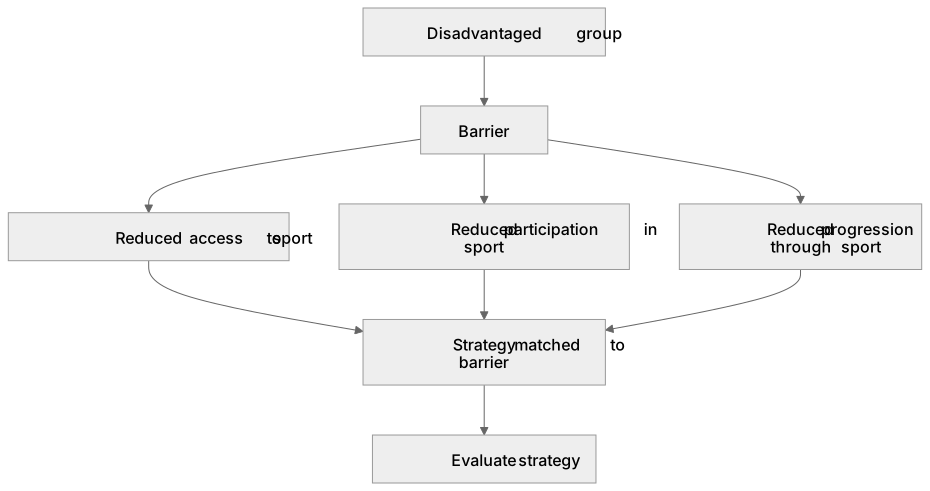
Disadvantaged, in this sociological topic, describes groups or individuals who face barriers that reduce their access to, participation in or progression through physical activity and sport.
Checked against the AQA 7582 specification (opens in a new tab) on .
- Point 10 of 18
- 4 key terms
Study notes
From the checked teaching notes for this specification point.
The idea
Disadvantaged, in this sociological topic, describes groups or individuals who face barriers that reduce their access to, participation in or progression through physical activity and sport. The disadvantage may be economic, social or cultural, and it can overlap with gender, ethnicity, disability or age. For example, a young person who cannot afford club fees, transport or kit may be excluded even when facilities exist. Sociological theory applied to equal opportunities asks you to identify the barrier, explain how it operates, and evaluate strategies such as subsidised membership, school-club links or inclusive provision. A strong answer names the disadvantaged group, gives a concrete sporting consequence and links it to a theoretical idea about power, resources or socialisation.
What earns the marks
- Defines disadvantaged as facing barriers that reduce access to, participation in or progression through sport and physical activity.
- Identifies types of disadvantage, such as economic, social, cultural or geographical, and explains how each can limit opportunity.
- Applies a sociological theory, such as conflict theory, social exclusion or labelling, to explain why some groups are disadvantaged in sport.
- Uses a concrete example, such as the cost of club membership, lack of transport or inaccessible facilities, to show the effect on participation.
- Evaluates strategies to reduce disadvantage, such as subsidised fees, outreach programmes, inclusive equipment or targeted funding.
Common mistakes and how to put them right
Treating disadvantage as a personal failing rather than a structural barrier.
Put it right by explaining how resources, socialisation and institutional practices create unequal opportunities.
Listing a disadvantaged group without explaining the barrier.
Put it right by naming the specific obstacle and its sporting consequence.
Confusing disadvantage with lack of interest.
Put it right by showing how cost, access, discrimination or cultural expectations can prevent participation even when the person is interested.
Offering a solution without linking it to the identified barrier.
Put it right by matching each strategy to the specific disadvantage it addresses.
Exam tips
- Identify the disadvantaged group and the specific barrier before considering possible solutions.
- Reject options that blame individuals for structural disadvantages or that ignore the equal opportunities focus.
- Choose the option that best links a sociological concept to a concrete sporting consequence.
Try the lesson
The start of the Sociological theory applied to equal opportunities: Disadvantaged. lesson, made from checked teaching notes for this specification point.
Have a go first
In the sociology of sport, which group is described as disadvantaged when access to sporting facilities, coaching and competition is unevenly distributed?
Listen
Disadvantaged, in this sociological topic, describes groups or individuals who face barriers that reduce their access to, participation in or progression through physical activity and sport. The disadvantage may be economic, social or cultural, and it can overlap with gender, ethnicity, disability or age. For example, a young person who cannot afford club fees, transport or kit may be excluded even when facilities exist. Sociological theory applied to equal opportunities asks you to identify the barrier, explain how it operates, and evaluate strategies such as subsidised membership, school-club links or inclusive provision. A strong answer names the disadvantaged group, gives a concrete sporting consequence and links it to a theoretical idea about power, resources or socialisation. A strong answer earns marks for these points. Defines disadvantaged as facing barriers that reduce access to, participation in or progression through sport and physical activity. Identifies types of disadvantage, such as economic, social, cultural or geographical, and explains how each can limit opportunity. Applies a sociological theory, such as conflict theory, social exclusion or labelling, to explain why some groups are disadvantaged in sport. Uses a concrete example, such as the cost of club membership, lack of transport or inaccessible facilities, to show the effect on participation. A common slip: Treating disadvantage as a personal failing rather than a structural barrier. Instead, explaining how resources, socialisation and institutional practices create unequal opportunities. Exam tip: Identify the disadvantaged group and the specific barrier before considering possible solutions.
See it
Key words
Say what each word means before you turn the card.
Disadvantaged
Try answering aloud or in your head before turning the card.
Social exclusion
Try answering aloud or in your head before turning the card.
Equal opportunities
Try answering aloud or in your head before turning the card.
Conflict theory
Try answering aloud or in your head before turning the card.
See every definition
- Disadvantaged
- Describes groups or individuals who face barriers that reduce their access to, participation in or progression through physical activity and sport.
- Social exclusion
- A sociological theory applied to explain why some groups are disadvantaged in sport.
- Equal opportunities
- The focus of sociological theory that asks you to identify the barrier, explain how it operates, and evaluate strategies such as subsidised membership, school-club links or inclusive provision.
- Conflict theory
- A sociological theory applied to explain why some groups are disadvantaged in sport.
Label the diagram
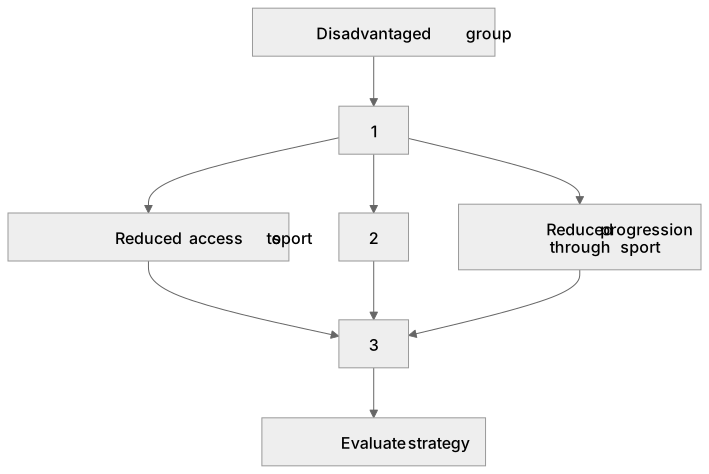
Some boxes have lost their names. Pick the right name for each number.
1Box 1
2Box 2
3Box 3
There is more to this lesson
The full lesson goes on to check your understanding and help you earn the marks. Create a free account to carry on, with your progress saved.
A week of Premium from your first lesson · Then the free plan continues · No card, no charge
Test your understanding of Sociological theory applied to equal opportunities: Disadvantaged.
Active recall beats re-reading. Take an instant quiz now to test what you’ve learned and lock it into long-term memory.
A week of Premium from your first lesson · Then the free plan continues · No card, no charge