AQA · A-Level · Physical Education
Course version: 7582 · Version from Sept 2016
Social processes (social control and social change).
Full specification wording
Sociological theory applied to equal opportunities: Social processes (social control and social change).
Social processes explain how behaviour is regulated and how participation patterns shift.
Checked against the AQA 7582 specification (opens in a new tab) on .
- Point 4 of 18
- 3 key terms
Study notes
From the checked teaching notes for this specification point.
The idea
Social processes explain how behaviour is regulated and how participation patterns shift. Social control works through formal agents such as schools, governing bodies and the law, and informal agents such as family, peers and media, which reward conformity and sanction deviation. In sport, eligibility rules and anti-doping testing are formal controls; team norms and peer approval are informal. Social change describes shifts in attitudes, provision and opportunity over time, driven by campaigns, role models, legislation and media coverage. For example, increased female participation followed equal-opportunity legislation, targeted funding and visible role models. The two processes interact: control can accelerate or resist change, and change can reshape what is controlled.
What earns the marks
- Defines social control as the formal and informal mechanisms that encourage conformity and discourage deviance in sport.
- Identifies formal agents of social control, such as schools, national governing bodies, officials and the law, and gives a sporting example.
- Identifies informal agents of social control, such as family, peers, coaches and media, and gives a sporting example.
- Defines social change as a shift over time in attitudes, provision or participation opportunities in sport.
- Explains at least one driver of social change, such as legislation, campaigns, funding, role models or media coverage.
- Explains how social control and social change interact, for example how rules can either speed up or slow down equal-opportunity change.
Common mistakes and how to put them right
Treating social control as only formal rules and punishments.
Put it right: Informal approval and disapproval from peers, family and coaches also regulate behaviour.
Confusing social change with individual behaviour change.
Put it right: Social change is a shift in shared attitudes, provision or participation patterns across a group or society.
Assuming social control always blocks equality.
Put it right: Formal controls such as anti-discrimination legislation can drive equal-opportunity change.
Giving a general example without naming the agent or mechanism.
Put it right: State who or what applies the control and how it operates.
Exam tips
- Read the question stem carefully to identify whether it asks about control, change or the interaction between them.
- Eliminate options that describe individual choices rather than shared social processes.
- Check that each remaining option names a plausible agent or driver of control or change in a sporting context.
Try the lesson
The start of the Sociological theory applied to equal opportunities: Social processes (social control and social change). lesson, made from checked teaching notes for this specification point.
Have a go first
In sociology of sport, which process describes the ways that coaches, officials and governing bodies guide and constrain participants' behaviour so that they conform to the accepted norms of their sport?
Listen
Social processes explain how behaviour is regulated and how participation patterns shift. Social control works through formal agents such as schools, governing bodies and the law, and informal agents such as family, peers and media, which reward conformity and sanction deviation. In sport, eligibility rules and anti-doping testing are formal controls; team norms and peer approval are informal. Social change describes shifts in attitudes, provision and opportunity over time, driven by campaigns, role models, legislation and media coverage. For example, increased female participation followed equal-opportunity legislation, targeted funding and visible role models. The two processes interact: control can accelerate or resist change, and change can reshape what is controlled. A strong answer earns marks for these points. Defines social control as the formal and informal mechanisms that encourage conformity and discourage deviance in sport. Identifies formal agents of social control, such as schools, national governing bodies, officials and the law, and gives a sporting example. Identifies informal agents of social control, such as family, peers, coaches and media, and gives a sporting example. Defines social change as a shift over time in attitudes, provision or participation opportunities in sport. A common slip: Treating social control as only formal rules and punishments. Instead, informal approval and disapproval from peers, family and coaches also regulate behaviour. Exam tip: Read the question stem carefully to identify whether it asks about control, change or the interaction between them.
See it
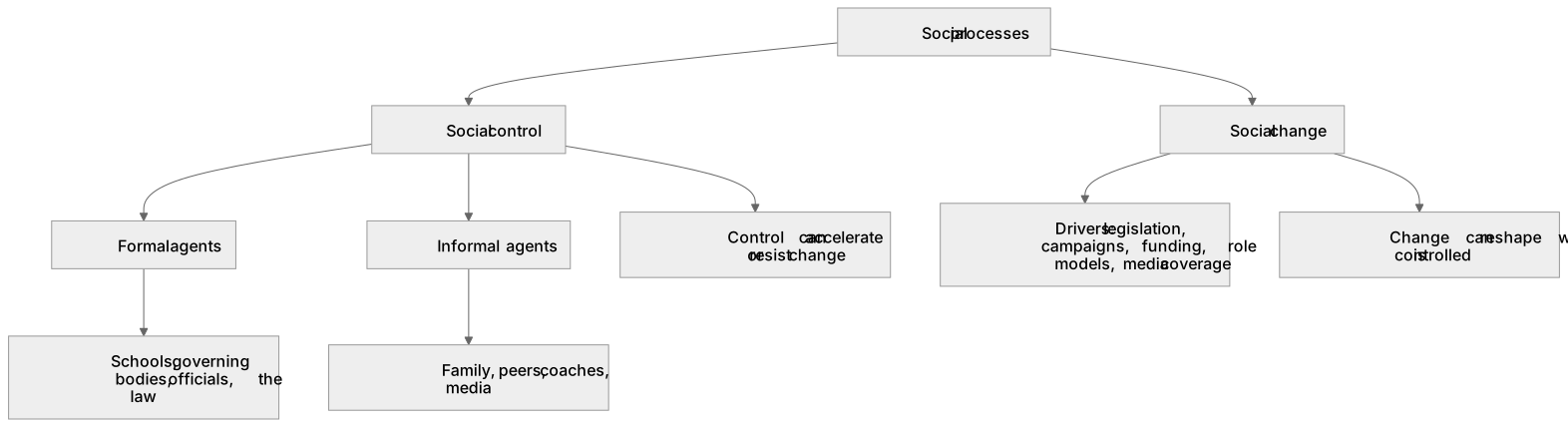
Key words
Say what each word means before you turn the card.
Formal and informal social control in sport
Try answering aloud or in your head before turning the card.
Agents of social control and their sanctions
Try answering aloud or in your head before turning the card.
Drivers and patterns of social change in participation
Try answering aloud or in your head before turning the card.
See every definition
- Formal and informal social control in sport
- Mechanisms that encourage conformity and discourage deviance in sport, working through formal agents such as schools, governing bodies and the law, and informal agents such as family, peers and media.
- Agents of social control and their sanctions
- Formal agents such as schools, governing bodies and the law, and informal agents such as family, peers and media, which reward conformity and sanction deviation.
- Drivers and patterns of social change in participation
- Shifts in attitudes, provision and opportunity over time, driven by campaigns, role models, legislation and media coverage.
Label the diagram
Some boxes have lost their names. Pick the right name for each number.
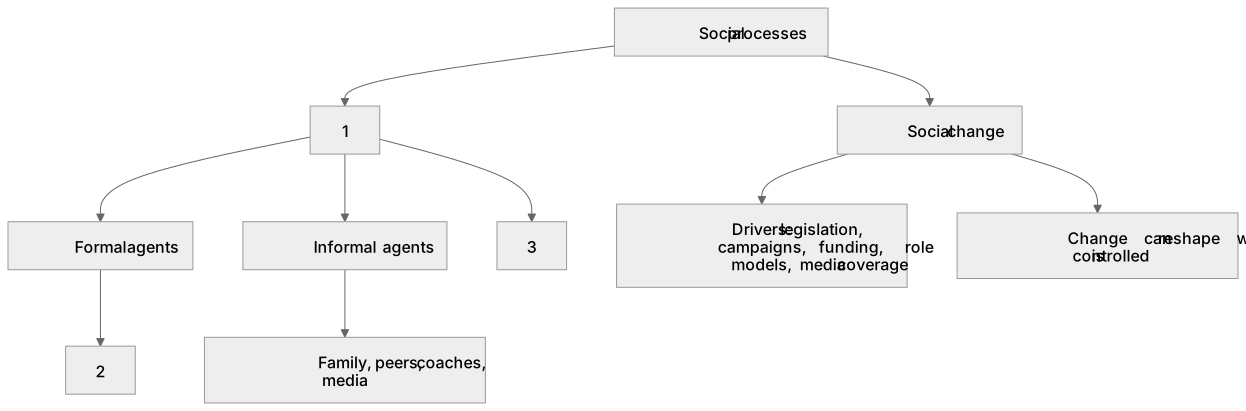
1Box 1
2Box 2
3Box 3
There is more to this lesson
The full lesson goes on to check your understanding and help you earn the marks. Create a free account to carry on, with your progress saved.
A week of Premium from your first lesson · Then the free plan continues · No card, no charge
Test your understanding of Sociological theory applied to equal opportunities: Social processes (social control and social change).
Active recall beats re-reading. Take an instant quiz now to test what you’ve learned and lock it into long-term memory.
A week of Premium from your first lesson · Then the free plan continues · No card, no charge