AQA · A-Level · Physical Education
Course version: 7582 · Version from Sept 2016
Socialisation (primary and secondary).
Full specification wording
Sociological theory applied to equal opportunities: Socialisation (primary and secondary).
Socialisation is the lifelong process through which people learn the norms, values and behaviours expected in society.
Checked against the AQA 7582 specification (opens in a new tab) on .
- Point 3 of 18
- 3 key terms
Study notes
From the checked teaching notes for this specification point.
The idea
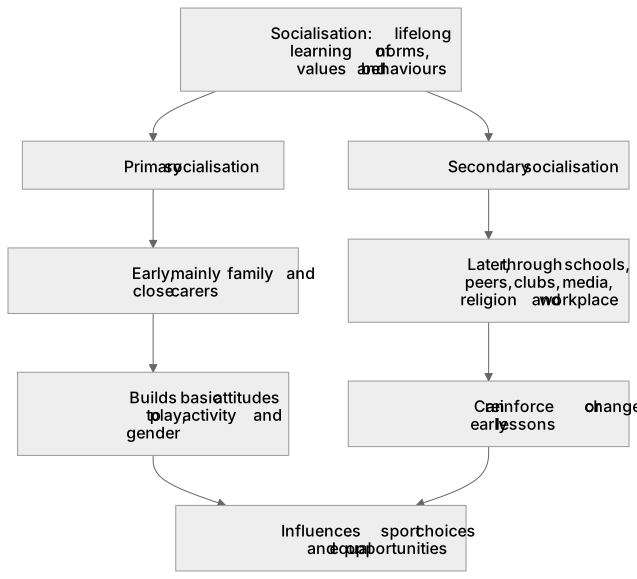
Socialisation is the lifelong process through which people learn the norms, values and behaviours expected in society. Primary socialisation happens early, mainly through family and close carers, and builds basic attitudes, including early views about play, activity and gender. Secondary socialisation happens later through schools, peers, clubs, media, religion and workplace, and it can reinforce or change those early lessons. In sport, a family may introduce a child to swimming, while a school or club may later steer them towards rugby, dance or disability sport. Peer groups can make certain activities socially attractive or embarrassing. Media can present role models that normalise participation for some groups and not others. Understanding both stages helps explain why equal opportunities are shaped across a lifetime, not fixed at birth.
What earns the marks
- Defines socialisation as the process of learning norms, values and behaviours expected in society.
- Distinguishes primary socialisation as early learning mainly through family and close carers.
- Distinguishes secondary socialisation as later learning through schools, peers, clubs, media, religion and workplace.
- Explains that primary socialisation builds foundational attitudes towards activity, play and gender.
- Explains that secondary socialisation can reinforce or change early attitudes and influence sport choices.
- Applies both stages to a sport example, such as family introducing swimming and a school or club steering a learner towards a specific activity.
- Links socialisation to equal opportunities by showing how agents can widen or narrow participation for different groups.
Common mistakes and how to put them right
Confusing primary and secondary socialisation.
Put it right: Primary is early and family-centred, while secondary is later and involves wider institutions such as school, peers and media.
Treating socialisation as finished in childhood.
Put it right: It is a lifelong process that continues through adulthood and new social settings.
Assuming only family matters for sport participation.
Put it right: Secondary agents such as schools, clubs, peers and media also strongly influence choices and opportunities.
Describing socialisation as passive copying.
Put it right: People actively interpret and sometimes resist social messages, which can change participation patterns.
Exam tips
- Look for the agent named in the option, such as family, school or media, and match it to the correct stage of socialisation.
- Reject options that describe socialisation as a single event rather than an ongoing process.
- Choose the option that explains how learning norms and values affects sport participation, not just what socialisation means.
- If two options mention the same agent, select the one that correctly identifies whether it is primary or secondary.
Try the lesson
The start of the Sociological theory applied to equal opportunities: Socialisation (primary and secondary). lesson, made from checked teaching notes for this specification point.
Have a go first
Which type of socialisation takes place mainly in early childhood within the family, where a child first learns basic norms and values?
Listen
Socialisation is the lifelong process through which people learn the norms, values and behaviours expected in society. Primary socialisation happens early, mainly through family and close carers, and builds basic attitudes, including early views about play, activity and gender. Secondary socialisation happens later through schools, peers, clubs, media, religion and workplace, and it can reinforce or change those early lessons. In sport, a family may introduce a child to swimming, while a school or club may later steer them towards rugby, dance or disability sport. Peer groups can make certain activities socially attractive or embarrassing. Media can present role models that normalise participation for some groups and not others. Understanding both stages helps explain why equal opportunities are shaped across a lifetime, not fixed at birth. A strong answer earns marks for these points. Defines socialisation as the process of learning norms, values and behaviours expected in society. Distinguishes primary socialisation as early learning mainly through family and close carers. Distinguishes secondary socialisation as later learning through schools, peers, clubs, media, religion and workplace. Explains that primary socialisation builds foundational attitudes towards activity, play and gender. A common slip: Confusing primary and secondary socialisation. Instead, primary is early and family-centred, while secondary is later and involves wider institutions such as school, peers and media. Exam tip: Look for the agent named in the option, such as family, school or media, and match it to the correct stage of socialisation.
See it
Key words
Say what each word means before you turn the card.
Socialisation
Try answering aloud or in your head before turning the card.
Primary socialisation
Try answering aloud or in your head before turning the card.
Secondary socialisation
Try answering aloud or in your head before turning the card.
See every definition
- Socialisation
- The lifelong process through which people learn the norms, values and behaviours expected in society.
- Primary socialisation
- Early learning that happens mainly through family and close carers and builds basic attitudes, including early views about play, activity and gender.
- Secondary socialisation
- Later learning through schools, peers, clubs, media, religion and workplace that can reinforce or change early lessons.
Label the diagram
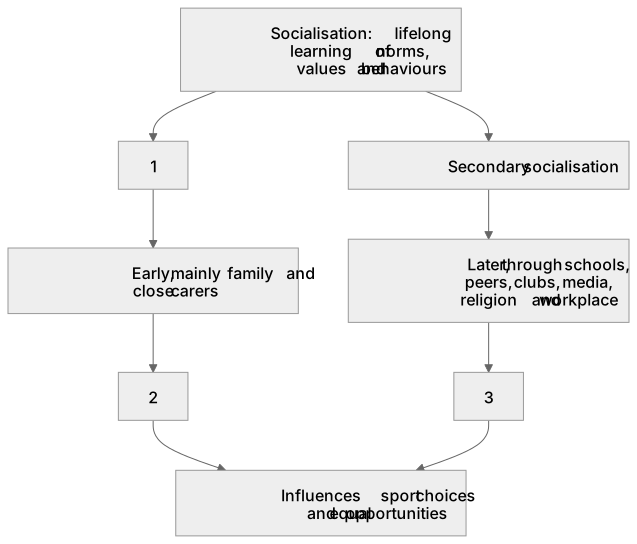
Some boxes have lost their names. Pick the right name for each number.
1Box 1
2Box 2
3Box 3
There is more to this lesson
The full lesson goes on to check your understanding and help you earn the marks. Create a free account to carry on, with your progress saved.
A week of Premium from your first lesson · Then the free plan continues · No card, no charge
Test your understanding of Sociological theory applied to equal opportunities: Socialisation (primary and secondary).
Active recall beats re-reading. Take an instant quiz now to test what you’ve learned and lock it into long-term memory.
A week of Premium from your first lesson · Then the free plan continues · No card, no charge