AQA · A-Level · Physical Education
Course version: 7582 · Version from Sept 2016
Sociological theory applied to equal opportunities: Stereotyping
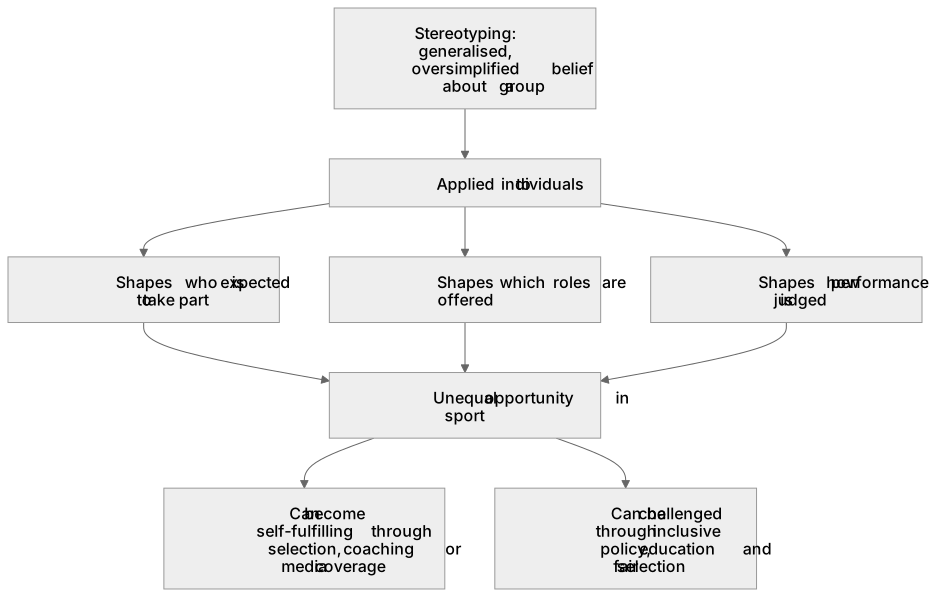
Stereotyping is a generalised, oversimplified belief about a group that is applied to individuals, often without evidence.
Checked against the AQA 7582 specification (opens in a new tab) on .
- Point 13 of 18
- 4 key terms
Study notes
From the checked teaching notes for this specification point.
The idea
Stereotyping is a generalised, oversimplified belief about a group that is applied to individuals, often without evidence. In sport it can shape who is expected to take part, which roles they are offered and how their performance is judged. For example, assuming that women are naturally less competitive in rugby, or that older adults cannot improve aerobic fitness, ignores individual variation and the social factors that affect access. Stereotypes can become self-fulfilling when they influence selection, coaching or media coverage. Sociological theory applied to equal opportunities examines how such beliefs create barriers, how they differ from prejudice and discrimination, and how sport organisations can challenge them through inclusive policy, education and fair selection.
What earns the marks
- Defines stereotyping as a generalised and oversimplified belief about a group that is applied to individuals.
- Explains that stereotypes are not necessarily negative but can still distort expectations and limit opportunity.
- Links stereotyping to unequal opportunity in sport, for example through selection, role allocation or media representation.
- Distinguishes stereotyping from prejudice and discrimination: a stereotype is a belief, prejudice is an attitude, discrimination is behaviour.
- Uses a sporting example to show how a stereotype can become self-fulfilling or can be challenged by inclusive practice.
Common mistakes and how to put them right
Treating stereotyping as identical to discrimination.
Put it right: Stereotyping is a generalised belief, while discrimination is unequal treatment or behaviour.
Assuming all stereotypes are hostile or negative.
Put it right: Stereotypes can appear positive, such as 'Asian girls are naturally flexible', but they still overgeneralise and can restrict choice.
Believing stereotypes are harmless because they are only thoughts.
Put it right: Stereotypes can influence selection, coaching, funding and media coverage, producing real barriers to equal opportunity.
Confusing stereotyping with prejudice.
Put it right: Prejudice is a preconceived attitude or feeling, whereas a stereotype is a cognitive generalisation about a group.
Exam tips
- Read the stem carefully to identify whether the question is asking about a belief, an attitude or an action before choosing an option.
- Eliminate options that describe individual ability or personal preference rather than a generalised group belief.
- Check that the chosen option explains unequal opportunity in sport, not just a general statement about society.
Try the lesson
The start of the Sociological theory applied to equal opportunities: Stereotyping lesson, made from checked teaching notes for this specification point.
Have a go first
In the sociology of sport, which term describes a widely held but oversimplified belief about the characteristics of a group of people?
Listen
Stereotyping is a generalised, oversimplified belief about a group that is applied to individuals, often without evidence. In sport it can shape who is expected to take part, which roles they are offered and how their performance is judged. For example, assuming that women are naturally less competitive in rugby, or that older adults cannot improve aerobic fitness, ignores individual variation and the social factors that affect access. Stereotypes can become self-fulfilling when they influence selection, coaching or media coverage. Sociological theory applied to equal opportunities examines how such beliefs create barriers, how they differ from prejudice and discrimination, and how sport organisations can challenge them through inclusive policy, education and fair selection. A strong answer earns marks for these points. Defines stereotyping as a generalised and oversimplified belief about a group that is applied to individuals. Explains that stereotypes are not necessarily negative but can still distort expectations and limit opportunity. Links stereotyping to unequal opportunity in sport, for example through selection, role allocation or media representation. Distinguishes stereotyping from prejudice and discrimination: a stereotype is a belief, prejudice is an attitude, discrimination is behaviour. A common slip: Treating stereotyping as identical to discrimination. Instead, stereotyping is a generalised belief, while discrimination is unequal treatment or behaviour. Exam tip: Read the stem carefully to identify whether the question is asking about a belief, an attitude or an action before choosing an option.
See it
Key words
Say what each word means before you turn the card.
Stereotyping
Try answering aloud or in your head before turning the card.
Prejudice
Try answering aloud or in your head before turning the card.
Discrimination
Try answering aloud or in your head before turning the card.
Self-fulfilling stereotype
Try answering aloud or in your head before turning the card.
See every definition
- Stereotyping
- A generalised, oversimplified belief about a group that is applied to individuals, often without evidence.
- Prejudice
- A preconceived attitude or feeling, distinguished from a stereotype, which is a cognitive generalisation about a group.
- Discrimination
- Unequal treatment or behaviour, distinguished from stereotyping, which is a generalised belief.
- Self-fulfilling stereotype
- A stereotype that becomes self-fulfilling when it influences selection, coaching or media coverage.
Label the diagram
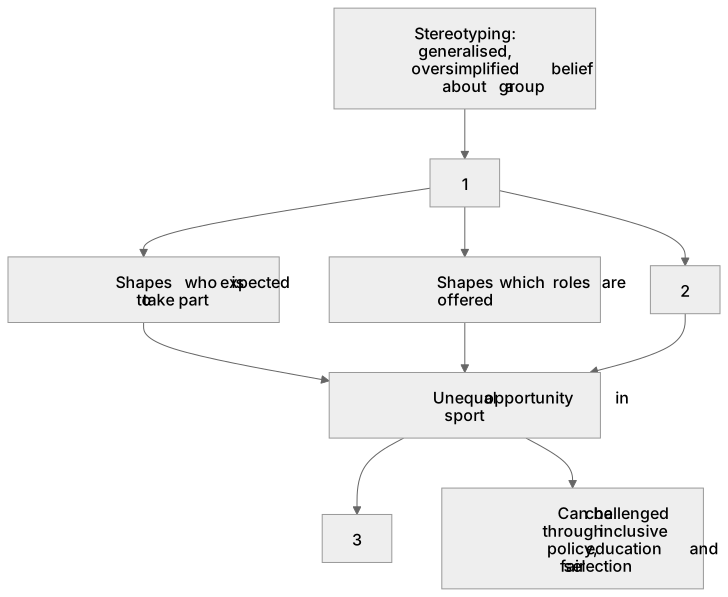
Some boxes have lost their names. Pick the right name for each number.
1Box 1
2Box 2
3Box 3
There is more to this lesson
The full lesson goes on to check your understanding and help you earn the marks. Create a free account to carry on, with your progress saved.
A week of Premium from your first lesson · Then the free plan continues · No card, no charge
Test your understanding of Sociological theory applied to equal opportunities: Stereotyping
Active recall beats re-reading. Take an instant quiz now to test what you’ve learned and lock it into long-term memory.
A week of Premium from your first lesson · Then the free plan continues · No card, no charge