AQA · A-Level · Physical Education
Course version: 7582 · Version from Sept 2016
Sociological theory applied to equal opportunities: Discrimination
Discrimination is the unequal treatment of a person or group because of a characteristic such as sex, race, disability, age, religion or social class.
Checked against the AQA 7582 specification (opens in a new tab) on .
- Point 12 of 18
- 4 key terms
Study notes
From the checked teaching notes for this specification point.
The idea
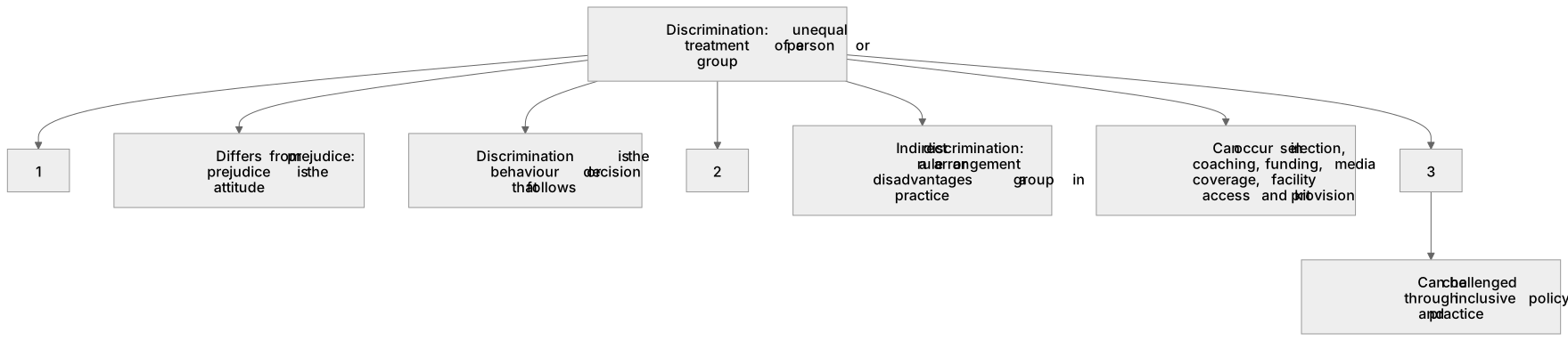
Discrimination is the unequal treatment of a person or group because of a characteristic such as sex, race, disability, age, religion or social class. It differs from prejudice, which is the attitude; discrimination is the behaviour or decision that follows. It can be direct, such as refusing a girl a place in a rugby team, or indirect, such as scheduling a disability session only at a time with no accessible transport. In physical education and sport it can occur in selection, coaching, funding, media coverage, facility access and kit provision. A useful method is to identify the decision, the characteristic it targets, and the unequal outcome it produces.
What earns the marks
- Discrimination is unequal or unfair treatment of an individual or group on the basis of a protected or social characteristic.
- Direct discrimination openly treats a group less favourably, for example excluding a performer because of their sex.
- Indirect discrimination applies a rule or arrangement that disadvantages a group in practice, even if it appears neutral.
- Discrimination in sport can occur in selection, coaching, funding, media coverage, facility access and kit provision.
- Discrimination reduces participation, progression and opportunity, and can be challenged through inclusive policy and practice.
Common mistakes and how to put them right
Using discrimination and prejudice interchangeably.
Put it right: Prejudice is the attitude, discrimination is the unequal treatment or behaviour.
Assuming discrimination must be deliberate.
Put it right: Indirect discrimination can result from a neutral-looking rule that disadvantages a group in practice.
Restricting discrimination to race or sex alone.
Put it right: It also applies to disability, age, religion and social class.
Thinking discrimination only happens at elite level.
Put it right: It can occur in school physical education, community clubs and recreational provision.
Exam tips
- Read the stem carefully to decide whether it describes an attitude, a behaviour or an outcome, then match the correct term.
- For scenario questions, name the characteristic targeted and the unequal outcome, as both are needed to justify the answer.
- Eliminate options that describe a barrier or a stereotype when the question asks specifically about discrimination.
Try the lesson
The start of the Sociological theory applied to equal opportunities: Discrimination lesson, made from checked teaching notes for this specification point.
Have a go first
In the sociology of sport, which term describes the unfair treatment of a person or group because of a characteristic such as race, gender or disability?
Listen
Discrimination is the unequal treatment of a person or group because of a characteristic such as sex, race, disability, age, religion or social class. It differs from prejudice, which is the attitude; discrimination is the behaviour or decision that follows. It can be direct, such as refusing a girl a place in a rugby team, or indirect, such as scheduling a disability session only at a time with no accessible transport. In physical education and sport it can occur in selection, coaching, funding, media coverage, facility access and kit provision. A useful method is to identify the decision, the characteristic it targets, and the unequal outcome it produces. A strong answer earns marks for these points. Discrimination is unequal or unfair treatment of an individual or group on the basis of a protected or social characteristic. Direct discrimination openly treats a group less favourably, for example excluding a performer because of their sex. Indirect discrimination applies a rule or arrangement that disadvantages a group in practice, even if it appears neutral. Discrimination in sport can occur in selection, coaching, funding, media coverage, facility access and kit provision. Exam tip: Read the stem carefully to decide whether it describes an attitude, a behaviour or an outcome, then match the correct term.
See it

Key words
Say what each word means before you turn the card.
Discrimination
Try answering aloud or in your head before turning the card.
Prejudice as attitude versus discrimination as behaviour
Try answering aloud or in your head before turning the card.
Direct and indirect discrimination
Try answering aloud or in your head before turning the card.
Discrimination in selection, funding and provision
Try answering aloud or in your head before turning the card.
See every definition
- Discrimination
- The unequal treatment of a person or group because of a characteristic such as sex, race, disability, age, religion or social class.
- Prejudice as attitude versus discrimination as behaviour
- Prejudice is the underlying attitude or belief, whereas discrimination is the behaviour or decision that follows.
- Direct and indirect discrimination
- Direct discrimination openly treats a group less favourably, while indirect discrimination applies a rule or arrangement that disadvantages a group in practice even if it appears neutral.
- Discrimination in selection, funding and provision
- Discrimination in sport can occur in selection, coaching, funding, media coverage, facility access and kit provision.
Label the diagram
Some boxes have lost their names. Pick the right name for each number.
1Box 1
2Box 2
3Box 3
There is more to this lesson
The full lesson goes on to check your understanding and help you earn the marks. Create a free account to carry on, with your progress saved.
A week of Premium from your first lesson · Then the free plan continues · No card, no charge
Test your understanding of Sociological theory applied to equal opportunities: Discrimination
Active recall beats re-reading. Take an instant quiz now to test what you’ve learned and lock it into long-term memory.
A week of Premium from your first lesson · Then the free plan continues · No card, no charge