AQA · A-Level · Physical Education
Course version: 7582 · Version from Sept 2016
Understanding of the key terms relating to the study of sport and their…
Full specification wording
Sociological theory applied to equal opportunities: Understanding of the key terms relating to the study of sport and their impact on equal opportunities in sport and society.
This topic requires defining key sociological terms and explaining their impact on equal opportunities in sport and society.
Checked against the AQA 7582 specification (opens in a new tab) on .
- Point 1 of 18
- 4 key terms
Study notes
From the checked teaching notes for this specification point.
The idea
This topic requires defining key sociological terms and explaining their impact on equal opportunities in sport and society. Society is an organised group of people associated for a specific purpose or shared interest. Socialisation is the lifelong process of learning norms, values, and roles to take a place in society. Social processes are recurring forms of social interaction, while social issues are problems affecting many people within a society. Inequality is the unfair, uneven distribution of resources or opportunities. You must link these to equal opportunities: for example, inequality in society (like lower income) impacts sport by limiting access to expensive facilities, reducing equal opportunities.
What earns the marks
- Define society as an organised group of people associated for a specific purpose or with a shared common interest.
- Define socialisation as the lifelong process of learning the norms, values, and roles of a society.
- Define social processes as recurring forms of social interaction between individuals and groups.
- Define social issues as problems affecting many people, and inequality as the uneven distribution of resources or opportunities.
- Explain the impact of these terms on equal opportunities in sport (e.g., lack of disposable income limiting club membership) and society (e.g., restricted educational opportunities).
Common mistakes and how to put them right
Confusing social issues with individual problems.
Put it right: Social issues affect large numbers of people and stem from societal structures.
Misunderstanding socialisation. Correction: it is a lifelong process of learning norms and values, not just something that happens in childhood (primary socialisation).
Confusing society with social processes.
Put it right: Society is the organised group itself, while social processes are the recurring interactions within that group.
Exam tips
- Read the stem to identify which of the specific terms (society, socialisation, social processes, social issues, inequality) is being tested.
- Look for keywords like 'lifelong process' to identify socialisation or 'uneven distribution' for inequality.
- Ensure you can distinguish between the impact of these terms on sport (e.g., participation rates) versus society (e.g., employment opportunities).
Try the lesson
The start of the Sociological theory applied to equal opportunities: Understanding of the key terms relating to the study of sport and their impact on equal opportunities in sport and society. lesson, made from checked teaching notes for this specification point.
Have a go first
In the context of sociological theory applied to sport, which of the following best defines the term 'socialisation'?
Listen
This topic requires defining key sociological terms and explaining their impact on equal opportunities in sport and society. Society is an organised group of people associated for a specific purpose or shared interest. Socialisation is the lifelong process of learning norms, values, and roles to take a place in society. Social processes are recurring forms of social interaction, while social issues are problems affecting many people within a society. Inequality is the unfair, uneven distribution of resources or opportunities. You must link these to equal opportunities: for example, inequality in society (like lower income) impacts sport by limiting access to expensive facilities, reducing equal opportunities. A strong answer earns marks for these points. Define society as an organised group of people associated for a specific purpose or with a shared common interest. Define socialisation as the lifelong process of learning the norms, values, and roles of a society. Define social processes as recurring forms of social interaction between individuals and groups. Define social issues as problems affecting many people, and inequality as the uneven distribution of resources or opportunities. A common slip: Confusing social issues with individual problems. Instead, social issues affect large numbers of people and stem from societal structures. Exam tip: Read the stem to identify which of the specific terms (society, socialisation, social processes, social issues, inequality) is being tested.
See it
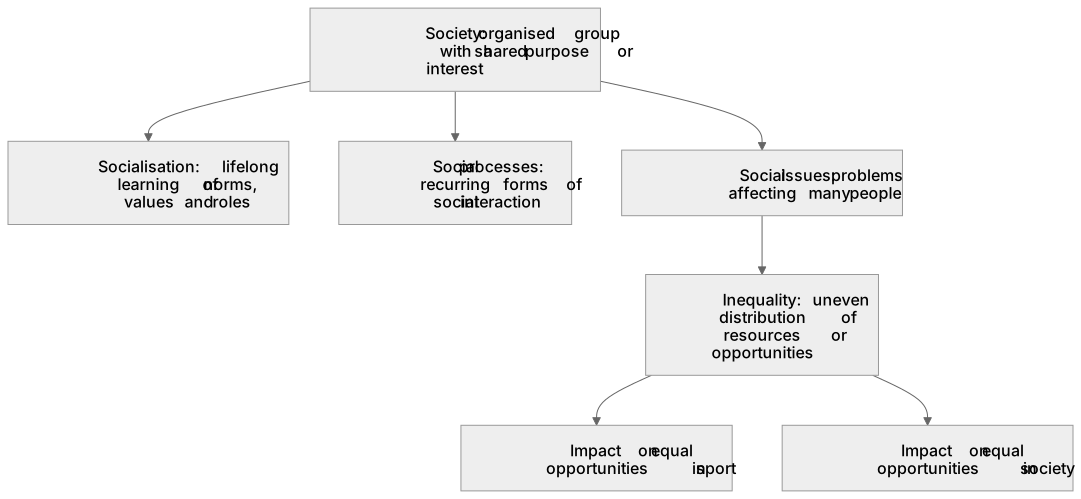
Key words
Say what each word means before you turn the card.
Society
Try answering aloud or in your head before turning the card.
Socialisation
Try answering aloud or in your head before turning the card.
Social processes
Try answering aloud or in your head before turning the card.
Inequality
Try answering aloud or in your head before turning the card.
See every definition
- Society
- An organised group of people associated for a specific purpose or with a shared common interest.
- Socialisation
- The lifelong process of learning the norms, values, and roles of a society.
- Social processes
- Recurring forms of social interaction between individuals and groups.
- Inequality
- The unfair, uneven distribution of resources or opportunities.
Label the diagram
Some boxes have lost their names. Pick the right name for each number.
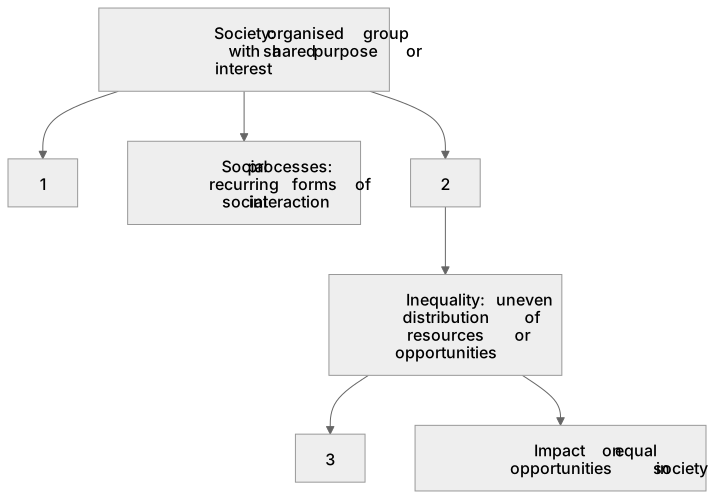
1Box 1
2Box 2
3Box 3
There is more to this lesson
The full lesson goes on to check your understanding and help you earn the marks. Create a free account to carry on, with your progress saved.
A week of Premium from your first lesson · Then the free plan continues · No card, no charge
Test your understanding of Sociological theory applied to equal opportunities: Understanding of the key terms relating to the study of sport and their impact on equal opportunities in sport and society.
Active recall beats re-reading. Take an instant quiz now to test what you’ve learned and lock it into long-term memory.
A week of Premium from your first lesson · Then the free plan continues · No card, no charge