AQA · A-Level · Physical Education
Course version: 7582 · Version from Sept 2016
Sociological theory applied to equal opportunities: Society.
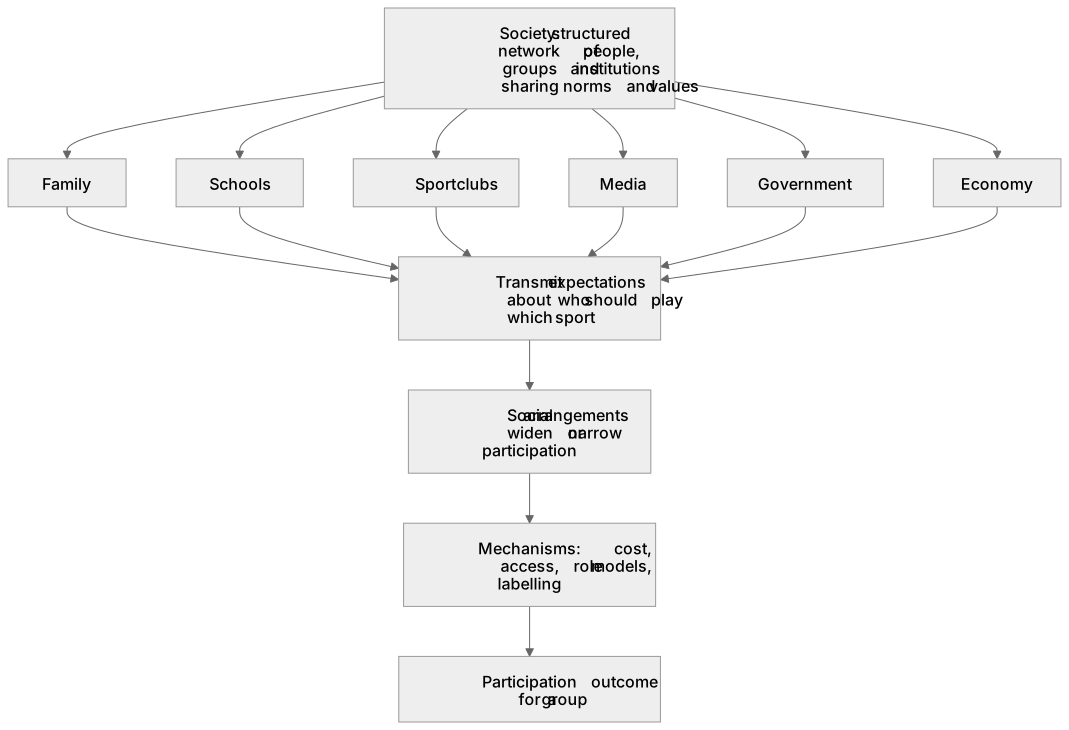
Society is the structured network of people, groups and institutions sharing norms, values and patterns of interaction.
Checked against the AQA 7582 specification (opens in a new tab) on .
- Point 2 of 18
- 4 key terms
Study notes
From the checked teaching notes for this specification point.
The idea
Society is the structured network of people, groups and institutions sharing norms, values and patterns of interaction. In AQA A-level PE, society is the context in which sport is shaped and in which equal opportunities are won or lost. You must treat society as more than a crowd: it includes families, schools, clubs, media, government and the economy, each transmitting expectations about who should play which sport. For example, a local authority may fund a leisure centre, a school may timetable rugby for boys and netball for girls, and a national governing body may target under-represented groups. These social arrangements can widen or narrow participation. When answering, link a social feature to a participation outcome, then explain the mechanism, such as cost, access, role models or labelling. This shows how society operates as a system of influence rather than a vague backdrop.
What earns the marks
- Defines society as an organised collection of people, groups and institutions sharing norms, values and patterns of interaction.
- Identifies social institutions such as family, education, sport clubs, media, government and the economy as parts of society.
- Explains that society transmits norms and values that influence which groups take part in which sports.
- Links a social factor such as cost, access, role models or labelling to a participation outcome for a named group.
- Uses a concrete example, such as local authority leisure funding or school sport provision, to show society shaping opportunity.
- Distinguishes society from a single group or crowd by referring to shared structures and expectations.
Common mistakes and how to put them right
Treating society as simply a large group of people.
Put it right: Society is a structured system of institutions, norms and values that shapes behaviour.
Listing social institutions without linking them to participation.
Put it right: Explain the mechanism, such as how media coverage creates role models that encourage or discourage a group.
Assuming equal opportunities are natural rather than socially produced.
Put it right: Show how social arrangements such as funding, timetabling or transport can create or remove barriers.
Using a single personal opinion as evidence about society.
Put it right: Refer to shared social patterns, institutions or policies that affect groups.
Exam tips
- Read the question stem carefully to identify whether it asks about society as a whole or a specific social institution.
- Eliminate options that describe an individual choice without any social or structural influence.
- When two options seem similar, choose the one that names a social structure or shared norm rather than a personal feeling.
- Check that your chosen option explains a participation outcome, not just a definition of society.
Try the lesson
The start of the Sociological theory applied to equal opportunities: Society. lesson, made from checked teaching notes for this specification point.
Have a go first
In sociology, which term describes the structured network of relationships, shared norms and institutions within which people live and interact?
Listen
Society is the structured network of people, groups and institutions sharing norms, values and patterns of interaction. In AQA A-level PE, society is the context in which sport is shaped and in which equal opportunities are won or lost. You must treat society as more than a crowd: it includes families, schools, clubs, media, government and the economy, each transmitting expectations about who should play which sport. For example, a local authority may fund a leisure centre, a school may timetable rugby for boys and netball for girls, and a national governing body may target under-represented groups. These social arrangements can widen or narrow participation. When answering, link a social feature to a participation outcome, then explain the mechanism, such as cost, access, role models or labelling. This shows how society operates as a system of influence rather than a vague backdrop. A strong answer earns marks for these points. Defines society as an organised collection of people, groups and institutions sharing norms, values and patterns of interaction. Identifies social institutions such as family, education, sport clubs, media, government and the economy as parts of society. Explains that society transmits norms and values that influence which groups take part in which sports. Links a social factor such as cost, access, role models or labelling to a participation outcome for a named group. A common slip: Treating society as simply a large group of people. Instead, society is a structured system of institutions, norms and values that shapes behaviour. Exam tip: Read the question stem carefully to identify whether it asks about society as a whole or a specific social institution.
See it
Key words
Say what each word means before you turn the card.
Society
Try answering aloud or in your head before turning the card.
Social structures and institutions
Try answering aloud or in your head before turning the card.
Norms, values and social expectations
Try answering aloud or in your head before turning the card.
Participation patterns and barriers
Try answering aloud or in your head before turning the card.
See every definition
- Society
- An organised collection of people, groups and institutions sharing norms, values and patterns of interaction.
- Social structures and institutions
- Parts of society such as family, education, sport clubs, media, government and the economy, each transmitting expectations about who should play which sport.
- Norms, values and social expectations
- Shared expectations transmitted by society that influence which groups take part in which sports.
- Participation patterns and barriers
- Social arrangements such as cost, access, role models or labelling that can widen or narrow participation for a named group.
Label the diagram
Some boxes have lost their names. Pick the right name for each number.
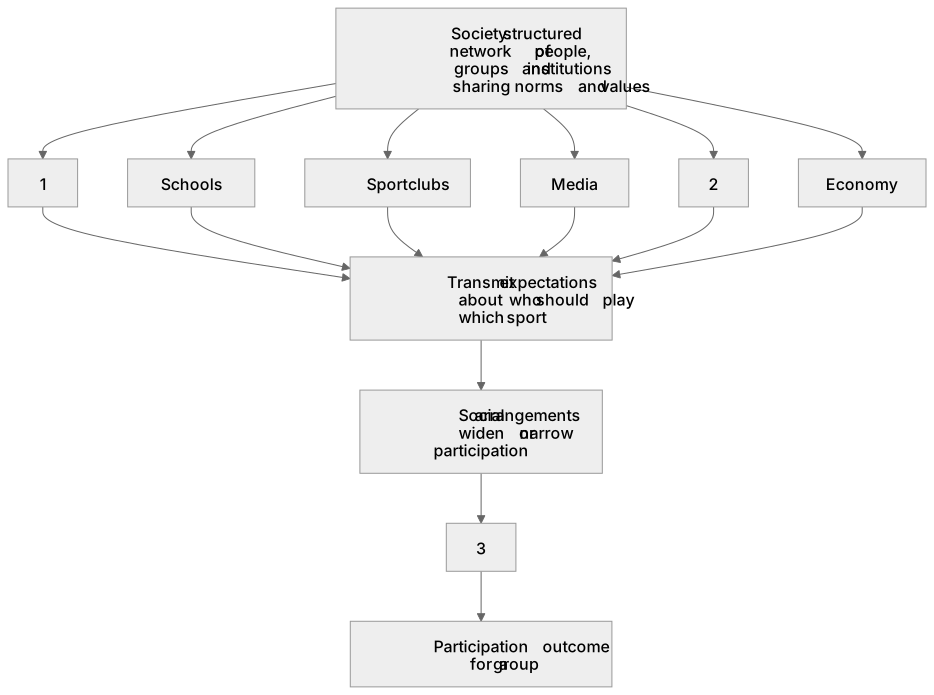
1Box 1
2Box 2
3Box 3
There is more to this lesson
The full lesson goes on to check your understanding and help you earn the marks. Create a free account to carry on, with your progress saved.
A week of Premium from your first lesson · Then the free plan continues · No card, no charge
Test your understanding of Sociological theory applied to equal opportunities: Society.
Active recall beats re-reading. Take an instant quiz now to test what you’ve learned and lock it into long-term memory.
A week of Premium from your first lesson · Then the free plan continues · No card, no charge