AQA · A-Level · Physical Education
Course version: 7582 · Version from Sept 2016
Biofeedback, centering, breathing control, progressive muscle relaxation.
Full specification wording
Stress management: Biofeedback, centering, breathing control, progressive muscle relaxation.
Four somatic techniques are named here.
Checked against the AQA 7582 specification (opens in a new tab) on .
- Point 12 of 12
- 4 key terms
Study notes
From the checked teaching notes for this specification point.
The idea
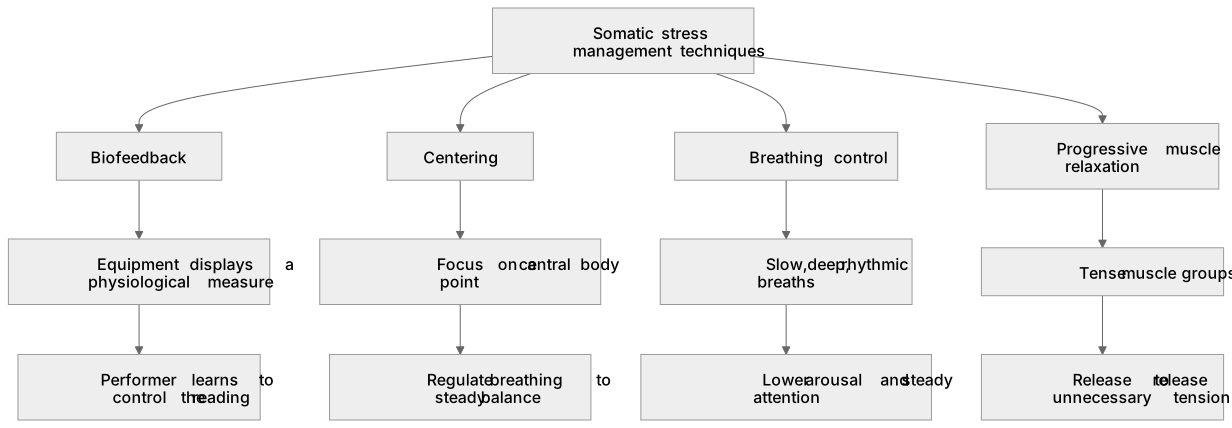
Four somatic techniques are named here. Biofeedback uses equipment to display a physiological measure such as heart rate or muscle activity, so the performer learns through feedback to bring that reading under control. Centering involves focusing attention on a point near the centre of the body, often the lower abdomen, while regulating breathing to steady balance and reduce tension before a key skill. Breathing control means using slow, deep, rhythmic breaths, often with a longer out-breath, to lower arousal and steady attention. Progressive muscle relaxation involves systematically tensing then releasing muscle groups to teach the performer to recognise and release unnecessary tension. Each technique is a physical routine that lowers excessive arousal.
What earns the marks
- Biofeedback uses equipment to display a physiological measure so the performer can learn to control it.
- Centering focuses attention on a central body point while regulating breathing to steady the performer.
- Breathing control uses slow, deep, rhythmic breathing to reduce arousal and steady attention.
- Progressive muscle relaxation involves tensing then releasing muscle groups to release unnecessary tension.
- All four are somatic because they act on the body rather than on thoughts.
- Each technique aims to bring arousal towards the optimum for the task.
Common mistakes and how to put them right
Treating biofeedback as a purely mental technique.
Put it right: It depends on equipment giving physiological feedback, so the performer learns to control a body measure.
Reversing progressive muscle relaxation.
Put it right: The sequence is to tense a muscle group and then release it, not to relax first and tense afterwards.
Confusing centering with simple distraction.
Put it right: Centering combines a focus point with controlled breathing to steady the body, not just looking away from the crowd.
Exam tips
- Match each named technique to its defining feature: equipment for biofeedback, a central focus point for centering, slow rhythmic breaths for breathing control, and tense-then-release for progressive muscle relaxation.
- Eliminate options that describe cognitive strategies such as positive self-talk or visualisation.
- Check the direction of the technique: all four aim to reduce excessive arousal, not to raise it.
Try the lesson
The start of the Stress management: Biofeedback, centering, breathing control, progressive muscle relaxation. lesson, made from checked teaching notes for this specification point.
Have a go first
Which of these is a somatic stress-management technique in which a performer learns to control a bodily response by monitoring it?
Listen
Four somatic techniques are named here. Biofeedback uses equipment to display a physiological measure such as heart rate or muscle activity, so the performer learns through feedback to bring that reading under control. Centering involves focusing attention on a point near the centre of the body, often the lower abdomen, while regulating breathing to steady balance and reduce tension before a key skill. Breathing control means using slow, deep, rhythmic breaths, often with a longer out-breath, to lower arousal and steady attention. Progressive muscle relaxation involves systematically tensing then releasing muscle groups to teach the performer to recognise and release unnecessary tension. Each technique is a physical routine that lowers excessive arousal. A strong answer earns marks for these points. Biofeedback uses equipment to display a physiological measure so the performer can learn to control it. Centering focuses attention on a central body point while regulating breathing to steady the performer. Breathing control uses slow, deep, rhythmic breathing to reduce arousal and steady attention. Progressive muscle relaxation involves tensing then releasing muscle groups to release unnecessary tension. Exam tip: Match each named technique to its defining feature: equipment for biofeedback, a central focus point for centering, slow rhythmic breaths for breathing control, and tense-then-release for progressive muscle relaxation.
See it
Key words
Say what each word means before you turn the card.
Biofeedback
Try answering aloud or in your head before turning the card.
Centering
Try answering aloud or in your head before turning the card.
Breathing control
Try answering aloud or in your head before turning the card.
Progressive muscle relaxation
Try answering aloud or in your head before turning the card.
See every definition
- Biofeedback
- Uses equipment to display a physiological measure such as heart rate or muscle activity, so the performer learns through feedback to bring that reading under control.
- Centering
- Involves focusing attention on a point near the centre of the body, often the lower abdomen, while regulating breathing to steady balance and reduce tension before a key skill.
- Breathing control
- Means using slow, deep, rhythmic breaths, often with a longer out-breath, to lower arousal and steady attention.
- Progressive muscle relaxation
- Involves systematically tensing then releasing muscle groups to teach the performer to recognise and release unnecessary tension.
Label the diagram
Some boxes have lost their names. Pick the right name for each number.
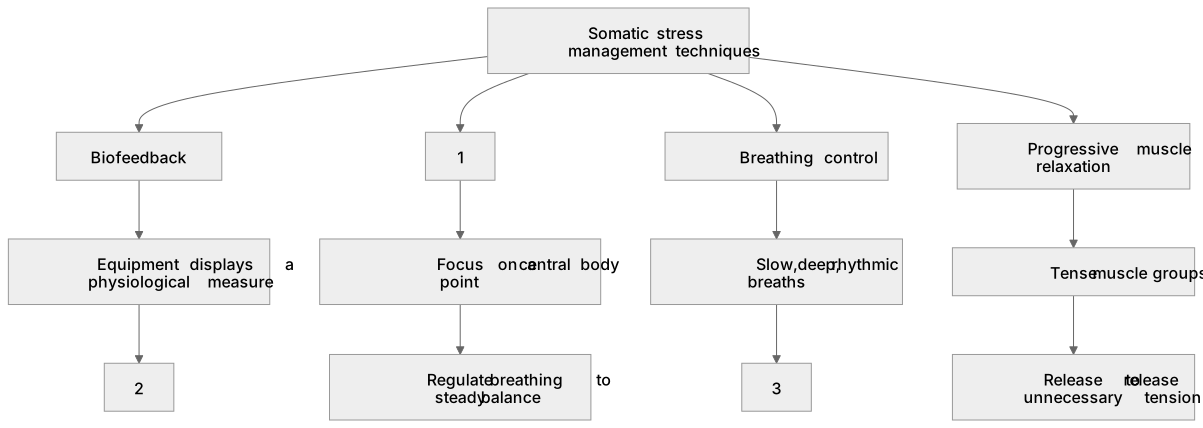
1Box 1
2Box 2
3Box 3
There is more to this lesson
The full lesson goes on to check your understanding and help you earn the marks. Create a free account to carry on, with your progress saved.
A week of Premium from your first lesson · Then the free plan continues · No card, no charge
Test your understanding of Stress management: Biofeedback, centering, breathing control, progressive muscle relaxation.
Active recall beats re-reading. Take an instant quiz now to test what you’ve learned and lock it into long-term memory.
A week of Premium from your first lesson · Then the free plan continues · No card, no charge