AQA · A-Level · Physical Education
Course version: 7582 · Version from Sept 2016
Stress management: Explanation of somatic techniques.
Somatic techniques manage stress by acting on the body rather than on thoughts.
Checked against the AQA 7582 specification (opens in a new tab) on .
- Point 11 of 12
- 4 key terms
Study notes
From the checked teaching notes for this specification point.
The idea
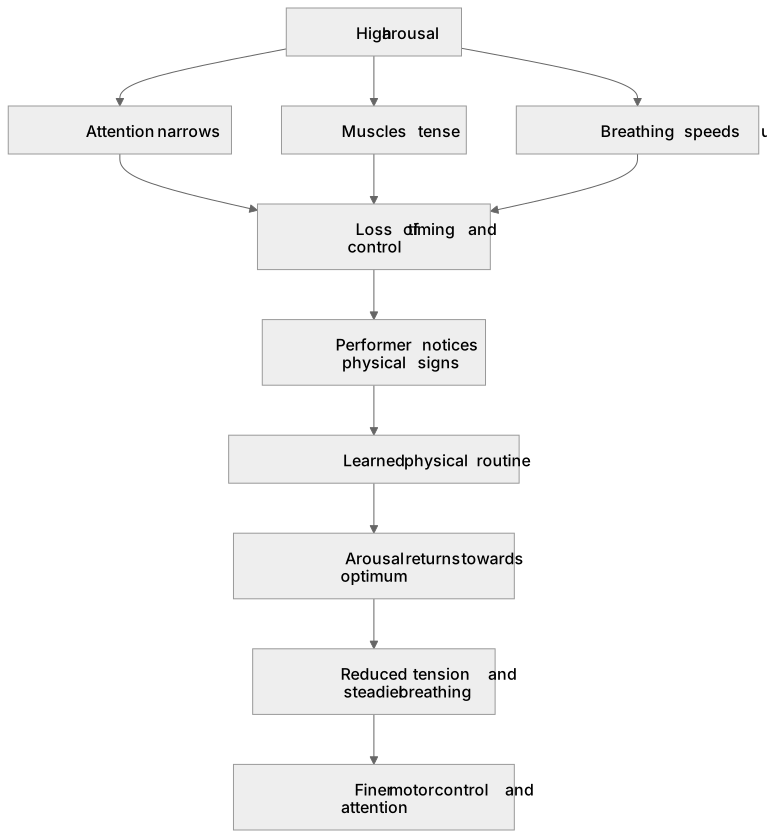
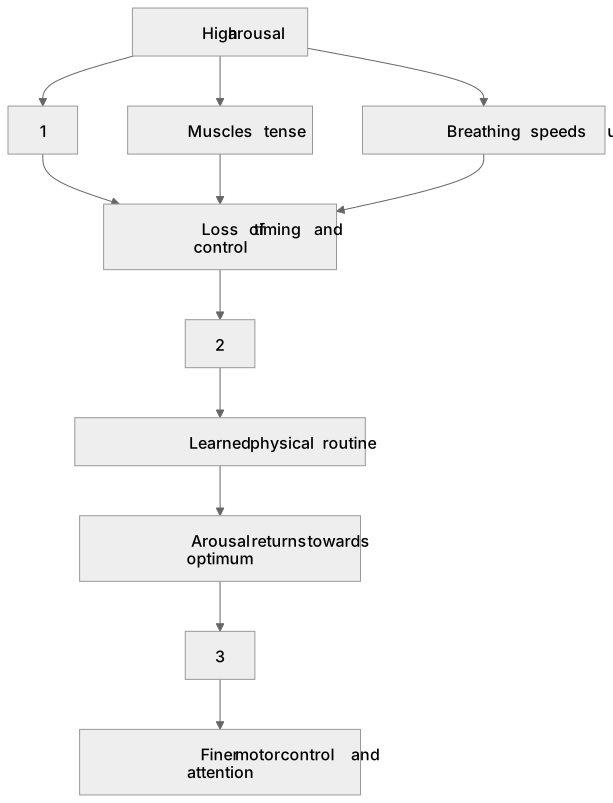
Somatic techniques manage stress by acting on the body rather than on thoughts. In sport, arousal that is too high narrows attention, tenses muscles and speeds breathing, so a performer loses timing and control. Somatic methods target these physical signs directly: the athlete learns to notice rising muscle tension, a racing heart or shallow breathing, then uses a physical routine to bring arousal back towards an optimal level for the task. The approach suits performers who find cognitive restructuring slow under pressure, because the body can be calmed in seconds. Explanation in an exam means stating what the technique is, how the performer carries it out, and why the physical change reduces felt stress and improves execution.
What earns the marks
- Somatic techniques act on physiological arousal rather than on cognitions or self-talk.
- Physical signs targeted include muscle tension, breathing rate and heart rate.
- The performer uses a learned physical routine, often before or during performance.
- Reduced tension and steadier breathing support finer motor control and attention.
- Explanation should link the technique to its effect on performance, not just name it.
Common mistakes and how to put them right
Confusing somatic with cognitive techniques.
Put it right: Somatic work changes the body, while cognitive work changes thoughts, so keep the two categories separate.
Assuming lower arousal is always better.
Put it right: Each skill has its own optimum, so a power athlete may need arousal maintained rather than reduced.
Describing a technique without explaining its effect.
Put it right: An explanation must connect the physical routine to reduced tension and improved control.
Exam tips
- Read the stem carefully to check whether it asks for a somatic or a cognitive technique before choosing.
- Reject options that describe self-talk, imagery or thought stopping, because these are cognitive rather than somatic.
- Where two options look similar, choose the one describing a physical routine acting on the body.
Try the lesson
The start of the Stress management: Explanation of somatic techniques. lesson, made from checked teaching notes for this specification point.
Have a go first
Which description best explains what a somatic technique for stress management involves?
Listen
Somatic techniques manage stress by acting on the body rather than on thoughts. In sport, arousal that is too high narrows attention, tenses muscles and speeds breathing, so a performer loses timing and control. Somatic methods target these physical signs directly: the athlete learns to notice rising muscle tension, a racing heart or shallow breathing, then uses a physical routine to bring arousal back towards an optimal level for the task. The approach suits performers who find cognitive restructuring slow under pressure, because the body can be calmed in seconds. Explanation in an exam means stating what the technique is, how the performer carries it out, and why the physical change reduces felt stress and improves execution. A strong answer earns marks for these points. Somatic techniques act on physiological arousal rather than on cognitions or self-talk. Physical signs targeted include muscle tension, breathing rate and heart rate. The performer uses a learned physical routine, often before or during performance. Reduced tension and steadier breathing support finer motor control and attention. Exam tip: Read the stem carefully to check whether it asks for a somatic or a cognitive technique before choosing.
See it
Key words
Say what each word means before you turn the card.
Somatic techniques
Try answering aloud or in your head before turning the card.
Optimal level
Try answering aloud or in your head before turning the card.
Physical routine
Try answering aloud or in your head before turning the card.
Explanation
Try answering aloud or in your head before turning the card.
See every definition
- Somatic techniques
- Body-based stress management methods that act on physiological arousal rather than on cognitions or self-talk.
- Optimal level
- An individual's best level of arousal for the task, towards which excessive arousal is lowered.
- Physical routine
- A learned physical action the performer uses, often before or during performance, to bring arousal back towards an optimal level.
- Explanation
- Stating what the technique is, how the performer carries it out, and why the physical change reduces felt stress and improves execution.
Label the diagram
Some boxes have lost their names. Pick the right name for each number.
1Box 1
2Box 2
3Box 3
There is more to this lesson
The full lesson goes on to check your understanding and help you earn the marks. Create a free account to carry on, with your progress saved.
A week of Premium from your first lesson · Then the free plan continues · No card, no charge
Test your understanding of Stress management: Explanation of somatic techniques.
Active recall beats re-reading. Take an instant quiz now to test what you’ve learned and lock it into long-term memory.
A week of Premium from your first lesson · Then the free plan continues · No card, no charge