AQA · A-Level · Physical Education
Course version: 7582 · Version from Sept 2016
Stress management: Explanation of cognitive techniques.
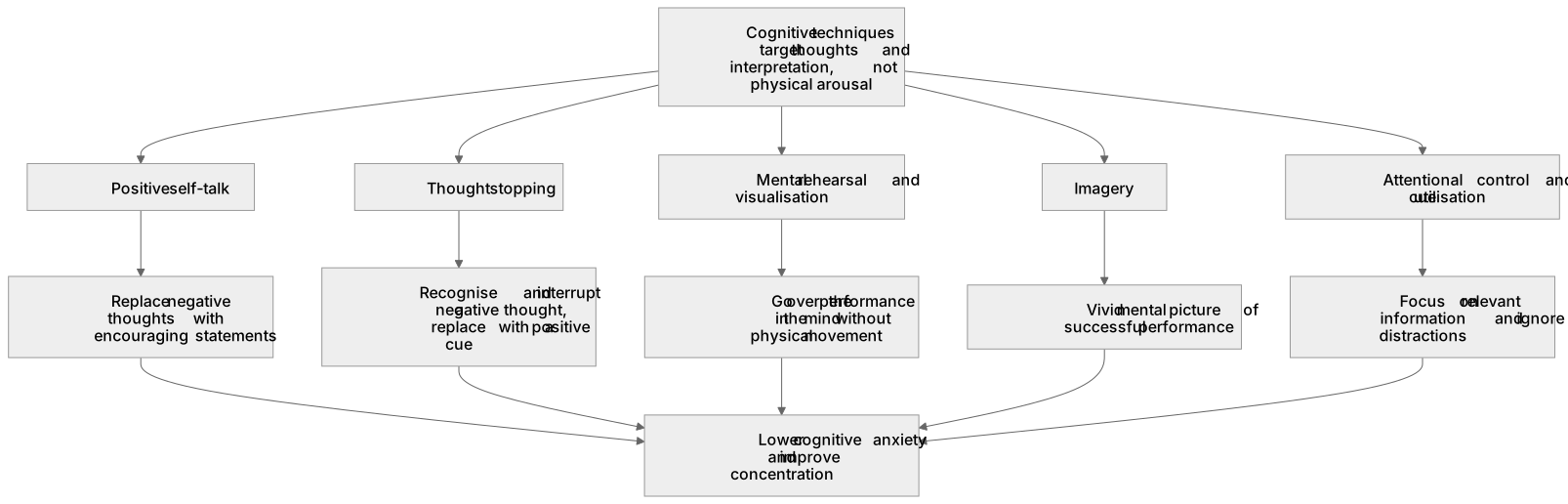
Cognitive techniques target the performer's thoughts and interpretation of a stressful situation rather than the body's physical arousal.
Checked against the AQA 7582 specification (opens in a new tab) on .
- Point 4 of 12
- 4 key terms
Study notes
From the checked teaching notes for this specification point.
The idea
Cognitive techniques target the performer's thoughts and interpretation of a stressful situation rather than the body's physical arousal. Positive self-talk replaces negative thoughts with encouraging statements. Thought stopping involves recognising and interrupting a negative thought, replacing it with a positive cue. Mental rehearsal and visualisation involve going over the performance in the mind without physical movement. Imagery creates a vivid mental picture of successful performance, building confidence. Attentional control and cue utilisation help the performer focus on relevant information and ignore distractions. These techniques lower cognitive anxiety and help the performer concentrate, often developed through a psychological skills training programme.
What earns the marks
- Cognitive techniques change thoughts and interpretation of a stressful situation rather than physiological arousal.
- Positive self-talk uses encouraging statements to replace negative thoughts, raising confidence and focus.
- Thought stopping involves recognising a negative thought, interrupting it and replacing it with a positive cue.
- Mental rehearsal and visualisation involve mentally practising a skill or movement without physical execution to improve focus and confidence.
- Imagery creates a vivid mental picture of successful performance, improving confidence and cue selection.
- Attentional control and cue utilisation direct focus towards task-relevant information and away from distractions.
Common mistakes and how to put them right
Describing cognitive techniques as directly lowering heart rate or muscle tension.
Put it right: That is the role of somatic techniques such as breathing control.
Confusing thought stopping with simply ignoring a problem.
Put it right: The negative thought must be actively recognised, interrupted and replaced with a positive cue.
Treating imagery, mental rehearsal and visualisation as daydreaming.
Put it right: Effective cognitive techniques are vivid, controlled and practised, focusing on successful execution.
Exam tips
- Name the technique, then explain the mental process it changes, for example self-talk replacing negative thoughts with encouraging cues.
- Use a sporting example to show understanding, such as a gymnast using mental rehearsal to go over a routine before competing.
- Distinguish cognitive from somatic techniques clearly so your explanation matches the category asked for.
Try the lesson
The start of the Stress management: Explanation of cognitive techniques. lesson, made from checked teaching notes for this specification point.
Have a go first
Which description explains the cognitive technique of positive self-talk?
Listen
Cognitive techniques target the performer's thoughts and interpretation of a stressful situation rather than the body's physical arousal. Positive self-talk replaces negative thoughts with encouraging statements. Thought stopping involves recognising and interrupting a negative thought, replacing it with a positive cue. Mental rehearsal and visualisation involve going over the performance in the mind without physical movement. Imagery creates a vivid mental picture of successful performance, building confidence. Attentional control and cue utilisation help the performer focus on relevant information and ignore distractions. These techniques lower cognitive anxiety and help the performer concentrate, often developed through a psychological skills training programme. A strong answer earns marks for these points. Cognitive techniques change thoughts and interpretation of a stressful situation rather than physiological arousal. Positive self-talk uses encouraging statements to replace negative thoughts, raising confidence and focus. Thought stopping involves recognising a negative thought, interrupting it and replacing it with a positive cue. Mental rehearsal and visualisation involve mentally practising a skill or movement without physical execution to improve focus and confidence. Exam tip: Name the technique, then explain the mental process it changes, for example self-talk replacing negative thoughts with encouraging cues.
See it
Key words
Say what each word means before you turn the card.
Thought control and self-talk
Try answering aloud or in your head before turning the card.
Mental rehearsal, visualisation and imagery
Try answering aloud or in your head before turning the card.
Attentional control and cue utilisation
Try answering aloud or in your head before turning the card.
Psychological skills training
Try answering aloud or in your head before turning the card.
See every definition
- Thought control and self-talk
- Positive self-talk uses encouraging statements to replace negative thoughts, raising confidence and focus, while thought stopping involves recognising a negative thought, interrupting it and replacing it with a positive cue.
- Mental rehearsal, visualisation and imagery
- Going over the performance in the mind without physical movement, or creating a vivid mental picture of successful performance, to improve focus and confidence.
- Attentional control and cue utilisation
- Directing focus towards task-relevant information and away from distractions.
- Psychological skills training
- A programme through which these techniques are often developed to lower cognitive anxiety and help the performer concentrate.
Label the diagram
Some boxes have lost their names. Pick the right name for each number.
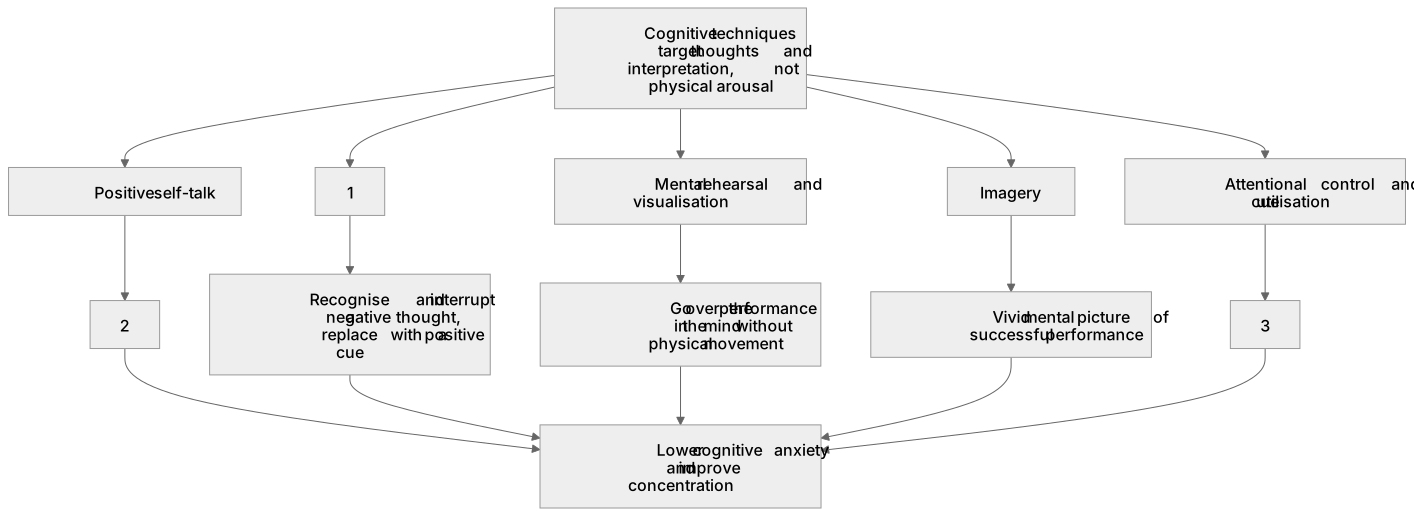
1Box 1
2Box 2
3Box 3
There is more to this lesson
The full lesson goes on to check your understanding and help you earn the marks. Create a free account to carry on, with your progress saved.
A week of Premium from your first lesson · Then the free plan continues · No card, no charge
Test your understanding of Stress management: Explanation of cognitive techniques.
Active recall beats re-reading. Take an instant quiz now to test what you’ve learned and lock it into long-term memory.
A week of Premium from your first lesson · Then the free plan continues · No card, no charge