AQA · A-Level · Physical Education
Course version: 7582 · Version from Sept 2016
Stress management: Explanation of the terms ‘stress’ and ‘stressor’.
Stress is the body's and mind's response to a demand that is perceived as threatening or beyond current coping resources; it is the internal reaction, shown through raised arousal, muscular…
Checked against the AQA 7582 specification (opens in a new tab) on .
- Point 1 of 12
- 3 key terms
Study notes
From the checked teaching notes for this specification point.
The idea
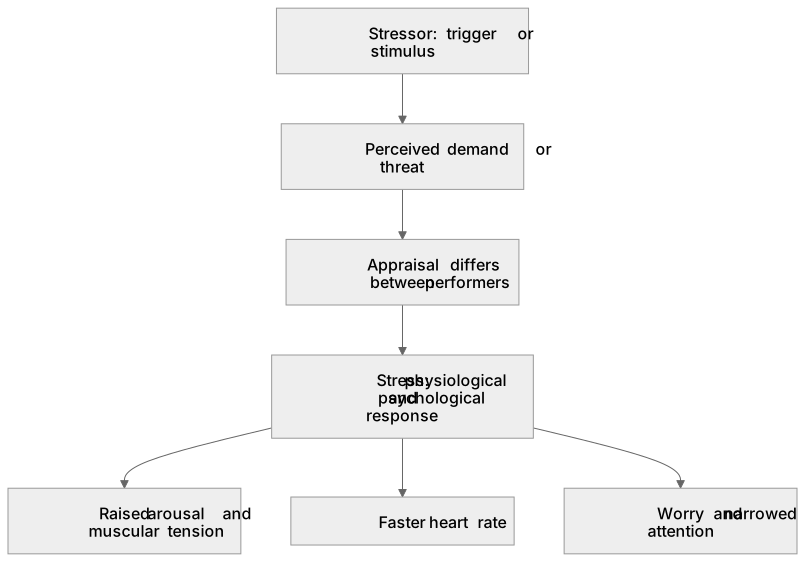
Stress is the body's and mind's response to a demand that is perceived as threatening or beyond current coping resources; it is the internal reaction, shown through raised arousal, muscular tension, faster heart rate, worry or narrowed attention. A stressor is the external or internal trigger that produces that response, such as a penalty in the final minute, a large crowd, a coach's criticism, an injury worry or a heavy training load. The two terms are therefore linked but distinct: the stressor is the cause, stress is the effect. In sport, a performer may face the same stressor as a team-mate yet experience different stress because perception and appraisal differ. Recognising which term applies helps a student analyse a scenario and select an appropriate management technique.
What earns the marks
- Stress is the individual's physiological and psychological response to a perceived demand or threat.
- A stressor is the trigger or stimulus that causes the stress response.
- Stressors may be environmental, such as crowd noise or an opponent, or internal, such as worry about selection.
- The same stressor can produce different levels of stress in different performers because appraisal differs.
- Stress can be described through symptoms such as increased heart rate, muscular tension, anxiety and narrowed concentration.
- Correctly distinguishing cause (stressor) from effect (stress) is the key discriminator in a scenario question.
Common mistakes and how to put them right
Treating stress and stressor as interchangeable.
Put it right: The stressor is the trigger, while stress is the response it produces.
Assuming a stressor always causes harmful stress.
Put it right: Some performers appraise a demanding situation as a challenge and perform well.
Describing only physical symptoms.
Put it right: Stress also includes cognitive and emotional responses such as worry and loss of focus.
Believing stress is always negative.
Put it right: Moderate arousal can aid performance, so the term describes a response rather than a fixed outcome.
Exam tips
- Read the scenario and label the trigger first, then label the reaction, so the two terms cannot be confused.
- Use precise vocabulary such as perceived demand, appraisal, arousal and trigger rather than vague words like pressure.
- When a question gives a sporting example, state which element is the stressor and which is the stress before explaining the link.
Try the lesson
The start of the Stress management: Explanation of the terms ‘stress’ and ‘stressor’. lesson, made from checked teaching notes for this specification point.
Have a go first
In sport psychology, which term describes the external demand or situation that triggers a performer's stress response?
Listen
Stress is the body's and mind's response to a demand that is perceived as threatening or beyond current coping resources; it is the internal reaction, shown through raised arousal, muscular tension, faster heart rate, worry or narrowed attention. A stressor is the external or internal trigger that produces that response, such as a penalty in the final minute, a large crowd, a coach's criticism, an injury worry or a heavy training load. The two terms are therefore linked but distinct: the stressor is the cause, stress is the effect. In sport, a performer may face the same stressor as a team-mate yet experience different stress because perception and appraisal differ. Recognising which term applies helps a student analyse a scenario and select an appropriate management technique. A strong answer earns marks for these points. Stress is the individual's physiological and psychological response to a perceived demand or threat. A stressor is the trigger or stimulus that causes the stress response. Stressors may be environmental, such as crowd noise or an opponent, or internal, such as worry about selection. The same stressor can produce different levels of stress in different performers because appraisal differs. Exam tip: Read the scenario and label the trigger first, then label the reaction, so the two terms cannot be confused.
See it
Key words
Say what each word means before you turn the card.
Stress
Try answering aloud or in your head before turning the card.
Stressor
Try answering aloud or in your head before turning the card.
Appraisal
Try answering aloud or in your head before turning the card.
See every definition
- Stress
- The body's and mind's response to a demand that is perceived as threatening or beyond current coping resources, shown through raised arousal, muscular tension, faster heart rate, worry or narrowed attention.
- Stressor
- The external or internal trigger that produces the stress response, such as a penalty in the final minute, a large crowd, a coach's criticism, an injury worry or a heavy training load.
- Appraisal
- The perception of a demand that differs between performers, so a performer may face the same stressor as a team-mate yet experience different stress.
Label the diagram
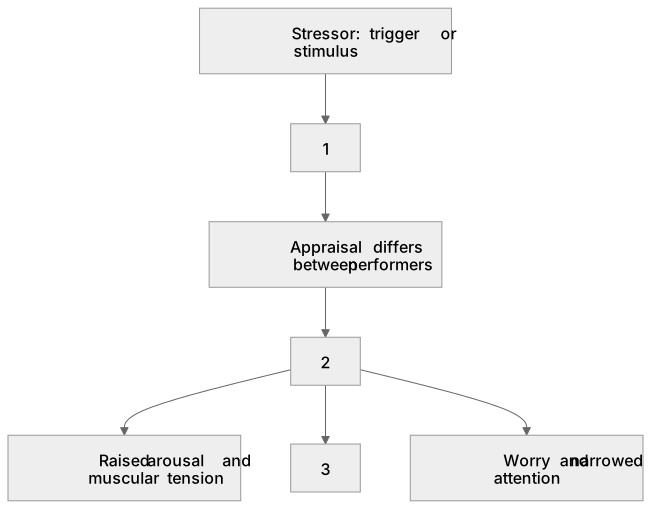
Some boxes have lost their names. Pick the right name for each number.
1Box 1
2Box 2
3Box 3
There is more to this lesson
The full lesson goes on to check your understanding and help you earn the marks. Create a free account to carry on, with your progress saved.
A week of Premium from your first lesson · Then the free plan continues · No card, no charge
Test your understanding of Stress management: Explanation of the terms ‘stress’ and ‘stressor’.
Active recall beats re-reading. Take an instant quiz now to test what you’ve learned and lock it into long-term memory.
A week of Premium from your first lesson · Then the free plan continues · No card, no charge