AQA · A-Level · Physical Education
Course version: 7582 · Version from Sept 2016
Stress management: Visualisation.
Visualisation is a cognitive stress-management technique closely related to mental rehearsal.
Checked against the AQA 7582 specification (opens in a new tab) on .
- Point 6 of 12
Study notes
From the checked teaching notes for this specification point.
The idea
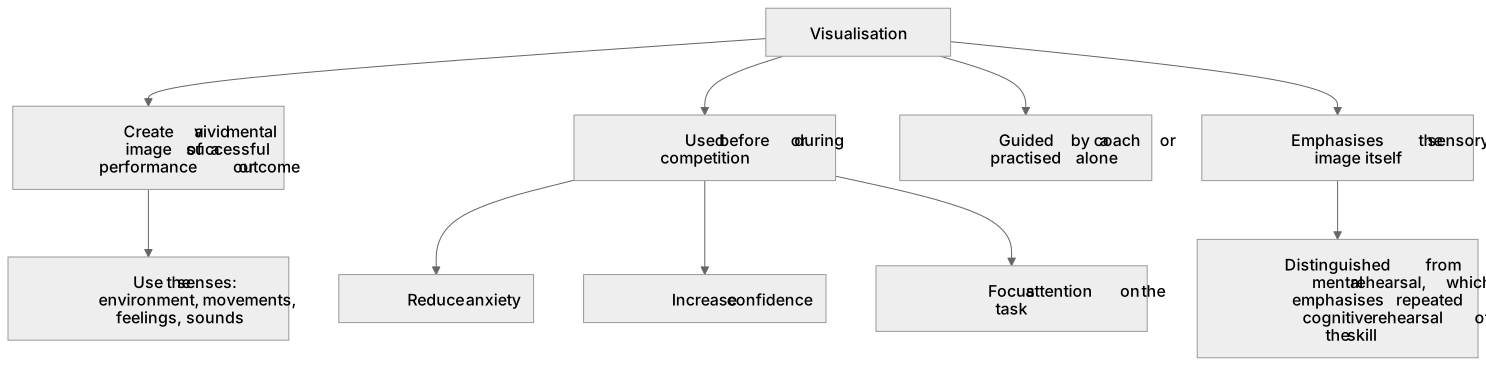
Visualisation is a cognitive stress-management technique closely related to mental rehearsal. It involves creating a vivid mental image of a successful performance or outcome, often using all the senses. The performer may visualise the environment, the movements, the feelings and the sounds associated with success. Visualisation can be used before or during competition to reduce anxiety, increase confidence and focus attention on the task. For example, a tennis player may visualise serving an ace before a crucial point. It can be guided by a coach or practised alone. While the terms are sometimes used interchangeably, visualisation often emphasises the sensory image itself, whereas mental rehearsal emphasises the repeated cognitive rehearsal of the skill.
What earns the marks
- Defines visualisation as creating a vivid mental image of a successful performance or outcome.
- States that it involves using the senses to make the image realistic.
- Explains that it can reduce anxiety by promoting positive expectations and reducing negative thoughts.
- Identifies that it can improve confidence, focus and motivation.
- Recognises that it can be used before or during performance and may be guided or self-directed.
Common mistakes and how to put them right
Treating visualisation as identical to mental rehearsal.
Put it right: Visualisation emphasises the sensory image, while mental rehearsal emphasises repeated cognitive rehearsal of the skill.
Thinking visualisation only involves seeing.
Put it right: It should engage multiple senses such as hearing, feeling and even smell.
Assuming visualisation is only for outcome (e.g., winning).
Put it right: It can also focus on process (e.g., technique) and is often more effective when process-oriented.
Believing visualisation is a quick fix.
Put it right: It requires regular practice to be effective.
Exam tips
- If a question asks for a definition, include the idea of creating a mental image of success using the senses.
- When distinguishing visualisation from mental rehearsal, focus on the emphasis on sensory imagery versus repeated cognitive rehearsal.
- Link visualisation to stress management by explaining how it can replace negative thoughts with positive images.
Try the lesson
The start of the Stress management: Visualisation. lesson, made from checked teaching notes for this specification point.
Have a go first
In stress management for sport, what does visualisation involve?
Listen
Visualisation is a cognitive stress-management technique closely related to mental rehearsal. It involves creating a vivid mental image of a successful performance or outcome, often using all the senses. The performer may visualise the environment, the movements, the feelings and the sounds associated with success. Visualisation can be used before or during competition to reduce anxiety, increase confidence and focus attention on the task. For example, a tennis player may visualise serving an ace before a crucial point. It can be guided by a coach or practised alone. While the terms are sometimes used interchangeably, visualisation often emphasises the sensory image itself, whereas mental rehearsal emphasises the repeated cognitive rehearsal of the skill. A strong answer earns marks for these points. Defines visualisation as creating a vivid mental image of a successful performance or outcome. States that it involves using the senses to make the image realistic. Explains that it can reduce anxiety by promoting positive expectations and reducing negative thoughts. Identifies that it can improve confidence, focus and motivation. A common slip: Treating visualisation as identical to mental rehearsal. Instead, visualisation emphasises the sensory image, while mental rehearsal emphasises repeated cognitive rehearsal of the skill. Exam tip: If a question asks for a definition, include the idea of creating a mental image of success using the senses.
See it
Label the diagram
Some boxes have lost their names. Pick the right name for each number.
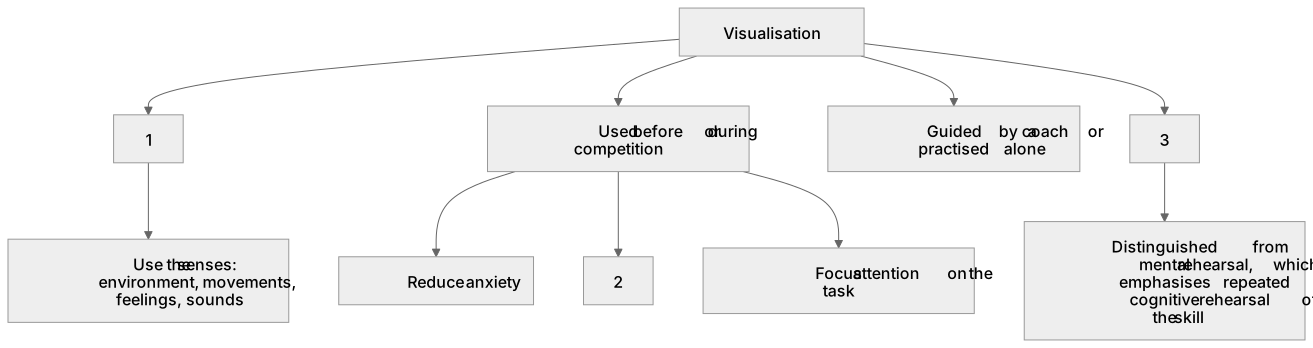
1Box 1
2Box 2
3Box 3
There is more to this lesson
The full lesson goes on to check your understanding and help you earn the marks. Create a free account to carry on, with your progress saved.
A week of Premium from your first lesson · Then the free plan continues · No card, no charge
Test your understanding of Stress management: Visualisation.
Active recall beats re-reading. Take an instant quiz now to test what you’ve learned and lock it into long-term memory.
A week of Premium from your first lesson · Then the free plan continues · No card, no charge