AQA · A-Level · Physical Education
Course version: 7582 · Version from Sept 2016
Stress management: Imagery.
Imagery is a psychological skill in which a performer creates or recreates a sporting experience in the mind using the senses, so the brain rehearses the movement or situation without physically…
Checked against the AQA 7582 specification (opens in a new tab) on .
- Point 7 of 12
- 4 key terms
Study notes
From the checked teaching notes for this specification point.
The idea
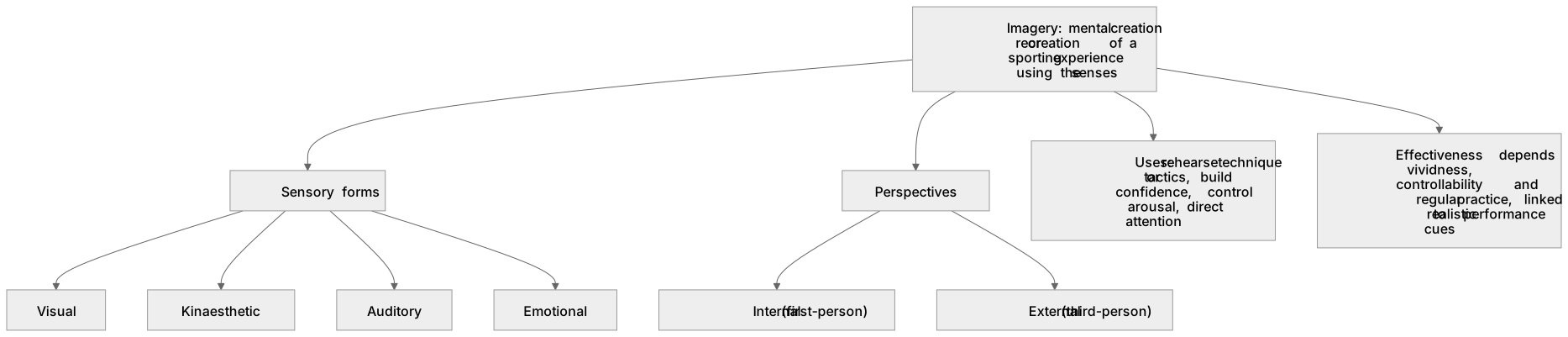
Imagery is a psychological skill in which a performer creates or recreates a sporting experience in the mind using the senses, so the brain rehearses the movement or situation without physically performing it. A gymnast might picture a vault routine from a first-person view, feeling the run-up, the spring off the board and the landing, or from an external view, watching themselves as if on video. Imagery can be visual, kinaesthetic, auditory or emotional, and it is used to build confidence, control arousal, focus attention and rehearse technique or tactics. Its effectiveness depends on vividness, controllability and practice, and it is most useful when combined with realistic cues from the actual performance environment.
What earns the marks
- Imagery is the mental creation or recreation of a sporting experience using the senses.
- Performers use imagery to rehearse technique or tactics, build confidence, control arousal and direct attention.
- Effectiveness depends on vividness, controllability and regular practice, ideally linked to realistic performance cues.
- Imagery is a cognitive stress-management and mental-rehearsal technique, not simply daydreaming or positive thinking.
Common mistakes and how to put them right
Thinking imagery is only visual.
Put it right: It also includes kinaesthetic, auditory and emotional sensations, so a performer should feel the movement as well as see it.
Confusing imagery with positive self-talk.
Put it right: Self-talk uses words and phrases, whereas imagery recreates a sensory experience of the skill or situation.
Assuming imagery works instantly.
Put it right: It needs regular, structured practice with vivid and controllable images to influence performance.
Believing imagery must always be first-person.
Put it right: External imagery, watching yourself as if on video, is also valid and useful for some skills.
Exam tips
- Define imagery precisely, then give a named sporting example showing the sense or perspective used.
- Link imagery to a specific benefit such as confidence, arousal control or technique rehearsal rather than listing benefits vaguely.
- Use correct terminology such as vividness, controllability, internal and external imagery to show precise understanding.
Try the lesson
The start of the Stress management: Imagery. lesson, made from checked teaching notes for this specification point.
Have a go first
In psychological skills training, what is meant by the term imagery?
Listen
Imagery is a psychological skill in which a performer creates or recreates a sporting experience in the mind using the senses, so the brain rehearses the movement or situation without physically performing it. A gymnast might picture a vault routine from a first-person view, feeling the run-up, the spring off the board and the landing, or from an external view, watching themselves as if on video. Imagery can be visual, kinaesthetic, auditory or emotional, and it is used to build confidence, control arousal, focus attention and rehearse technique or tactics. Its effectiveness depends on vividness, controllability and practice, and it is most useful when combined with realistic cues from the actual performance environment. A strong answer earns marks for these points. Imagery is the mental creation or recreation of a sporting experience using the senses. Performers use imagery to rehearse technique or tactics, build confidence, control arousal and direct attention. Effectiveness depends on vividness, controllability and regular practice, ideally linked to realistic performance cues. Imagery is a cognitive stress-management and mental-rehearsal technique, not simply daydreaming or positive thinking. Exam tip: Define imagery precisely, then give a named sporting example showing the sense or perspective used.
See it
Key words
Say what each word means before you turn the card.
Imagery
Try answering aloud or in your head before turning the card.
Sensory and perspective dimensions of imagery
Try answering aloud or in your head before turning the card.
Mental rehearsal of technique and tactics
Try answering aloud or in your head before turning the card.
Confidence, arousal control and attention
Try answering aloud or in your head before turning the card.
See every definition
- Imagery
- A psychological skill in which a performer creates or recreates a sporting experience in the mind using the senses, so the brain rehearses the movement or situation without physically performing it.
- Sensory and perspective dimensions of imagery
- Imagery can be visual, kinaesthetic, auditory or emotional, and may be internal (first-person) or external (third-person).
- Mental rehearsal of technique and tactics
- Performers use imagery to rehearse technique or tactics, build confidence, control arousal and direct attention.
- Confidence, arousal control and attention
- Performers use imagery to rehearse technique or tactics, build confidence, control arousal and direct attention.
Label the diagram
Some boxes have lost their names. Pick the right name for each number.
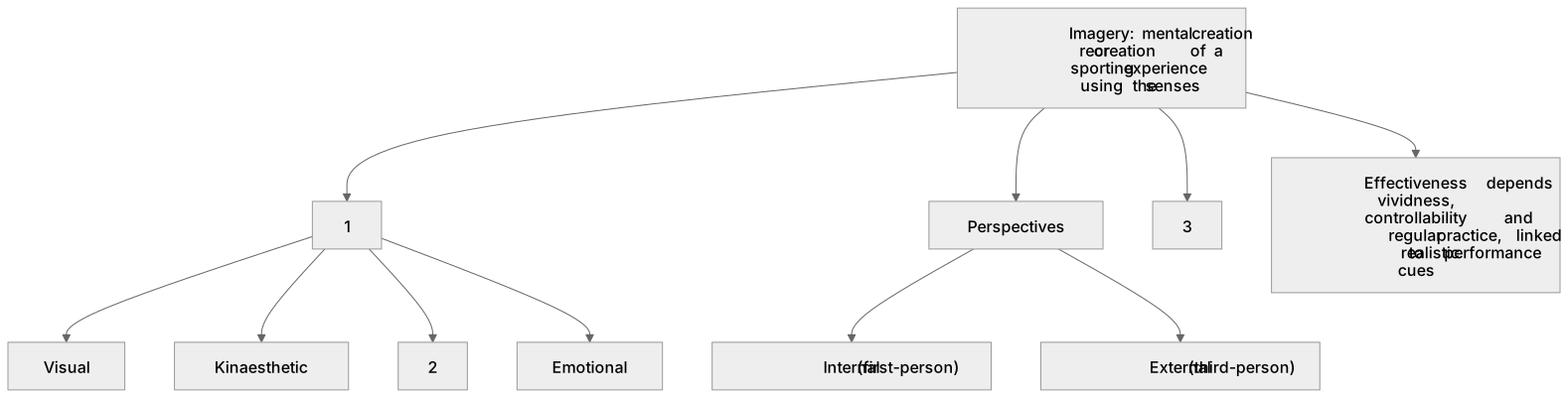
1Box 1
2Box 2
3Box 3
There is more to this lesson
The full lesson goes on to check your understanding and help you earn the marks. Create a free account to carry on, with your progress saved.
A week of Premium from your first lesson · Then the free plan continues · No card, no charge
Test your understanding of Stress management: Imagery.
Active recall beats re-reading. Take an instant quiz now to test what you’ve learned and lock it into long-term memory.
A week of Premium from your first lesson · Then the free plan continues · No card, no charge