AQA · A-Level · Physical Education
Course version: 7582 · Version from Sept 2016
Joint actions in the frontal plane/sagittal axis.
Full specification wording
The musculo-skeletal system and analysis of movement in physical activities: Joint actions in the frontal plane/sagittal axis.
A plane is an imaginary flat surface through which a body part moves, and an axis is the line about which that rotation occurs.
Checked against the AQA 7582 specification (opens in a new tab) on .
- Point 5 of 10
- 4 key terms
Study notes
From the checked teaching notes for this specification point.
The idea
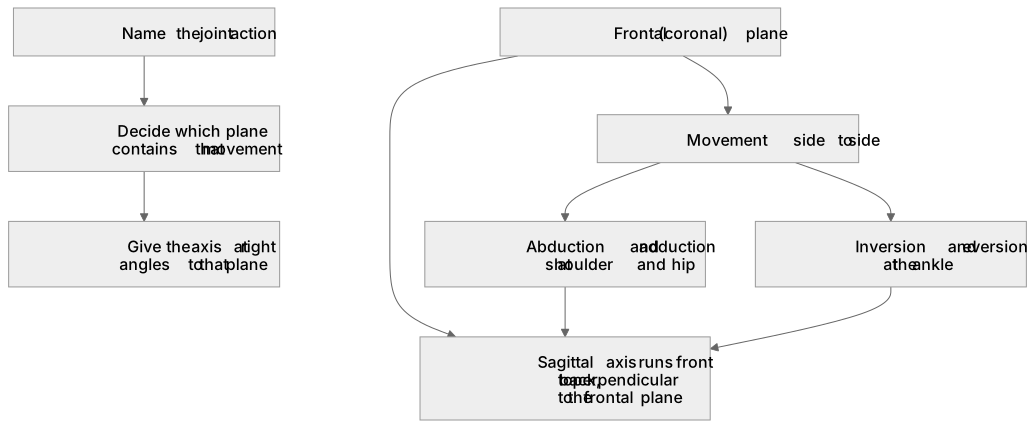
A plane is an imaginary flat surface through which a body part moves, and an axis is the line about which that rotation occurs. In the frontal (coronal) plane, movement happens side to side, and the axis perpendicular to that plane is the sagittal axis, which runs front to back through the body. So abduction and adduction of the shoulder or hip, and inversion and eversion at the ankle, are frontal-plane actions about the sagittal axis. Picture a gymnast raising the arms sideways to a T shape: the arms travel in the frontal plane, rotating about the sagittal axis. To analyse a skill, first name the joint action, then decide which plane contains that movement, then give the axis at right angles to that plane.
What earns the marks
- A plane is an imaginary flat surface through which a body part moves; an axis is the line about which rotation occurs.
- The frontal (coronal) plane divides the body into front and back portions, and movement within it occurs side to side.
- The sagittal axis runs front to back through the body and lies perpendicular to the frontal plane.
- Frontal-plane actions about the sagittal axis include abduction and adduction at the shoulder and hip, and inversion and eversion at the ankle.
- To analyse a movement, identify the joint action first, then the plane containing it, then the axis at right angles to that plane.
Common mistakes and how to put them right
Confusing the sagittal axis with the sagittal plane.
Put it right: The sagittal plane divides the body into left and right portions and contains flexion and extension, whereas the sagittal axis is a front-to-back line about which frontal-plane movements such as abduction rotate.
Assuming any sideways movement must occur about a vertical axis.
Put it right: Raising the arms sideways to a T shape is abduction in the frontal plane, and the rotation is about the sagittal axis, not the longitudinal axis.
Treating plane and axis as the same idea.
Put it right: A plane describes the surface in which a body part travels, while an axis is the line about which it rotates, and the two are always perpendicular to each other.
Exam tips
- Learn each plane with its perpendicular axis as a paired fact, for example frontal plane with sagittal axis, so a question naming one immediately prompts the other.
- When a question describes a skill, name the joint action first, then state the plane containing that action, then give the axis at right angles to it.
- Use a physical check: if the limb moves sideways away from or towards the midline, the action is in the frontal plane about the sagittal axis.
Try the lesson
The start of the The musculo-skeletal system and analysis of movement in physical activities: Joint actions in the frontal plane/sagittal axis. lesson, made from checked teaching notes for this specification point.
Have a go first
A gymnast stands upright and lifts both arms out sideways, away from the body, until they are level with the shoulders. In which plane does this movement of the arms occur?
Listen
A plane is an imaginary flat surface through which a body part moves, and an axis is the line about which that rotation occurs. In the frontal (coronal) plane, movement happens side to side, and the axis perpendicular to that plane is the sagittal axis, which runs front to back through the body. So abduction and adduction of the shoulder or hip, and inversion and eversion at the ankle, are frontal-plane actions about the sagittal axis. Picture a gymnast raising the arms sideways to a T shape: the arms travel in the frontal plane, rotating about the sagittal axis. To analyse a skill, first name the joint action, then decide which plane contains that movement, then give the axis at right angles to that plane. A strong answer earns marks for these points. A plane is an imaginary flat surface through which a body part moves; an axis is the line about which rotation occurs. The frontal (coronal) plane divides the body into front and back portions, and movement within it occurs side to side. The sagittal axis runs front to back through the body and lies perpendicular to the frontal plane. Frontal-plane actions about the sagittal axis include abduction and adduction at the shoulder and hip, and inversion and eversion at the ankle. Exam tip: Learn each plane with its perpendicular axis as a paired fact, for example frontal plane with sagittal axis, so a question naming one immediately prompts the other.
See it
Key words
Say what each word means before you turn the card.
Plane
Try answering aloud or in your head before turning the card.
Axis
Try answering aloud or in your head before turning the card.
Frontal plane
Try answering aloud or in your head before turning the card.
Sagittal axis
Try answering aloud or in your head before turning the card.
See every definition
- Plane
- An imaginary flat surface through which a body part moves.
- Axis
- The line about which rotation occurs.
- Frontal plane
- Divides the body into front and back portions, and movement within it occurs side to side.
- Sagittal axis
- Runs front to back through the body and lies perpendicular to the frontal plane.
Label the diagram
Some boxes have lost their names. Pick the right name for each number.
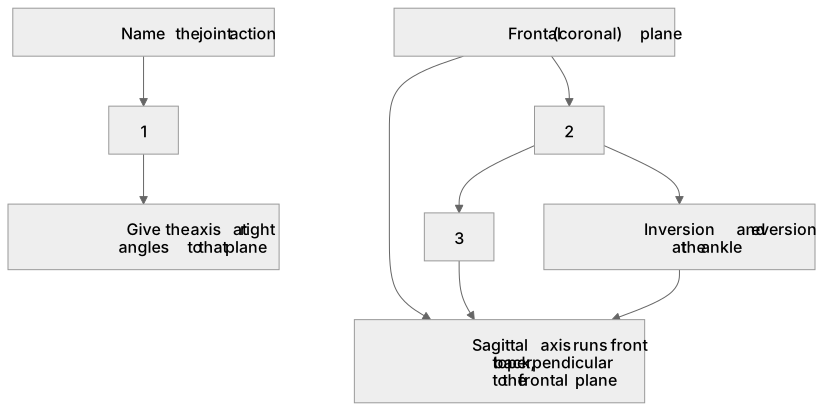
1Box 1
2Box 2
3Box 3
There is more to this lesson
The full lesson goes on to check your understanding and help you earn the marks. Create a free account to carry on, with your progress saved.
A week of Premium from your first lesson · Then the free plan continues · No card, no charge
Test your understanding of The musculo-skeletal system and analysis of movement in physical activities: Joint actions in the frontal plane/sagittal axis.
Active recall beats re-reading. Take an instant quiz now to test what you’ve learned and lock it into long-term memory.
A week of Premium from your first lesson · Then the free plan continues · No card, no charge