AQA · A-Level · Physical Education
Course version: 7582 · Version from Sept 2016
Use of guidance and feedback: Extrinsic.
Extrinsic feedback is information about performance that comes from an outside source rather than from the performer's own senses.
Checked against the AQA 7582 specification (opens in a new tab) on .
- Point 11 of 11
- 4 key terms
Study notes
From the checked teaching notes for this specification point.
The idea
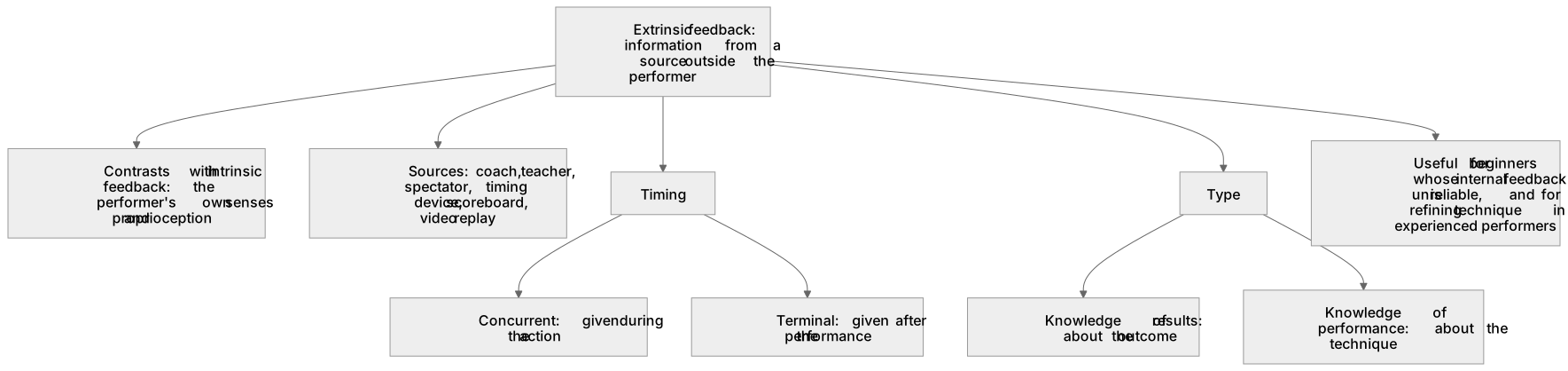
Extrinsic feedback is information about performance that comes from an outside source rather than from the performer's own senses. A coach calling out "keep your elbow high" during a badminton overhead clear, a scoreboard showing a time, or a video replay are all external. It contrasts with intrinsic feedback, which the performer detects through proprioception and vision. Extrinsic feedback can be concurrent, given during the action, or terminal, given after it, and it may be knowledge of results, about the outcome, or knowledge of performance, about the technique. Beginners often rely on it because their internal sense of the movement is not yet accurate; skilled performers may use it to refine specific details.
What earns the marks
- Extrinsic feedback originates from a source outside the performer, such as a coach, teacher, spectator, timing device, scoreboard or video replay.
Common mistakes and how to put them right
Confusing extrinsic feedback with intrinsic feedback.
Put it right: The misunderstanding is that any feedback felt by the performer is extrinsic, whereas the correction is that feedback generated by the performer's own senses is intrinsic and only external sources make it extrinsic.
Assuming extrinsic feedback is always given verbally by a coach.
Put it right: The misunderstanding ignores written, visual, electronic and mechanical sources, whereas the correction is that a stopwatch reading, a video replay or a scoreboard is also extrinsic.
Believing extrinsic feedback must always be given after the performance.
Put it right: The misunderstanding overlooks concurrent feedback, whereas the correction is that extrinsic feedback can be provided during the action as well as after it.
Treating knowledge of results and knowledge of performance as the same thing.
Put it right: The misunderstanding is that both describe the outcome, whereas the correction is that knowledge of results concerns the result and knowledge of performance concerns how the movement was executed.
Exam tips
- Read each option and ask where the information comes from; if the source is outside the performer, the option describes extrinsic feedback.
- Look for cue words such as coach, teacher, video, scoreboard, stopwatch or spectator, which signal an external source.
- Eliminate options that describe the performer sensing their own body position or movement, because those describe intrinsic feedback.
- Check whether the option describes feedback during the action or after it, and whether it concerns the result or the technique, to confirm the match.
Try the lesson
The start of the Use of guidance and feedback: Extrinsic. lesson, made from checked teaching notes for this specification point.
Have a go first
A tennis coach shouts 'keep your wrist firm' to a player during a practice rally. Which type of feedback is the player receiving?
Listen
Extrinsic feedback is information about performance that comes from an outside source rather than from the performer's own senses. A coach calling out "keep your elbow high" during a badminton overhead clear, a scoreboard showing a time, or a video replay are all external. It contrasts with intrinsic feedback, which the performer detects through proprioception and vision. Extrinsic feedback can be concurrent, given during the action, or terminal, given after it, and it may be knowledge of results, about the outcome, or knowledge of performance, about the technique. Beginners often rely on it because their internal sense of the movement is not yet accurate; skilled performers may use it to refine specific details. Exam tip: Read each option and ask where the information comes from; if the source is outside the performer, the option describes extrinsic feedback.
See it
Key words
Say what each word means before you turn the card.
Extrinsic feedback
Try answering aloud or in your head before turning the card.
Intrinsic feedback
Try answering aloud or in your head before turning the card.
Concurrent and terminal feedback
Try answering aloud or in your head before turning the card.
Knowledge of results and knowledge of performance
Try answering aloud or in your head before turning the card.
See every definition
- Extrinsic feedback
- Information about performance that comes from an outside source rather than from the performer's own senses.
- Intrinsic feedback
- Information the performer detects through proprioception and vision, gathered through their own senses during or after the movement.
- Concurrent and terminal feedback
- Extrinsic feedback can be concurrent, given during the action, or terminal, given after it.
- Knowledge of results and knowledge of performance
- Extrinsic feedback may be knowledge of results, about the outcome, or knowledge of performance, about the technique.
Label the diagram
Some boxes have lost their names. Pick the right name for each number.
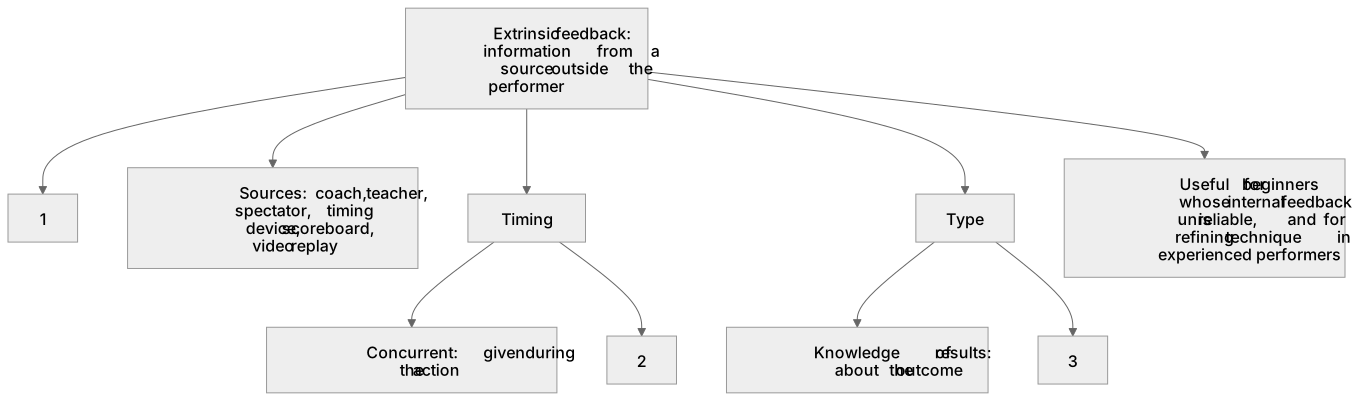
1Box 1
2Box 2
3Box 3
There is more to this lesson
The full lesson goes on to check your understanding and help you earn the marks. Create a free account to carry on, with your progress saved.
A week of Premium from your first lesson · Then the free plan continues · No card, no charge
Test your understanding of Use of guidance and feedback: Extrinsic.
Active recall beats re-reading. Take an instant quiz now to test what you’ve learned and lock it into long-term memory.
A week of Premium from your first lesson · Then the free plan continues · No card, no charge