AQA · A-Level · Physical Education
Course version: 7582 · Version from Sept 2016
Use of guidance and feedback: Intrinsic.
Intrinsic feedback is information the performer generates from their own senses during and after a movement, without relying on anyone else.
Checked against the AQA 7582 specification (opens in a new tab) on .
- Point 10 of 11
- 4 key terms
Study notes
From the checked teaching notes for this specification point.
The idea
Intrinsic feedback is information the performer generates from their own senses during and after a movement, without relying on anyone else. It comes through proprioception, the sense of joint position and movement, together with vision, touch, hearing and balance. A gymnast feels the body position in a handstand; a sprinter hears and feels foot strike rhythm; a badminton player sees the shuttle leave the racket. Because it is immediate and always available, intrinsic feedback is central to developing an internal reference of correctness, which lets a performer self-correct. Beginners often cannot interpret it accurately, so extrinsic feedback from a coach or video supplements it. Intrinsic feedback can be concurrent, during the action, or terminal, after it.
What earns the marks
- Intrinsic feedback is information arising from the performer's own sensory systems.
- Accurate interpretation of intrinsic feedback develops with practice and experience.
- Extrinsic feedback is often used alongside it when the performer cannot yet detect error reliably.
Common mistakes and how to put them right
Confusing intrinsic feedback with feedback given by a coach.
Put it right: Intrinsic feedback comes from within the performer, while coach feedback is extrinsic.
Restricting intrinsic feedback to feeling alone.
Put it right: It also draws on vision, hearing, touch and balance information.
Assuming beginners interpret intrinsic feedback accurately.
Put it right: Novices often need extrinsic feedback to learn what correct feels like.
Treating intrinsic feedback as only occurring after the movement.
Put it right: It can also be concurrent, gathered during the action itself.
Exam tips
- Name the sense or senses involved when you give an example of intrinsic feedback.
- Contrast intrinsic with extrinsic in one sentence to show the boundary clearly.
- Use a familiar skill so the sensory information you describe is credible.
- State whether your example is concurrent or terminal to show precise understanding.
Try the lesson
The start of the Use of guidance and feedback: Intrinsic. lesson, made from checked teaching notes for this specification point.
Have a go first
A gymnast feels the stretch in her shoulders during a handstand and uses this internal sensation to adjust her balance. Based on the source of this information, which type of feedback is she using?
Listen
Intrinsic feedback is information the performer generates from their own senses during and after a movement, without relying on anyone else. It comes through proprioception, the sense of joint position and movement, together with vision, touch, hearing and balance. A gymnast feels the body position in a handstand; a sprinter hears and feels foot strike rhythm; a badminton player sees the shuttle leave the racket. Because it is immediate and always available, intrinsic feedback is central to developing an internal reference of correctness, which lets a performer self-correct. Beginners often cannot interpret it accurately, so extrinsic feedback from a coach or video supplements it. Intrinsic feedback can be concurrent, during the action, or terminal, after it. A strong answer earns marks for these points. Intrinsic feedback is information arising from the performer's own sensory systems. Accurate interpretation of intrinsic feedback develops with practice and experience. Extrinsic feedback is often used alongside it when the performer cannot yet detect error reliably. A common slip: Confusing intrinsic feedback with feedback given by a coach. Instead, intrinsic feedback comes from within the performer, while coach feedback is extrinsic. Exam tip: Name the sense or senses involved when you give an example of intrinsic feedback.
See it
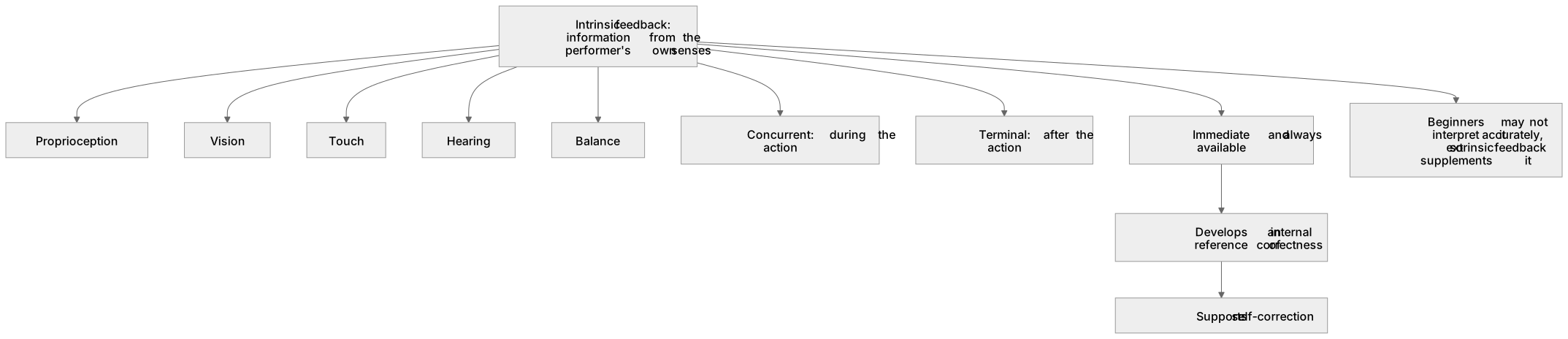
Key words
Say what each word means before you turn the card.
Intrinsic feedback
Try answering aloud or in your head before turning the card.
Proprioception
Try answering aloud or in your head before turning the card.
Internal reference of correctness
Try answering aloud or in your head before turning the card.
Concurrent feedback
Try answering aloud or in your head before turning the card.
See every definition
- Intrinsic feedback
- Information the performer generates from their own senses during and after a movement, without relying on anyone else.
- Proprioception
- The sense of joint position and movement, which together with vision, touch, hearing and balance provides intrinsic feedback.
- Internal reference of correctness
- A sense developed from immediate and always available intrinsic feedback that lets a performer self-correct.
- Concurrent feedback
- Intrinsic feedback gathered during the action itself, as opposed to terminal feedback after it.
Label the diagram
Some boxes have lost their names. Pick the right name for each number.
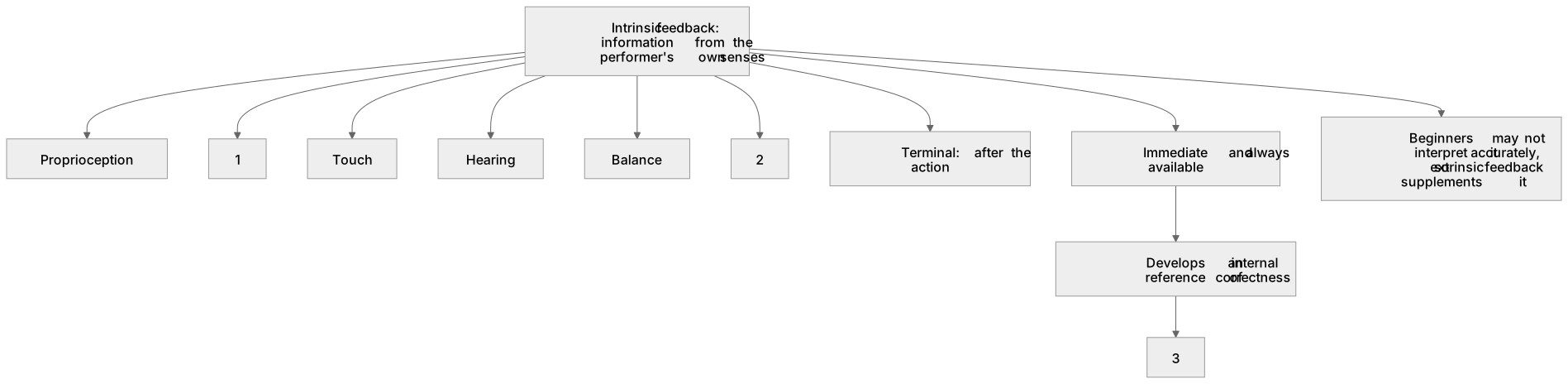
1Box 1
2Box 2
3Box 3
There is more to this lesson
The full lesson goes on to check your understanding and help you earn the marks. Create a free account to carry on, with your progress saved.
A week of Premium from your first lesson · Then the free plan continues · No card, no charge
Test your understanding of Use of guidance and feedback: Intrinsic.
Active recall beats re-reading. Take an instant quiz now to test what you’ve learned and lock it into long-term memory.
A week of Premium from your first lesson · Then the free plan continues · No card, no charge