AQA · A-Level · Physical Education
Course version: 7582 · Version from Sept 2016
Use of guidance and feedback: Positive and negative.
Feedback is information a performer receives about a movement or its outcome, and in this section it is classified by its effect on the learner.
Checked against the AQA 7582 specification (opens in a new tab) on .
- Point 9 of 11
- 4 key terms
Study notes
From the checked teaching notes for this specification point.
The idea
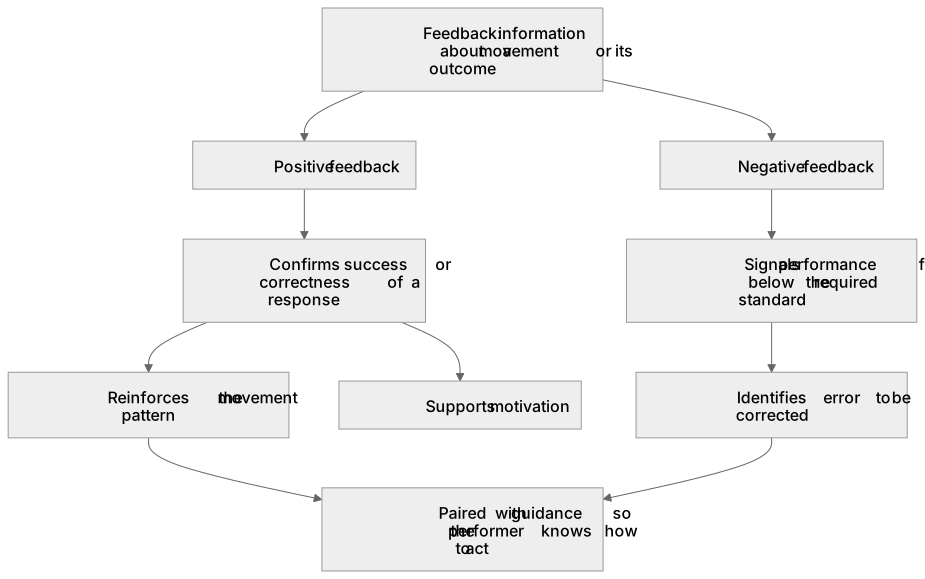
Feedback is information a performer receives about a movement or its outcome, and in this section it is classified by its effect on the learner. Positive feedback confirms that a response was successful or on the right track, so it strengthens the correct movement pattern and supports motivation. Negative feedback identifies that a response fell short of the required standard and directs attention to what must change. Negative does not mean harsh or discouraging: a coach saying the elbow dropped during a basketball free throw is giving negative feedback because it signals error, not because the tone is unkind. Both types work best when they are specific, accurate and given soon after the attempt, and they are usually combined with guidance so the performer knows how to correct the fault.
What earns the marks
- Positive feedback confirms success or correctness of a response and reinforces the movement pattern.
- Negative feedback signals that performance fell below the required standard and identifies error to be corrected.
- Negative feedback refers to the information content, not to a harsh or discouraging manner.
- Feedback is normally paired with guidance so the performer knows how to act on the information.
Common mistakes and how to put them right
Believing negative feedback means criticism delivered unkindly.
Put it right: It means information that performance was incorrect or below standard, and it can be delivered calmly and constructively.
Assuming positive feedback always improves learning.
Put it right: Praise that is vague or unrelated to the movement gives little information, so it should identify what was done well.
Thinking feedback and guidance are the same thing.
Put it right: Feedback is information about performance, while guidance is the means of directing the performer towards the correct response.
Treating the two types as a personal judgement of the performer.
Put it right: They describe the accuracy of the response, not the worth of the individual.
Exam tips
- Anchor each definition to a concrete sporting example so the distinction is unambiguous.
- When a question asks you to classify feedback, state what information the performer receives before naming the type.
- Link feedback to the guidance that follows it, because the specification treats them as a pair.
- Use precise wording such as below the required standard rather than simply bad.
Try the lesson
The start of the Use of guidance and feedback: Positive and negative. lesson, made from checked teaching notes for this specification point.
Have a go first
In the classification of feedback, what is meant by negative feedback?
Listen
Feedback is information a performer receives about a movement or its outcome, and in this section it is classified by its effect on the learner. Positive feedback confirms that a response was successful or on the right track, so it strengthens the correct movement pattern and supports motivation. Negative feedback identifies that a response fell short of the required standard and directs attention to what must change. Negative does not mean harsh or discouraging: a coach saying the elbow dropped during a basketball free throw is giving negative feedback because it signals error, not because the tone is unkind. Both types work best when they are specific, accurate and given soon after the attempt, and they are usually combined with guidance so the performer knows how to correct the fault. A strong answer earns marks for these points. Positive feedback confirms success or correctness of a response and reinforces the movement pattern. Negative feedback signals that performance fell below the required standard and identifies error to be corrected. Negative feedback refers to the information content, not to a harsh or discouraging manner. Feedback is normally paired with guidance so the performer knows how to act on the information. A common slip: Believing negative feedback means criticism delivered unkindly. Instead, it means information that performance was incorrect or below standard, and it can be delivered calmly and constructively. Exam tip: Anchor each definition to a concrete sporting example so the distinction is unambiguous.
See it
Key words
Say what each word means before you turn the card.
Classification of feedback by effect on the learner
Try answering aloud or in your head before turning the card.
Reinforcement of correct movement patterns
Try answering aloud or in your head before turning the card.
Detection and correction of error
Try answering aloud or in your head before turning the card.
The relationship between feedback and guidance
Try answering aloud or in your head before turning the card.
See every definition
- Classification of feedback by effect on the learner
- Feedback is information a performer receives about a movement or its outcome, and it is classified by its effect on the learner.
- Reinforcement of correct movement patterns
- Positive feedback confirms that a response was successful or on the right track, so it strengthens the correct movement pattern and supports motivation.
- Detection and correction of error
- Negative feedback identifies that a response fell short of the required standard and directs attention to what must change.
- The relationship between feedback and guidance
- Both types work best when specific, accurate and given soon after the attempt, and they are usually combined with guidance so the performer knows how to correct the fault.
Label the diagram
Some boxes have lost their names. Pick the right name for each number.
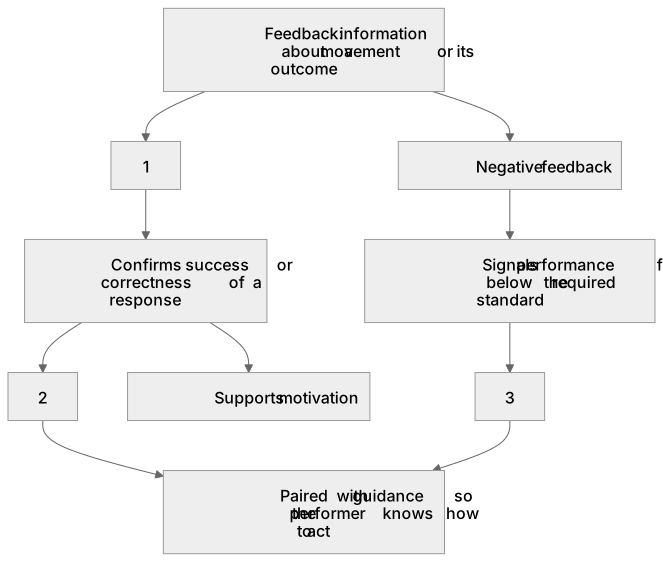
1Box 1
2Box 2
3Box 3
There is more to this lesson
The full lesson goes on to check your understanding and help you earn the marks. Create a free account to carry on, with your progress saved.
A week of Premium from your first lesson · Then the free plan continues · No card, no charge
Test your understanding of Use of guidance and feedback: Positive and negative.
Active recall beats re-reading. Take an instant quiz now to test what you’ve learned and lock it into long-term memory.
A week of Premium from your first lesson · Then the free plan continues · No card, no charge