Pearson Edexcel · A-Level · Physical Education
Practical performance
Component 3: Practical Performance is where you demonstrate your sporting ability in a live context. You will be assessed on your execution of skills, decision-making, and tactical awareness in both conditioned practices and formal competitive situations.
- 5 min read
- 3 worked examples
- 4 practice questions
- 6 key terms
Study Notes

Overview
Component 3: Practical Performance is the practical element of your GCSE Physical Education course. This is your opportunity to step away from the desk and demonstrate your physical abilities, tactical understanding, and decision-making skills in a real sporting context. You will be assessed in one chosen physical activity from the official specification list, performing either as a player/performer or, in some specific cases, as a coach.
Listen to our revision podcast for an in-depth breakdown of what examiners are looking for:

Key Knowledge & Theory
Core Concepts
To succeed in Component 3, you must understand the difference between isolated skills and applied performance. Examiners are looking for the seamless integration of technique, fitness, and cognitive processing under pressure.
- Conditioned Practice: A modified game or drill designed to focus on specific skills or tactics (e.g., a 3v2 overload drill in football to practice attacking under pressure).
- Formal/Competitive Situation: The full version of the sport played to its official rules (e.g., a full 11-a-side football match or a complete gymnastics floor routine in competition).
- Internal Standardisation: The process where teachers at your school compare their marking to ensure all students are assessed fairly and consistently against the same criteria.
Technical Vocabulary
- Aesthetic Quality: How a movement looks; the grace, control, and fluency of a performance (especially important in sports like gymnastics, trampolining, and dance).
- Motor Skill: A learned movement response (e.g., a tennis serve or a basketball lay-up).
- Tactical Application: The ability to change your strategy in response to the opposition or the state of the game.
- Perceptual Skill: The ability to interpret information from the sporting environment (e.g., reading the flight of a ball or the positioning of an opponent).
Practical Skills
Techniques & Processes
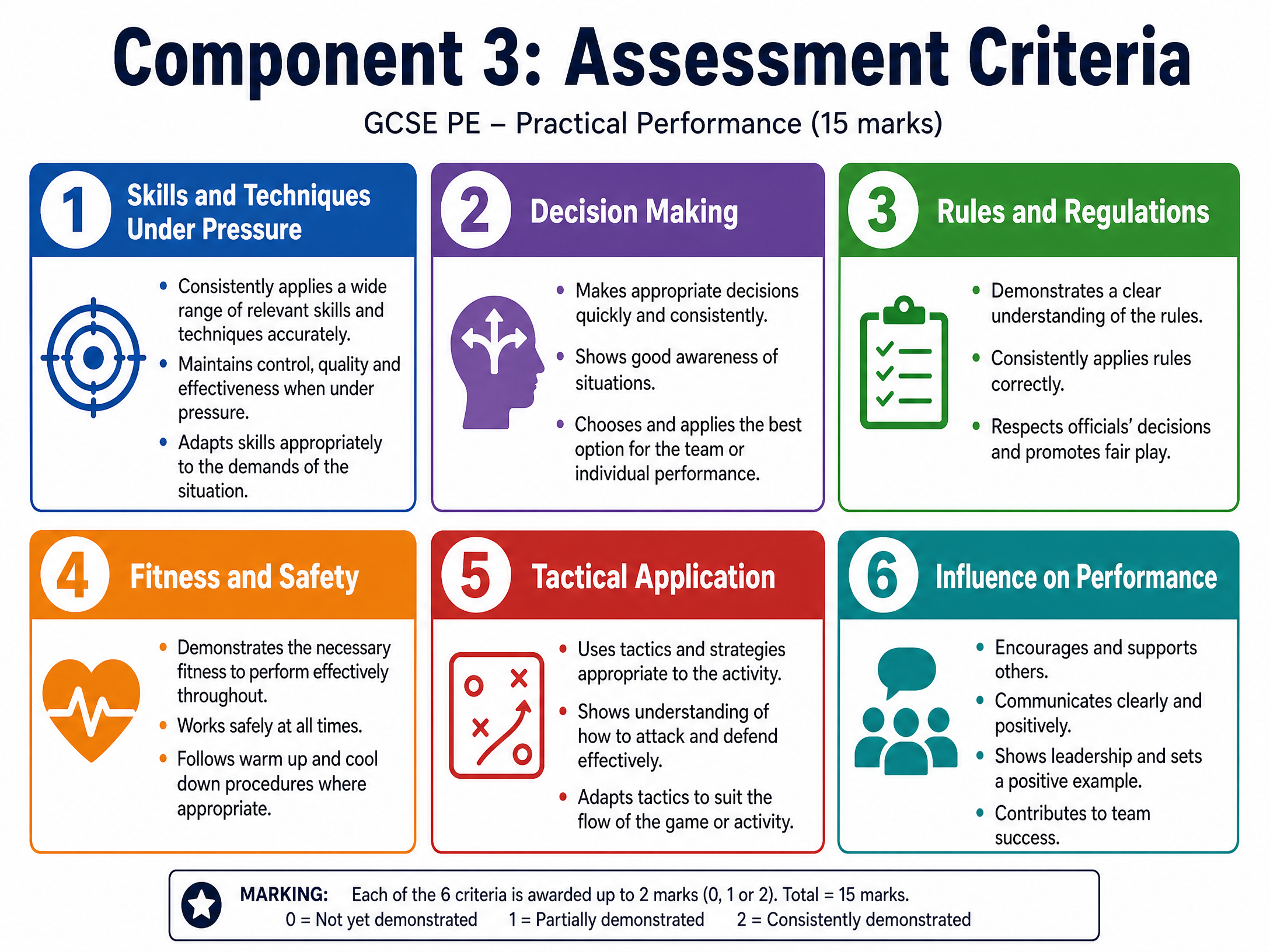
Your performance will be judged against six specific assessment criteria. You must ensure you are demonstrating all of these elements in your video evidence.
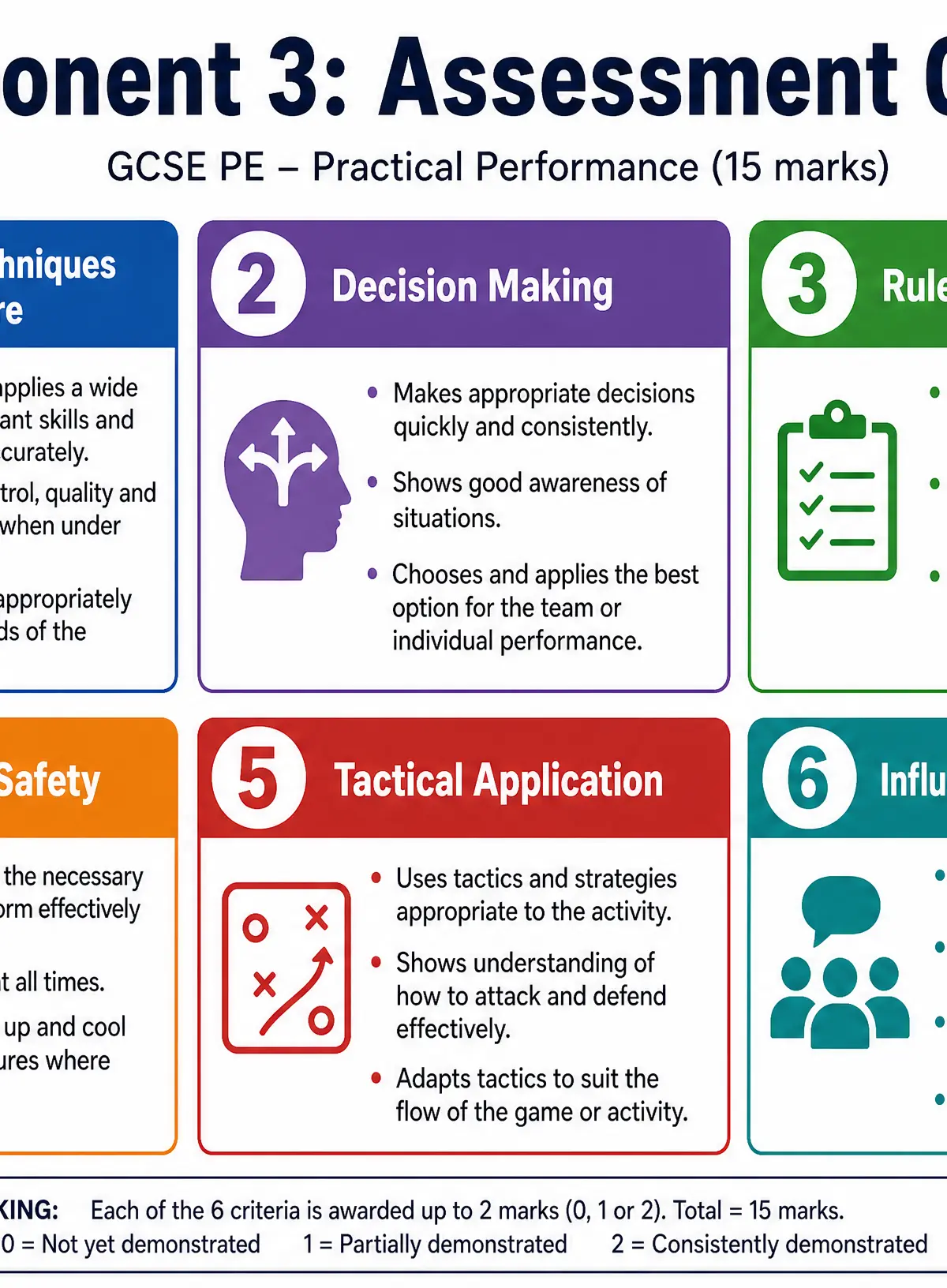
- Skills and Techniques Under Pressure: Can you execute the core skills of your sport accurately when an opponent is trying to stop you?
- Decision Making: Are you making the right choices? (e.g., knowing when to pass vs. when to shoot).
- Rules and Regulations: Are you adhering to the official laws of the game without needing referee intervention?
- Fitness and Safety: Do you have the cardiovascular endurance, strength, or flexibility required to perform effectively for the duration of the event?
- Tactical Application: Can you adapt your play? If you are losing, can you change your strategy to dominate the opponent?
- Influence on Performance: Are you communicating effectively, encouraging teammates, and showing leadership?
Materials & Equipment
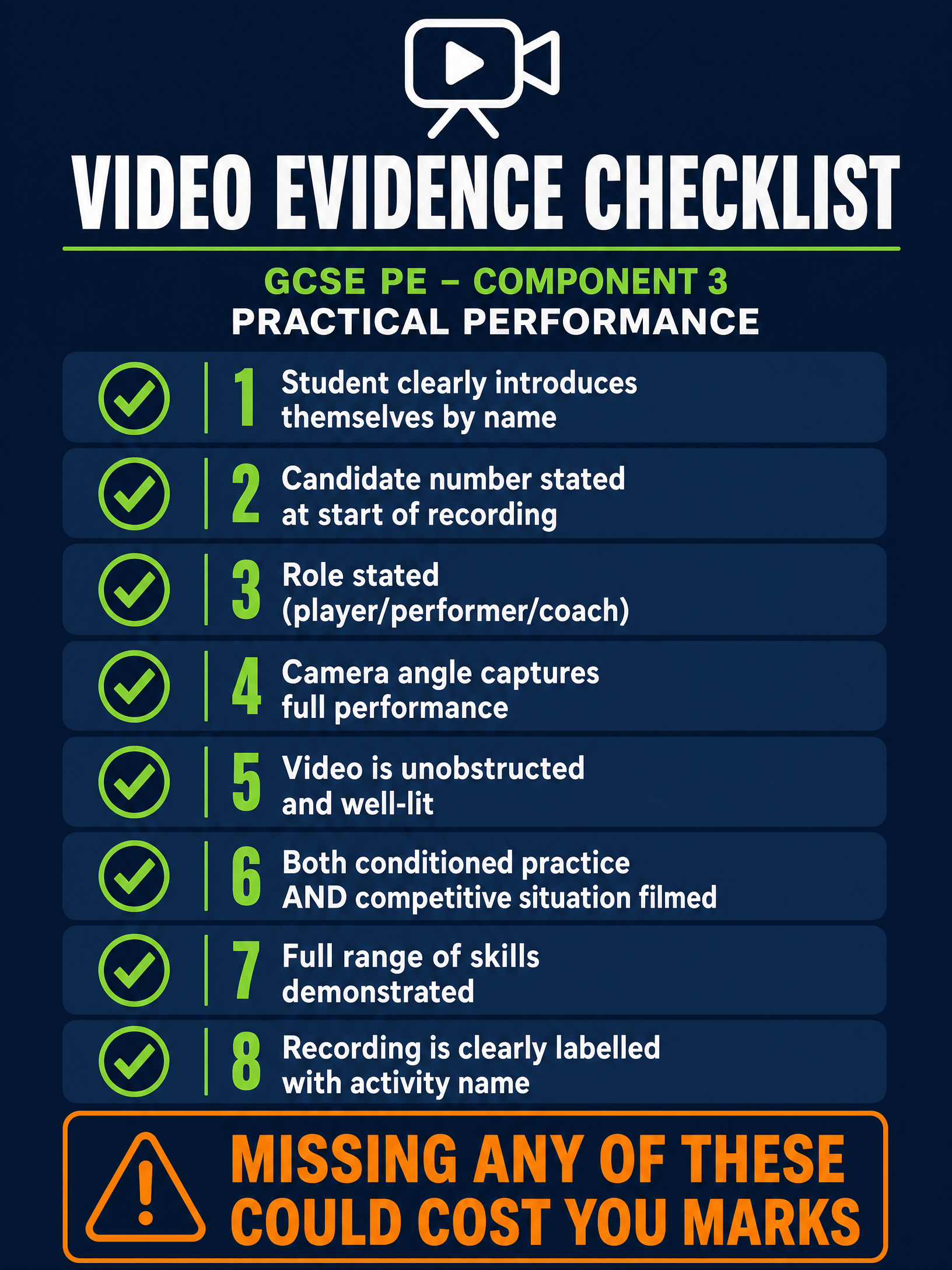
- Video Evidence: Most exam boards require video evidence for moderation.
Portfolio/Coursework Guidance
Assessment Criteria
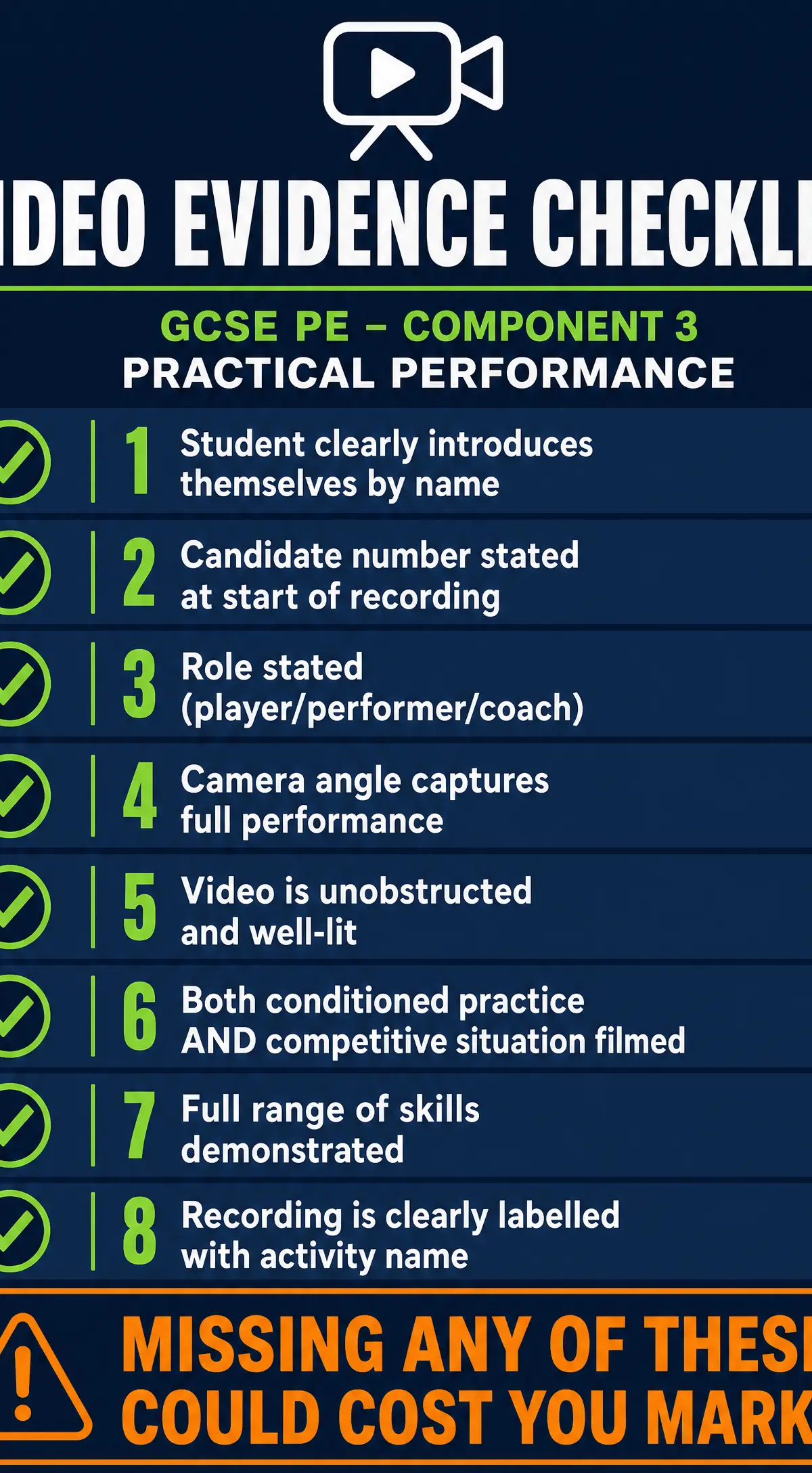
Examiners use a levels-based mark scheme. To reach the top band, your performance must be "consistent, highly effective, and demonstrate a wide range of complex skills under pressure." A mid-band performance might be "generally effective but inconsistent under high pressure."
Building Strong Video Evidence
- Introduction: Always start the video by clearly stating your full name, candidate number, and role (e.g., "Jane Smith, Candidate 1234, Goal Attack").
- Visibility: Wear a bib or a numbered shirt that makes you easily identifiable at all times.
- Context: Ensure the video shows BOTH conditioned practices (to highlight specific complex skills) AND a full competitive game (to highlight tactical awareness and decision-making).
Exam Component
Written Exam Knowledge
While Component 3 is practical, the knowledge you demonstrate here directly links to your written papers. When you write about "classification of skill" or "methods of training" in your theory exam, you should use your practical sport as your applied example.
Practical Exam Preparation
Do not assume that just because you play for a local club, you will automatically get full marks. You must actively demonstrate the specific criteria the examiner is looking for. If you play in defence but the ball never comes to your end of the pitch during the recorded game, the examiner cannot award you marks. Ask your teacher to set up conditioned practices that guarantee you get on the ball.
Interactive Diagrams
1 interactive diagram to visualise key concepts
Conceptual Flow Outline
The Component 3 Assessment Process
Worked Examples
3 worked examples — open one to explore the question and available guidance.
Practice Questions
Test your understanding — click to reveal model answers
State three pieces of information a student must provide at the start of their video evidence recording.
Hint: Remember the 'NCR' acronym.
Explain the difference between a conditioned practice and a competitive situation, and why both are required for assessment.
Hint: Think about what a drill allows you to do versus what a real game forces you to do.
Evaluate the importance of 'Tactical Application' in achieving a top-band mark in a team sport.
Hint: Link tactical application to decision making and influence on performance.
A student is performing a gymnastics routine for their assessment. Explain how they can ensure they meet the criteria for 'Fitness and Safety'.
Hint: Think about the specific physical requirements of gymnastics and how injuries are prevented.