Pearson Edexcel · A-Level · Physical Education
Scientific Principles of Physical Education
This topic covers the fundamental anatomical, physiological, and biomechanical principles that underpin all physical movement and sporting performance. Mastering this science is crucial for understanding how the body responds to exercise, recovers, and can be trained to achieve excellence.
- 5 min read
- 3 worked examples
- 3 practice questions
- 6 key terms
Study Notes
Overview
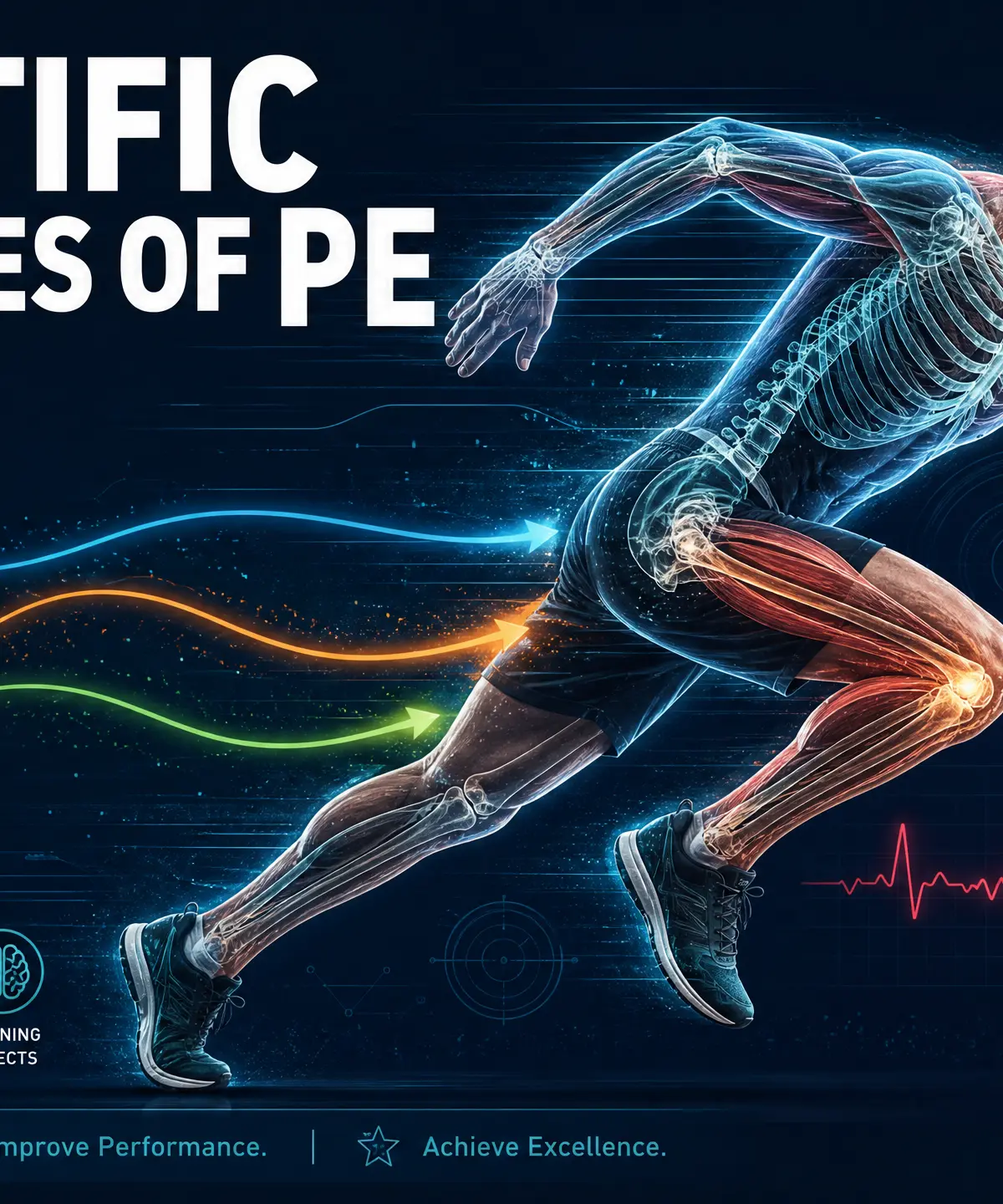
The Scientific Principles of Physical Education (Component 1) is the foundation of your GCSE PE course. It moves beyond simply playing sport into the rigorous science of how and why the body moves. You will explore the musculoskeletal system, biomechanics, the cardiovascular and respiratory systems, and the complex energy pathways that fuel performance. Examiners are looking for your ability to link these theoretical concepts directly to practical sporting examples.
Key Knowledge & Theory
The Musculoskeletal System & Movement
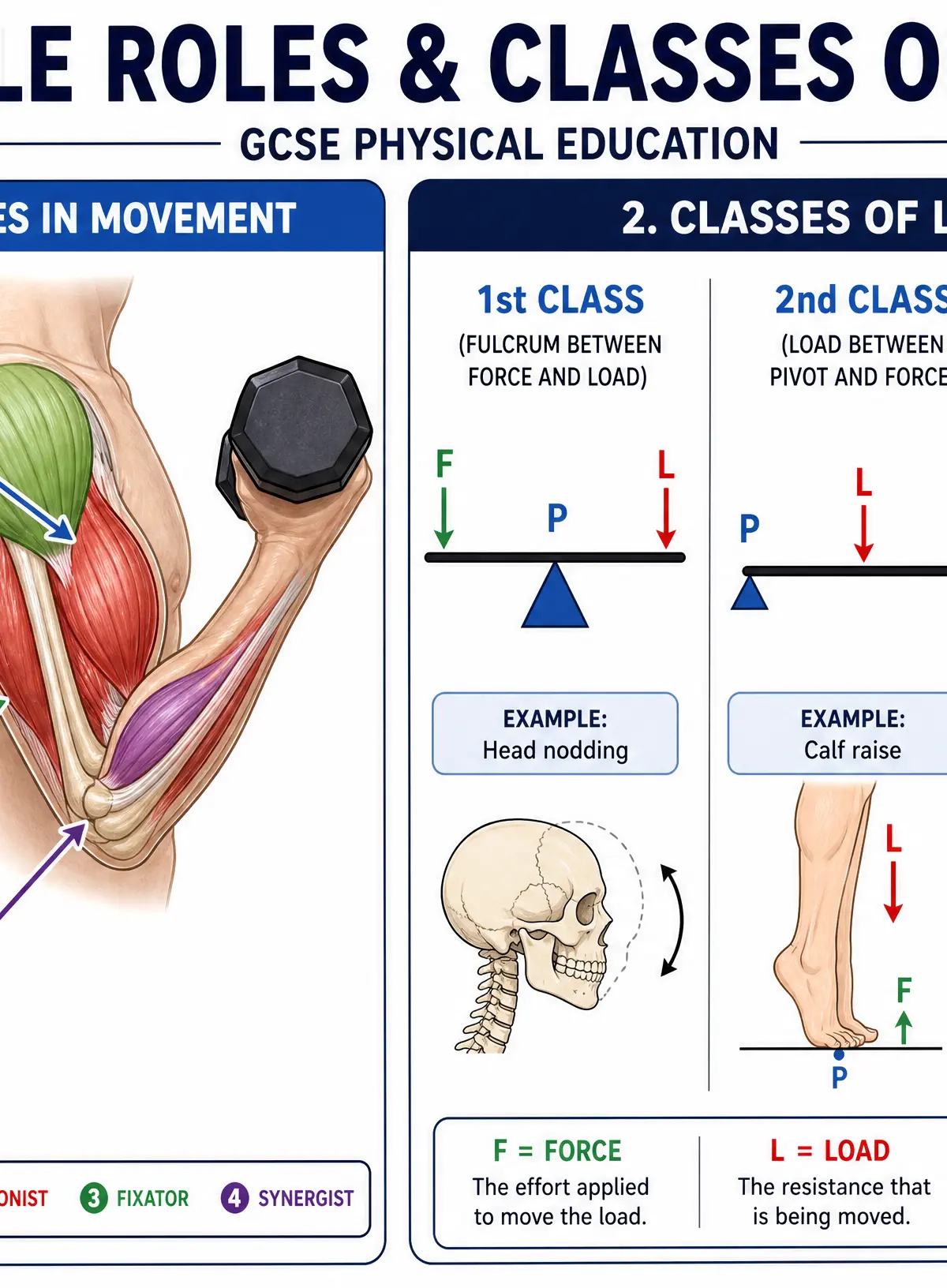
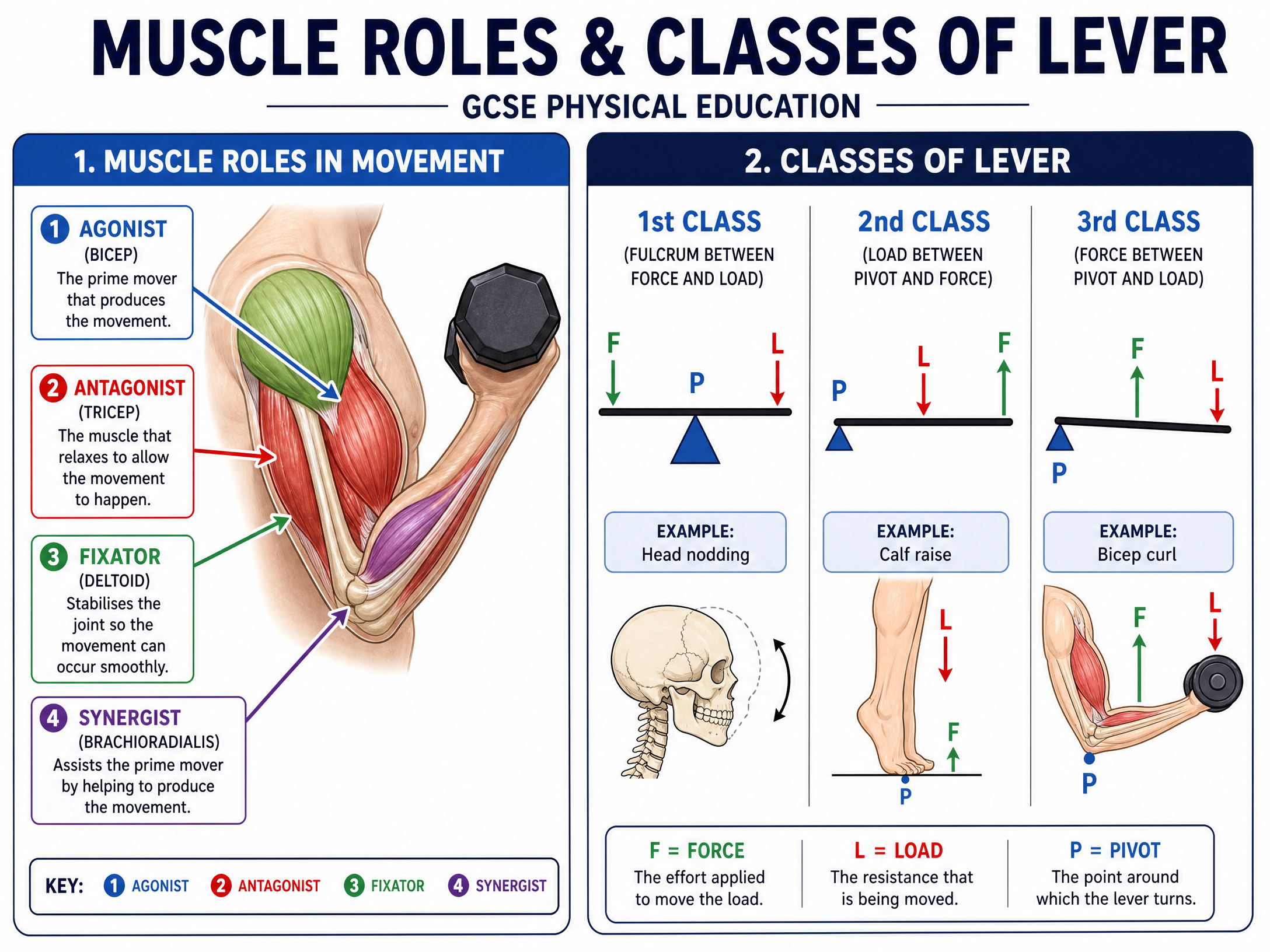
Muscles work in teams to produce movement around joints. The prime mover is the agonist, while the relaxing muscle is the antagonist. For example, in a bicep curl, the bicep is the agonist and the tricep is the antagonist. The fixator (e.g., deltoid) stabilises the joint, and the synergist assists the prime mover.
Muscle contractions are categorised into three types:
- Concentric: The muscle shortens under tension (e.g., the upward phase of a pull-up).
- Eccentric: The muscle lengthens under tension (e.g., the downward phase of a squat).
- Isometric: The muscle produces force but its length remains unchanged (e.g., holding a plank).
Biomechanics: Levers and Newton's Laws
The body operates as a series of lever systems, consisting of a fulcrum (joint), effort (muscle force), and load (resistance).
- 1st Class Lever: Fulcrum in the middle (e.g., nodding the head).
- 2nd Class Lever: Load in the middle (e.g., calf raise). Provides a mechanical advantage for moving heavy loads.
- 3rd Class Lever: Effort in the middle (e.g., bicep curl). Provides a mechanical disadvantage but allows for greater speed and range of motion.
Newton's Laws of Motion are essential for explaining sporting actions:
- Law of Inertia: A body remains at rest or in uniform motion unless acted upon by a force (e.g., a golf ball resting on a tee).
- Law of Acceleration: Force = mass × acceleration (e.g., a heavier shot put requires more force to accelerate than a lighter one).
- Law of Reaction: For every action, there is an equal and opposite reaction (e.g., a sprinter pushing against the blocks, and the blocks pushing back).
Energy Systems
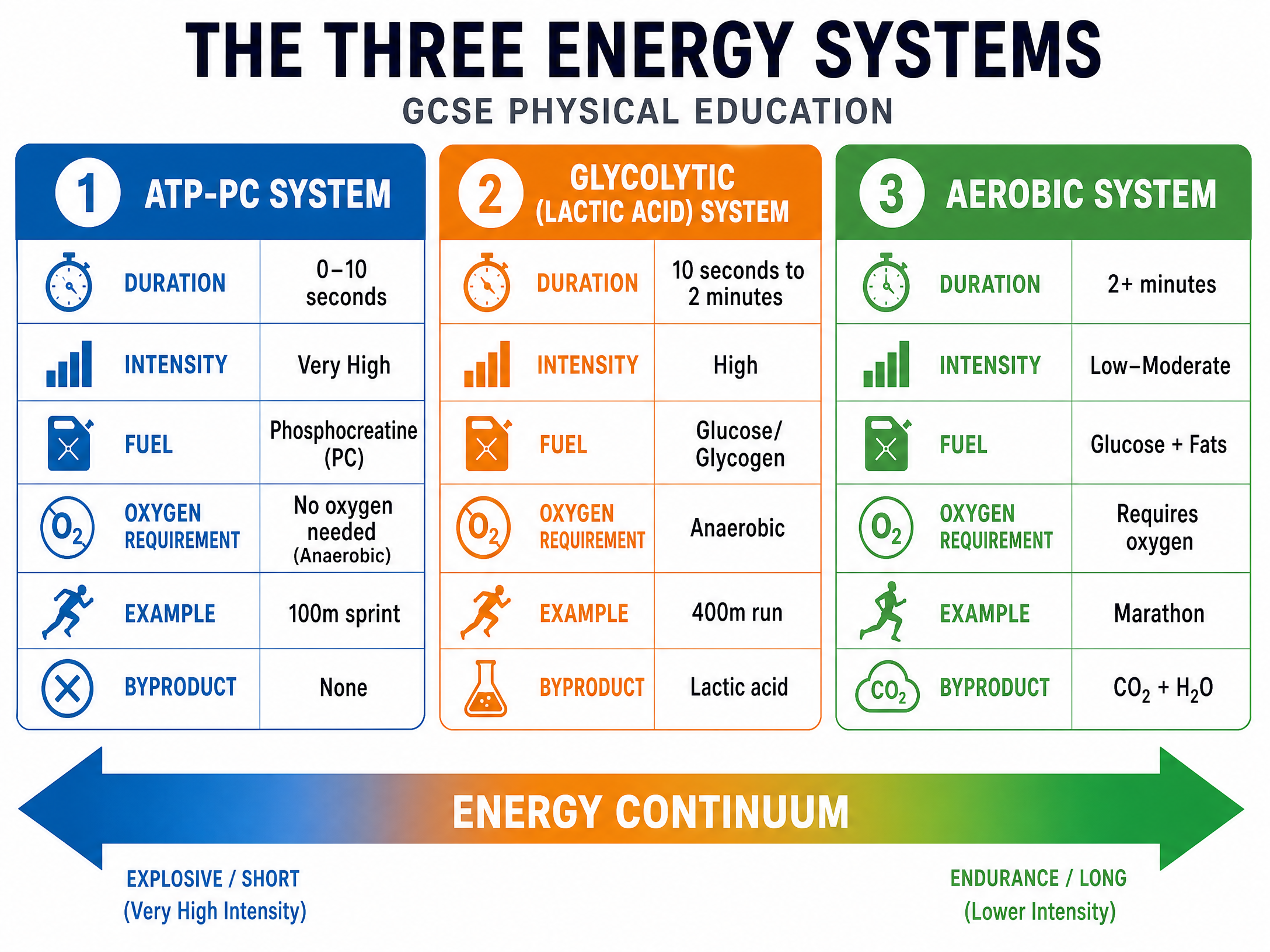
The body uses three distinct pathways to resynthesise ATP, the usable form of energy for muscles.
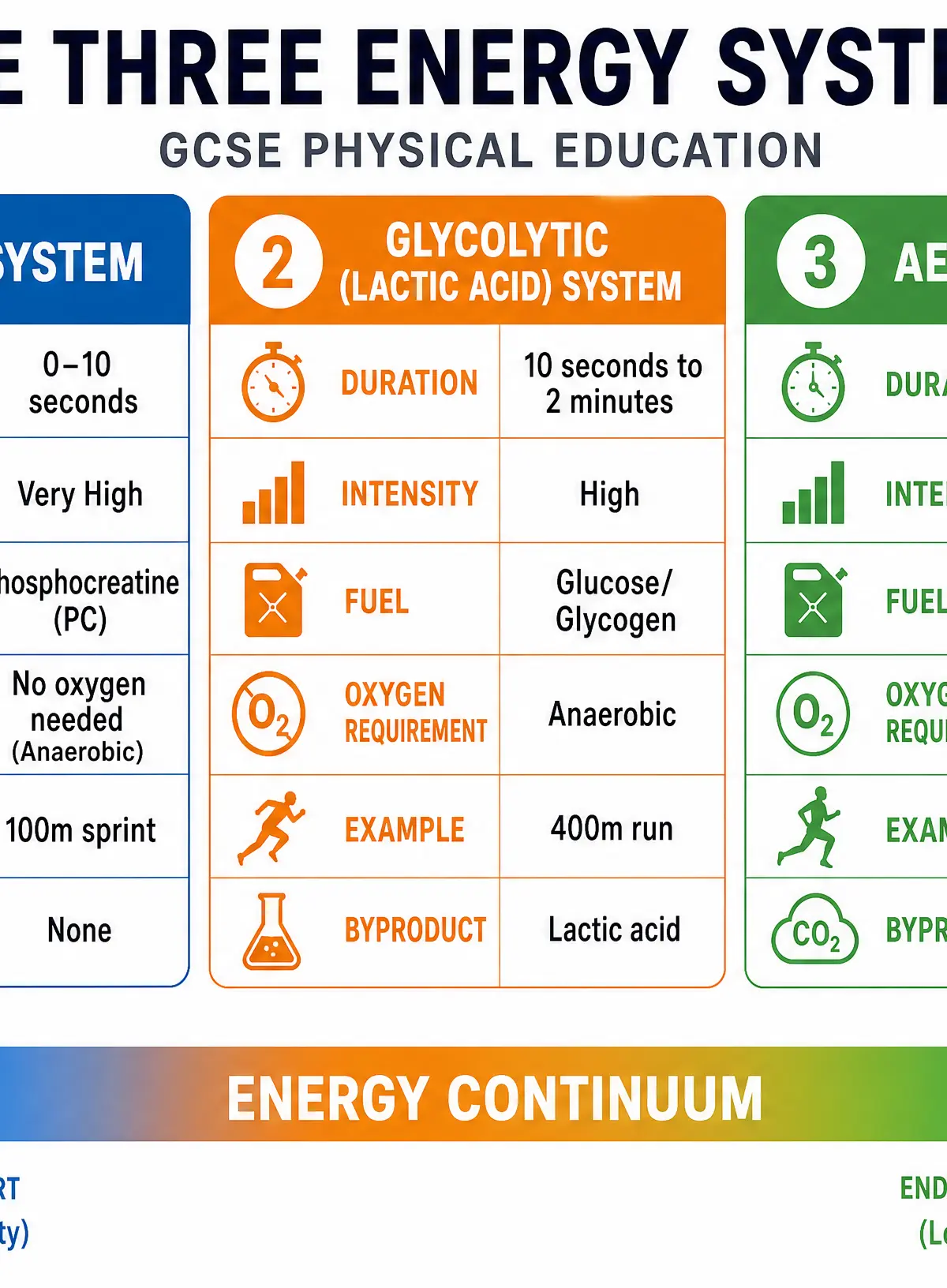
- ATP-PC System: Anaerobic, explosive power for 0-10 seconds. Fuelled by phosphocreatine. Example: 100m sprint or a shot put.
- Glycolytic (Lactic Acid) System: Anaerobic, high intensity for 10 seconds to 2 minutes. Fuelled by glycogen/glucose. Produces lactic acid, causing fatigue. Example: 400m run.
- Aerobic System: Uses oxygen to break down glucose and fats for low-to-moderate intensity exercise lasting longer than 2 minutes. Example: Marathon running.
The Energy Continuum explains that these systems do not work in isolation; they all contribute, but the dominant system depends on the intensity and duration of the activity.
Podcast Revision
Listen to our 10-minute revision podcast covering all these core concepts with examiner tips and a quick-fire quiz:

Practical Application & Performance
Applying Theory to Training
Understanding fibre types is critical for practical training:
- Type I (Slow Twitch): High fatigue resistance, aerobic. Best for endurance athletes.
- Type IIa (Fast Oxidative Glycolytic): Intermediate, used in middle-distance events.
- Type IIx (Fast Glycolytic): Explosive power, fatigues quickly. Best for powerlifters and sprinters.
When designing a training programme or evaluating a performance, you must justify your methods based on the specific physiological demands (e.g., "Interval training is appropriate for a football player to improve their glycolytic energy system and delay the onset of blood lactate accumulation (OBLA)").
Recovery Processes
Understanding recovery is just as important as the exercise itself. EPOC (Excess Post-exercise Oxygen Consumption) is the volume of oxygen consumed post-exercise to return the body to its pre-exercise state.
- Fast Component (Alactacid): Replenishes ATP and PC stores within 2-3 minutes.
- Slow Component (Lactacid): Removes lactic acid, maintains elevated heart and breathing rates, and regulates temperature over several hours.
Interactive Diagrams
1 interactive diagram to visualise key concepts
Conceptual Flow Outline
The Energy Continuum Decision Pathway
Worked Examples
3 worked examples — open one to explore the question and available guidance.
Practice Questions
Test your understanding — click to reveal model answers
Identify the main agonist and antagonist at the knee joint during the upward phase of a squat. (2 marks)
Hint: Think about which muscle group is contracting to straighten the leg.
Describe the characteristics of Type IIx muscle fibres and explain why they are suited to a 100m sprinter. (4 marks)
Hint: Focus on contraction speed, force produced, and fatigue rate.
Analyse how the cardiovascular and respiratory systems respond acutely to the onset of a game of basketball to ensure the muscles can perform effectively. (6 marks)
Hint: Use the P.E.A structure. Discuss heart rate, stroke volume, breathing rate, and gaseous exchange.