AQA · A-Level · Physics
Course version: 7408 · Version from Sept 2016
The astable as an oscillator to provide a clock pulse.
Full specification wording
Astables (A-level only): The astable as an oscillator to provide a clock pulse.
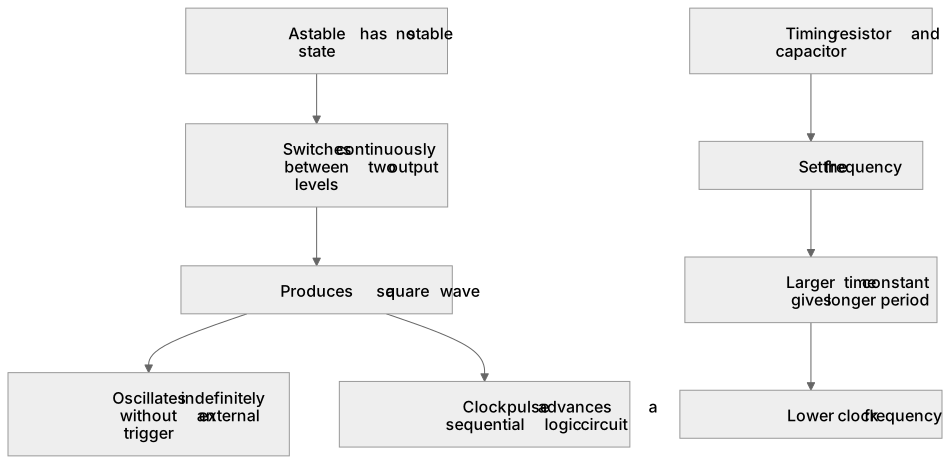
An astable circuit has no stable output state: it continuously switches between two output levels, producing a square wave.
Checked against the AQA 7408 specification (opens in a new tab) on .
- Point 1 of 3
- 4 key terms
Study notes
From the checked teaching notes for this specification point.
The idea
An astable circuit has no stable output state: it continuously switches between two output levels, producing a square wave. In this specification you treat the astable as an oscillator that supplies a clock pulse to sequential logic. The frequency depends on the resistor and capacitor values in the timing network, so changing R or C changes the clock rate. You should be able to describe the output waveform, explain that it alternates indefinitely without an external trigger, and relate the period to the timing components. You are not required to derive the internal operation of the astable from first principles.
What earns the marks
- Describe the astable output as a continuous square wave alternating between two levels.
- Explain that the astable has no stable state and needs no external trigger to oscillate.
- Identify the resistor and capacitor in the timing network as the components that set the frequency.
- Relate a larger time constant to a longer period and therefore a lower clock frequency.
- Explain the role of the clock pulse in advancing a sequential logic circuit.
Common mistakes and how to put them right
Describing the astable as a bistable or monostable.
Put it right: State that the astable has no stable state and oscillates continuously.
Claiming the output frequency is independent of the timing components.
Put it right: Link frequency to the resistor and capacitor values.
Stating that an external trigger is needed to start each cycle.
Put it right: Explain that the astable switches automatically.
Exam tips
- Sketch the output waveform and mark the period and amplitude clearly.
- Use the phrase 'no stable state' when defining an astable.
- When asked about clock rate, refer explicitly to the timing resistor and capacitor.
Try the lesson
The start of the Astables (A-level only): The astable as an oscillator to provide a clock pulse. lesson, made from checked teaching notes for this specification point.
Have a go first
What is the role of an astable circuit when it is used with a sequential logic system?
Listen
An astable circuit has no stable output state: it continuously switches between two output levels, producing a square wave. In this specification you treat the astable as an oscillator that supplies a clock pulse to sequential logic. The frequency depends on the resistor and capacitor values in the timing network, so changing R or C changes the clock rate. You should be able to describe the output waveform, explain that it alternates indefinitely without an external trigger, and relate the period to the timing components. You are not required to derive the internal operation of the astable from first principles. A strong answer earns marks for these points. Describe the astable output as a continuous square wave alternating between two levels. Explain that the astable has no stable state and needs no external trigger to oscillate. Identify the resistor and capacitor in the timing network as the components that set the frequency. Relate a larger time constant to a longer period and therefore a lower clock frequency. A common slip: Describing the astable as a bistable or monostable. Instead, state that the astable has no stable state and oscillates continuously. Exam tip: Sketch the output waveform and mark the period and amplitude clearly.
See it
Key words
Say what each word means before you turn the card.
Oscillation
Try answering aloud or in your head before turning the card.
Clock pulses
Try answering aloud or in your head before turning the card.
Timing circuits
Try answering aloud or in your head before turning the card.
Sequential logic
Try answering aloud or in your head before turning the card.
See every definition
- Oscillation
- Continuous switching between two output levels with no stable state and no external trigger needed.
- Clock pulses
- Supplied by the astable as an oscillator to advance a sequential logic circuit.
- Timing circuits
- The resistor and capacitor in the timing network set the frequency, so changing them changes the clock rate.
- Sequential logic
- Circuit advanced by the clock pulse that the astable supplies.
Label the diagram
Some boxes have lost their names. Pick the right name for each number.
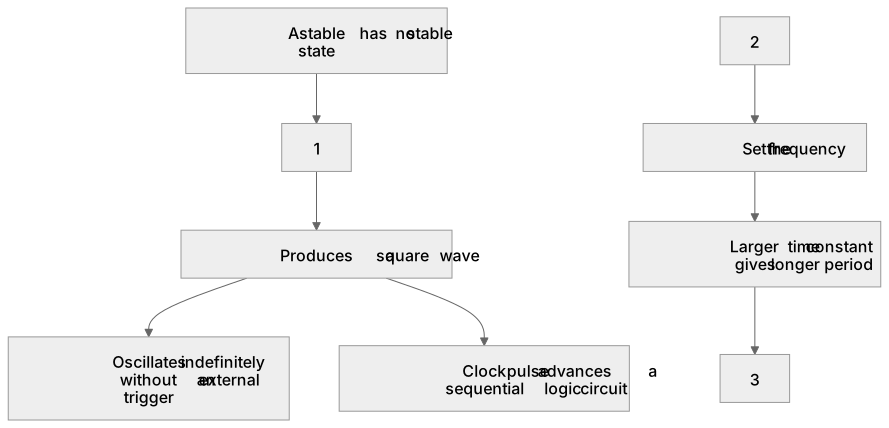
1Box 1
2Box 2
3Box 3
There is more to this lesson
The full lesson goes on to check your understanding and help you earn the marks. Create a free account to carry on, with your progress saved.
A week of Premium from your first lesson · Then the free plan continues · No card, no charge
Test your understanding of Astables (A-level only): The astable as an oscillator to provide a clock pulse.
Active recall beats re-reading. Take an instant quiz now to test what you’ve learned and lock it into long-term memory.
A week of Premium from your first lesson · Then the free plan continues · No card, no charge