AQA · A-Level · Physics
Course version: 7408 · Version from Sept 2016
Clock (pulse) rate (frequency), pulse width, period, duty cycle,…
Full specification wording
Astables (A-level only): Clock (pulse) rate (frequency), pulse width, period, duty cycle, mark-to-space ratio.
An astable produces a continuous rectangular wave, so its timing must be described precisely.
Checked against the AQA 7408 specification (opens in a new tab) on .
- Point 2 of 3
- 4 key terms
Study notes
From the checked teaching notes for this specification point.
The idea
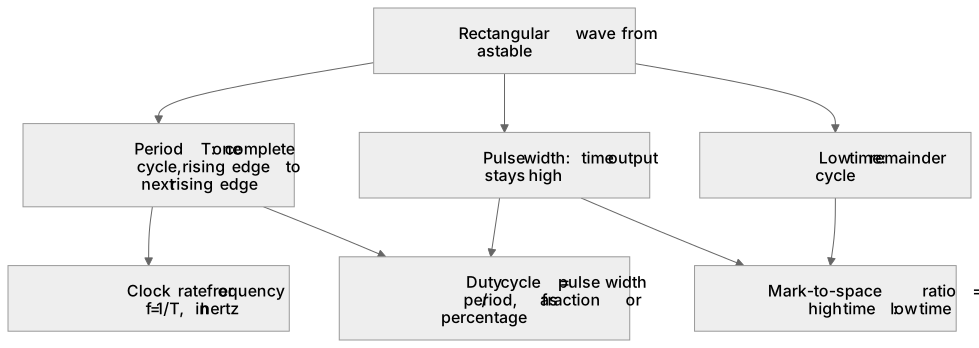
An astable produces a continuous rectangular wave, so its timing must be described precisely. Clock rate or frequency f is the number of pulses each second, measured in hertz, where f = 1/T. The period T is the time for one complete cycle, from one rising edge to the next. Pulse width is the time the output stays high in one cycle; the remainder is the low time. Duty cycle expresses the high time as a fraction or percentage of the period, for example 0.25 or 25 %. Mark-to-space ratio compares high time to low time, such as 3:1. For T = 4 ms with a 3 ms high time, f = 1/(4 × 10⁻³ s) = 250 Hz, duty cycle = 3/4 = 75 %, and mark-to-space ratio = 3:1. These quantities let you predict and check astable behaviour from an oscilloscope trace or datasheet.
What earns the marks
- Defines clock rate or frequency as the number of complete pulses per second, measured in hertz, and links it to period by f = 1/T.
- Defines period as the duration of one complete cycle, measured between corresponding points such as successive rising edges.
- Defines pulse width as the time for which the output remains high during one cycle, distinguishing it from the low time.
- Defines duty cycle as pulse width divided by period, expressed as a fraction or percentage.
- Defines mark-to-space ratio as the ratio of high time to low time, simplifying it to whole numbers where possible.
- Applies the definitions to a waveform or timing diagram, reading times from the horizontal scale and calculating the required quantity.
Common mistakes and how to put them right
Confusing period with pulse width.
Put it right by measuring edge-to-edge for period and high-time only for pulse width.
Treating frequency and period as directly proportional.
Put it right by using f = 1/T consistently.
Expressing duty cycle as high time divided by low time.
Put it right by dividing pulse width by the full period.
Exam tips
- Convert milliseconds or microseconds to seconds before substituting into f = 1/T, then state the unit hertz.
- When reading an oscilloscope trace, identify the timebase setting and count divisions carefully for both the high time and the full period.
- Give duty cycle as a fraction or percentage and mark-to-space ratio in the form high:low, simplifying the ratio where possible.
Try the lesson
The start of the Astables (A-level only): Clock (pulse) rate (frequency), pulse width, period, duty cycle, mark-to-space ratio. lesson, made from checked teaching notes for this specification point.
Have a go first
An astable clock produces a square wave with a period of 4.0 ms. What is the pulse rate of this clock?
Listen
An astable produces a continuous rectangular wave, so its timing must be described precisely. Clock rate or frequency f is the number of pulses each second, measured in hertz, where f = 1/T. The period T is the time for one complete cycle, from one rising edge to the next. Pulse width is the time the output stays high in one cycle; the remainder is the low time. Duty cycle expresses the high time as a fraction or percentage of the period, for example 0.25 or 25 %. Mark-to-space ratio compares high time to low time, such as 3:1. For T = 4 ms with a 3 ms high time, f = 1/(4 × 10⁻³ s) = 250 Hz, duty cycle = 3/4 = 75 %, and mark-to-space ratio = 3:1. These quantities let you predict and check astable behaviour from an oscilloscope trace or datasheet. A strong answer earns marks for these points. Defines clock rate or frequency as the number of complete pulses per second, measured in hertz, and links it to period by f = 1/T. Defines period as the duration of one complete cycle, measured between corresponding points such as successive rising edges. Defines pulse width as the time for which the output remains high during one cycle, distinguishing it from the low time. Defines duty cycle as pulse width divided by period, expressed as a fraction or percentage. A common slip: Confusing period with pulse width: the period covers the whole cycle, whereas pulse width covers only the high portion. Instead, measuring edge-to-edge for period and high-time only for pulse width. Exam tip: Convert milliseconds or microseconds to seconds before substituting into f = 1/T, then state the unit hertz.
See it
Key words
Say what each word means before you turn the card.
Clock rate
Try answering aloud or in your head before turning the card.
Period
Try answering aloud or in your head before turning the card.
Pulse width
Try answering aloud or in your head before turning the card.
Duty cycle
Try answering aloud or in your head before turning the card.
See every definition
- Clock rate
- The number of pulses each second, measured in hertz, where f = 1/T.
- Period
- The time for one complete cycle, from one rising edge to the next.
- Pulse width
- The time the output stays high in one cycle; the remainder is the low time.
- Duty cycle
- The high time expressed as a fraction or percentage of the period, for example 0.25 or 25 %.
Label the diagram
Some boxes have lost their names. Pick the right name for each number.
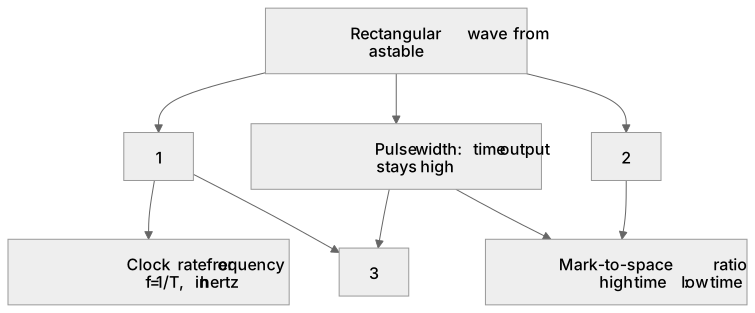
1Box 1
2Box 2
3Box 3
There is more to this lesson
The full lesson goes on to check your understanding and help you earn the marks. Create a free account to carry on, with your progress saved.
A week of Premium from your first lesson · Then the free plan continues · No card, no charge
Test your understanding of Astables (A-level only): Clock (pulse) rate (frequency), pulse width, period, duty cycle, mark-to-space ratio.
Active recall beats re-reading. Take an instant quiz now to test what you’ve learned and lock it into long-term memory.
A week of Premium from your first lesson · Then the free plan continues · No card, no charge