AQA · A-Level · Physics
Course version: 7408 · Version from Sept 2016
Variation of running frequency using an external RC network.
Full specification wording
Astables (A-level only): Variation of running frequency using an external RC network.
In an astable, the running frequency is set by an external resistor–capacitor network rather than by the supply voltage.
Checked against the AQA 7408 specification (opens in a new tab) on .
- Point 3 of 3
- 4 key terms
Study notes
From the checked teaching notes for this specification point.
The idea
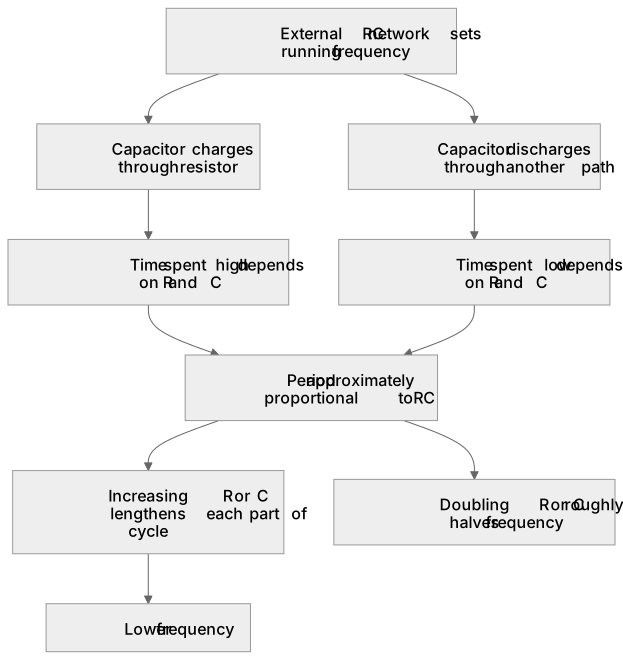
In an astable, the running frequency is set by an external resistor–capacitor network rather than by the supply voltage. The capacitor charges through the resistor and discharges through another path, so the time spent high and low depends on the resistance and capacitance values. Increasing either R or C increases the time constant, lengthening each part of the cycle and lowering the frequency. A larger capacitor stores more charge for a given voltage, while a larger resistor reduces charging current; both slow the voltage change across the capacitor. For a simple astable, the period is approximately proportional to RC, so doubling R or C roughly halves the frequency.
What earns the marks
- States that the running frequency of an astable is determined by the external resistor and capacitor values in the timing network.
- Explains that increasing resistance reduces charging or discharging current, so the capacitor takes longer to reach its threshold voltages.
- Explains that increasing capacitance increases the charge stored for a given voltage change, so the capacitor takes longer to charge or discharge.
- Links the period to the RC time constant, noting that period is approximately proportional to the product RC.
- Predicts the effect on frequency of changing R or C, for example doubling either value approximately halves the frequency.
- Selects or compares component values to achieve a required running frequency in a described astable circuit.
Common mistakes and how to put them right
Believing the supply voltage sets the running frequency.
Put it right: The frequency is set mainly by the external RC network, so correct by focusing on R and C values.
Assuming frequency is directly proportional to RC.
Put it right by using the reciprocal relationship.
Ignoring the effect of changing only one component.
Put it right: Changing either R or C alters the timing, so correct by considering the product RC rather than one value alone.
Exam tips
- Use proportional reasoning: if RC increases by a factor, state the corresponding factor change in period and hence frequency.
- When comparing circuits, identify which component has changed and explain the effect through charging current or stored charge.
- Quote the relationship between period and RC as approximate unless the exact circuit formula is given, and avoid inventing a precise constant.
Try the lesson
The start of the Astables (A-level only): Variation of running frequency using an external RC network. lesson, made from checked teaching notes for this specification point.
Have a go first
An astable circuit uses an external RC network. If the resistance R is increased while the capacitance C stays the same, what happens to the running frequency?
Listen
In an astable, the running frequency is set by an external resistor–capacitor network rather than by the supply voltage. The capacitor charges through the resistor and discharges through another path, so the time spent high and low depends on the resistance and capacitance values. Increasing either R or C increases the time constant, lengthening each part of the cycle and lowering the frequency. A larger capacitor stores more charge for a given voltage, while a larger resistor reduces charging current; both slow the voltage change across the capacitor. For a simple astable, the period is approximately proportional to RC, so doubling R or C roughly halves the frequency. A strong answer earns marks for these points. States that the running frequency of an astable is determined by the external resistor and capacitor values in the timing network. Explains that increasing resistance reduces charging or discharging current, so the capacitor takes longer to reach its threshold voltages. Explains that increasing capacitance increases the charge stored for a given voltage change, so the capacitor takes longer to charge or discharge. Links the period to the RC time constant, noting that period is approximately proportional to the product RC. A common slip: Assuming frequency is directly proportional to RC: period is approximately proportional to RC, so frequency varies inversely with RC. Instead, using the reciprocal relationship. Exam tip: Use proportional reasoning: if RC increases by a factor, state the corresponding factor change in period and hence frequency.
See it
Key words
Say what each word means before you turn the card.
RC timing network
Try answering aloud or in your head before turning the card.
Time constant
Try answering aloud or in your head before turning the card.
Frequency control
Try answering aloud or in your head before turning the card.
Proportional reasoning
Try answering aloud or in your head before turning the card.
See every definition
- RC timing network
- An external resistor–capacitor network that sets the running frequency of an astable rather than the supply voltage.
- Time constant
- A quantity increased by raising either resistance or capacitance, lengthening each part of the cycle and lowering the frequency.
- Frequency control
- The running frequency is set by the external resistor and capacitor values in the timing network.
- Proportional reasoning
- The period is approximately proportional to RC, so doubling R or C roughly halves the frequency.
Label the diagram
Some boxes have lost their names. Pick the right name for each number.
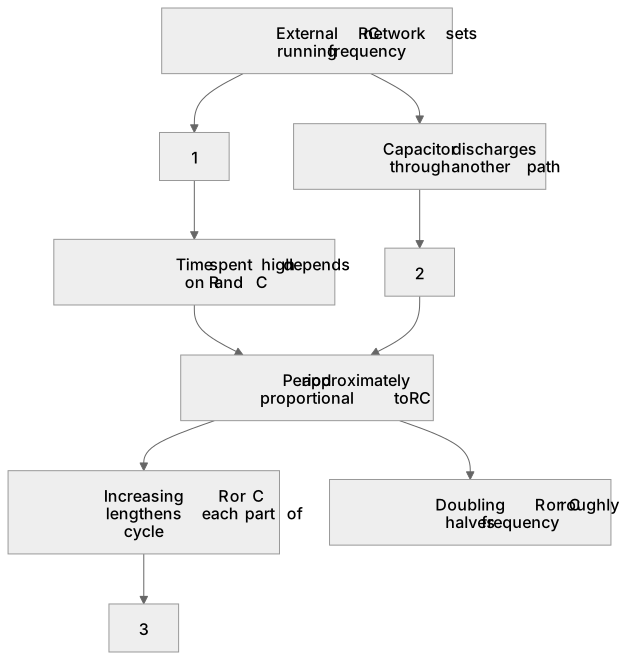
1Box 1
2Box 2
3Box 3
There is more to this lesson
The full lesson goes on to check your understanding and help you earn the marks. Create a free account to carry on, with your progress saved.
A week of Premium from your first lesson · Then the free plan continues · No card, no charge
Test your understanding of Astables (A-level only): Variation of running frequency using an external RC network.
Active recall beats re-reading. Take an instant quiz now to test what you’ve learned and lock it into long-term memory.
A week of Premium from your first lesson · Then the free plan continues · No card, no charge