AQA · A-Level · Physics
Course version: 7408 · Version from Sept 2016
Representation by graphical methods of uniform and non- uniform…
Full specification wording
Motion along a straight line: Representation by graphical methods of uniform and non- uniform acceleration.
Motion graphs represent acceleration by their shape.
Checked against the AQA 7408 specification (opens in a new tab) on .
- Point 2 of 4
- 4 key terms
Study notes
From the checked teaching notes for this specification point.
The idea
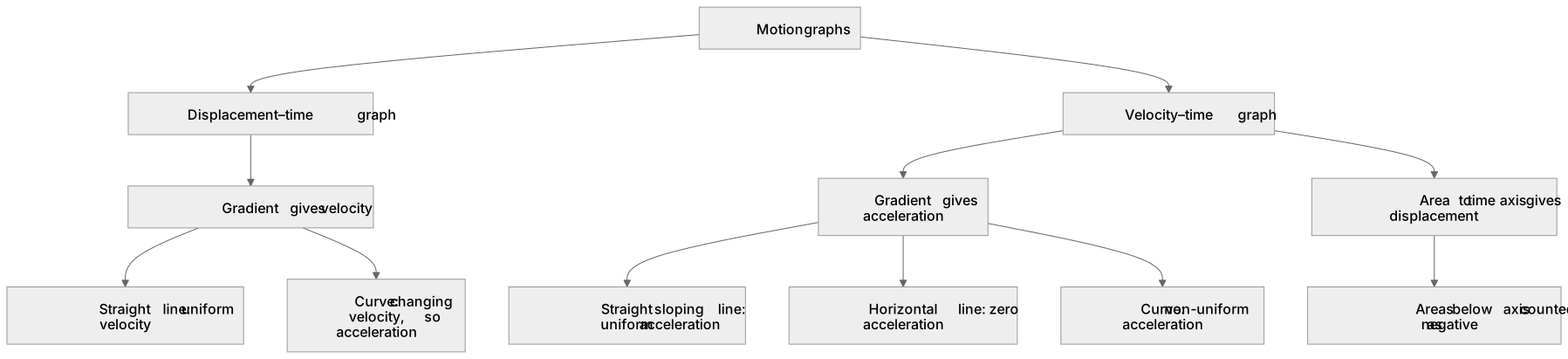
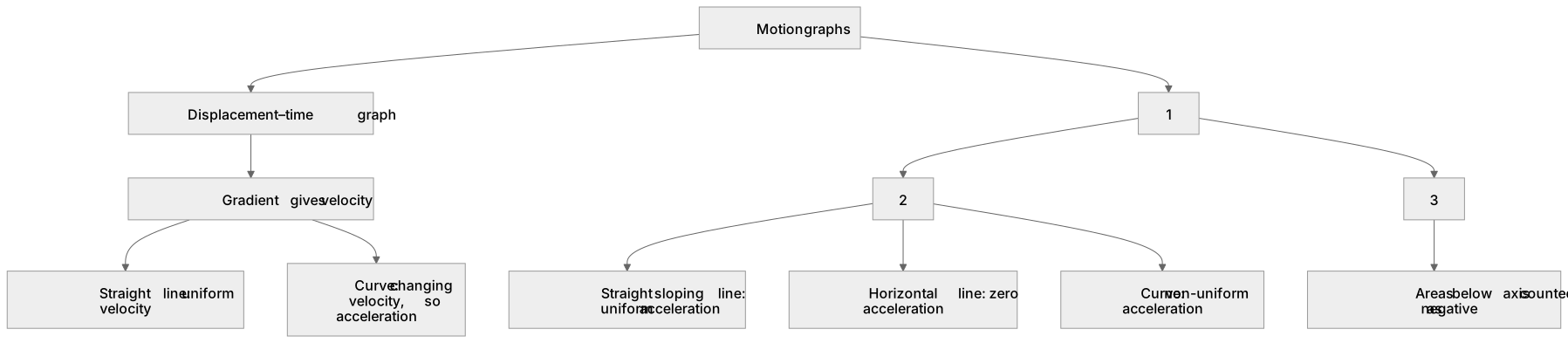
Motion graphs represent acceleration by their shape. On a displacement–time graph, the gradient gives velocity: a straight line means uniform velocity, while a curve means changing velocity and therefore acceleration. On a velocity–time graph, the gradient gives acceleration: a straight sloping line means uniform acceleration, a horizontal line means zero acceleration, and a curve means non-uniform acceleration. The area between the velocity–time graph and the time axis gives displacement, with areas below the axis counted as negative. To find a gradient, draw a tangent at the required instant and use Δv/Δt; to find displacement, split the area into triangles, rectangles or trapezia. A velocity–time graph that crosses the time axis shows a change of direction.
What earns the marks
- Interprets the gradient of a displacement–time graph as velocity, including the sign of the gradient.
- Interprets the gradient of a velocity–time graph as acceleration, using a tangent where the graph is curved.
- Recognises that a straight velocity–time line represents uniform acceleration and a curved line represents non-uniform acceleration.
- Finds displacement from the area under a velocity–time graph, treating areas below the time axis as negative.
- Sketches or selects graphs that match a described motion, such as constant velocity followed by uniform deceleration.
- Uses units and scales correctly when reading gradients and areas from axes.
Common mistakes and how to put them right
Reading the height of a velocity–time graph as displacement.
Put it right by using the area under the graph for displacement.
Treating a curved displacement–time graph as constant velocity.
Put it right by drawing tangents and noting that the gradient changes.
Ignoring the sign of areas below the time axis.
Put it right by subtracting those areas when finding displacement.
Using the whole graph gradient when an instantaneous acceleration is requested.
Put it right by drawing a tangent at the specified time.
Exam tips
- Label axes with quantity and unit before plotting or interpreting a graph.
- For curved graphs, draw a clear tangent at the required point and show the triangle used for the gradient.
- For area calculations, divide the region into simple shapes and state whether each area is positive or negative.
- Check that the gradient units follow from the axes, for example m s⁻¹ divided by s gives m s⁻².
Try the lesson
The start of the Motion along a straight line: Representation by graphical methods of uniform and non- uniform acceleration. lesson, made from checked teaching notes for this specification point.
Have a go first
On a velocity-time graph, a straight line sloping upwards from left to right represents which type of motion?
Listen
Motion graphs represent acceleration by their shape. On a displacement–time graph, the gradient gives velocity: a straight line means uniform velocity, while a curve means changing velocity and therefore acceleration. On a velocity–time graph, the gradient gives acceleration: a straight sloping line means uniform acceleration, a horizontal line means zero acceleration, and a curve means non-uniform acceleration. The area between the velocity–time graph and the time axis gives displacement, with areas below the axis counted as negative. To find a gradient, draw a tangent at the required instant and use Δv/Δt; to find displacement, split the area into triangles, rectangles or trapezia. A velocity–time graph that crosses the time axis shows a change of direction. A strong answer earns marks for these points. Interprets the gradient of a displacement–time graph as velocity, including the sign of the gradient. Interprets the gradient of a velocity–time graph as acceleration, using a tangent where the graph is curved. Recognises that a straight velocity–time line represents uniform acceleration and a curved line represents non-uniform acceleration. Finds displacement from the area under a velocity–time graph, treating areas below the time axis as negative. A common slip: Reading the height of a velocity–time graph as displacement. Instead, using the area under the graph for displacement. Exam tip: Label axes with quantity and unit before plotting or interpreting a graph.
See it
Key words
Say what each word means before you turn the card.
Gradient as a rate of change
Try answering aloud or in your head before turning the card.
Area under a graph as a product
Try answering aloud or in your head before turning the card.
Uniform and non-uniform acceleration
Try answering aloud or in your head before turning the card.
Sign and direction in motion graphs
Try answering aloud or in your head before turning the card.
See every definition
- Gradient as a rate of change
- On a displacement–time graph the gradient gives velocity, and on a velocity–time graph it gives acceleration, found using a tangent where the graph is curved.
- Area under a graph as a product
- The area between the velocity–time graph and the time axis gives displacement, with areas below the axis counted as negative.
- Uniform and non-uniform acceleration
- A straight sloping velocity–time line means uniform acceleration, a horizontal line means zero acceleration, and a curve means non-uniform acceleration.
- Sign and direction in motion graphs
- The sign of the gradient of a displacement–time graph is included in the velocity, and a velocity–time graph that crosses the time axis shows a change of direction.
Label the diagram
Some boxes have lost their names. Pick the right name for each number.
1Box 1
2Box 2
3Box 3
There is more to this lesson
The full lesson goes on to check your understanding and help you earn the marks. Create a free account to carry on, with your progress saved.
A week of Premium from your first lesson · Then the free plan continues · No card, no charge
Test your understanding of Motion along a straight line: Representation by graphical methods of uniform and non- uniform acceleration.
Active recall beats re-reading. Take an instant quiz now to test what you’ve learned and lock it into long-term memory.
A week of Premium from your first lesson · Then the free plan continues · No card, no charge