AQA · A-Level · Physics
Course version: 7408 · Version from Sept 2016
Projectile motion: Qualitative treatment of friction.
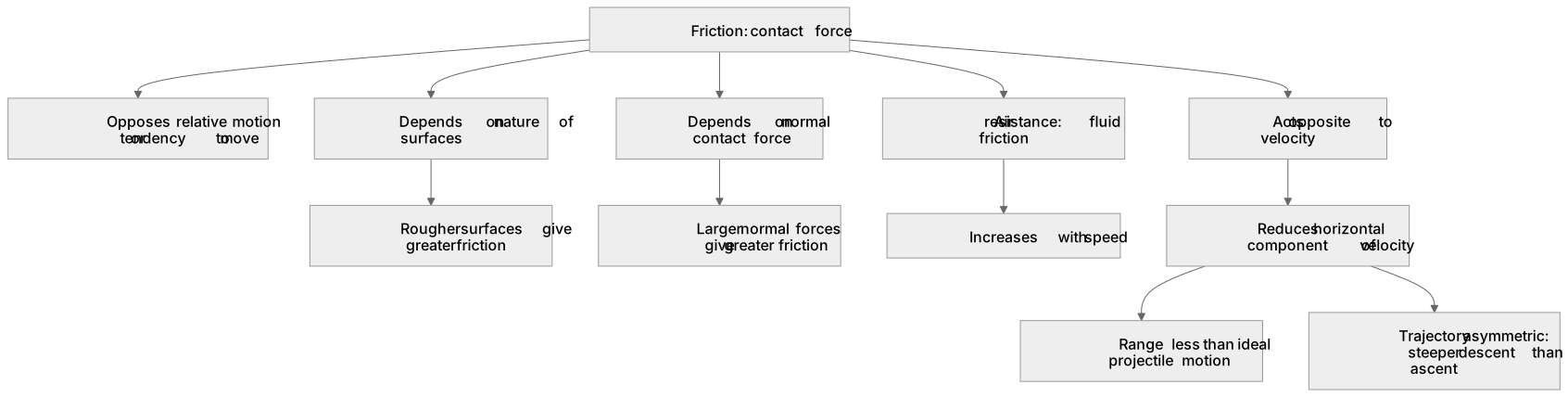
Friction is a contact force that opposes relative motion or the tendency to move between surfaces.
Checked against the AQA 7408 specification (opens in a new tab) on .
- Point 3 of 7
- 3 key terms
Study notes
From the checked teaching notes for this specification point.
The idea
Friction is a contact force that opposes relative motion or the tendency to move between surfaces. In projectile motion it acts opposite to the velocity, reducing horizontal range and altering the trajectory compared with ideal motion. Qualitatively, friction depends on the nature of the surfaces and the normal contact force: rougher surfaces and larger normal forces give greater friction. For a projectile, air resistance is a form of fluid friction that increases with speed, so the horizontal component of velocity decreases and the path becomes asymmetric, with a steeper descent than ascent. You should describe these effects in words and identify the direction of the frictional force without calculating coefficients.
What earns the marks
- States that friction acts in the opposite direction to the relative motion or attempted motion of the projectile through the medium.
- Explains that friction reduces the horizontal component of velocity, so the range is less than for ideal projectile motion.
- Describes that friction causes the trajectory to become asymmetric, with a steeper descent than ascent.
- Identifies that friction depends qualitatively on surface roughness and the normal contact force, and for air resistance increases with speed.
- Applies the qualitative idea to a named situation, such as a ball thrown through air or sliding on a rough surface, without numerical calculation.
Common mistakes and how to put them right
Treating friction as acting in the direction of motion.
Put it right by stating that friction opposes relative motion or attempted motion.
Assuming friction only affects vertical motion.
Put it right by explaining that friction also reduces the horizontal velocity component.
Believing friction is constant regardless of speed for air resistance.
Put it right by noting that air resistance increases with speed.
Exam tips
- Use the phrase 'opposes relative motion' when defining the direction of friction.
- Link friction explicitly to the reduced horizontal range and the asymmetric shape of the trajectory.
- Keep the treatment qualitative: describe effects in words rather than attempting calculations with coefficients.
Try the lesson
The start of the Projectile motion: Qualitative treatment of friction. lesson, made from checked teaching notes for this specification point.
Have a go first
A box slides across a rough horizontal floor and gradually slows down. What causes the box to slow down?
Listen
Friction is a contact force that opposes relative motion or the tendency to move between surfaces. In projectile motion it acts opposite to the velocity, reducing horizontal range and altering the trajectory compared with ideal motion. Qualitatively, friction depends on the nature of the surfaces and the normal contact force: rougher surfaces and larger normal forces give greater friction. For a projectile, air resistance is a form of fluid friction that increases with speed, so the horizontal component of velocity decreases and the path becomes asymmetric, with a steeper descent than ascent. You should describe these effects in words and identify the direction of the frictional force without calculating coefficients. A strong answer earns marks for these points. States that friction acts in the opposite direction to the relative motion or attempted motion of the projectile through the medium. Explains that friction reduces the horizontal component of velocity, so the range is less than for ideal projectile motion. Describes that friction causes the trajectory to become asymmetric, with a steeper descent than ascent. Identifies that friction depends qualitatively on surface roughness and the normal contact force, and for air resistance increases with speed. A common slip: Treating friction as acting in the direction of motion. Instead, stating that friction opposes relative motion or attempted motion. Exam tip: Use the phrase 'opposes relative motion' when defining the direction of friction.
See it
Key words
Say what each word means before you turn the card.
Friction
Try answering aloud or in your head before turning the card.
Air resistance
Try answering aloud or in your head before turning the card.
Qualitative treatment of friction
Try answering aloud or in your head before turning the card.
See every definition
- Friction
- A contact force that opposes relative motion or the tendency to move between surfaces.
- Air resistance
- A form of fluid friction that increases with speed and acts opposite to the velocity of a projectile.
- Qualitative treatment of friction
- Describing the effects of friction in words and identifying the direction of the frictional force without calculating coefficients.
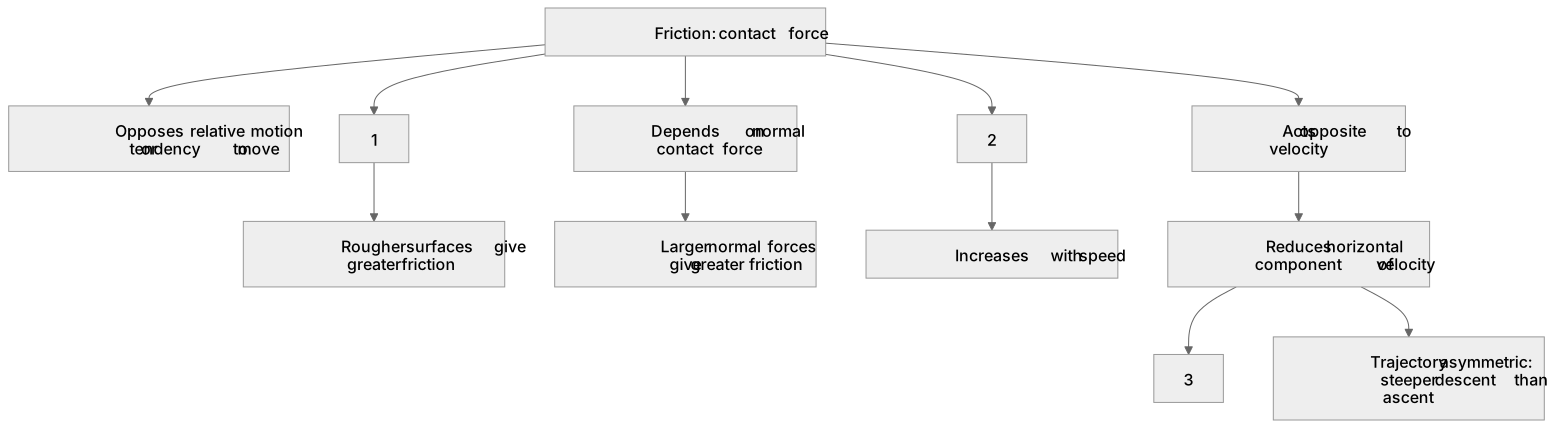
Label the diagram
Some boxes have lost their names. Pick the right name for each number.
1Box 1
2Box 2
3Box 3
There is more to this lesson
The full lesson goes on to check your understanding and help you earn the marks. Create a free account to carry on, with your progress saved.
A week of Premium from your first lesson · Then the free plan continues · No card, no charge
Test your understanding of Projectile motion: Qualitative treatment of friction.
Active recall beats re-reading. Take an instant quiz now to test what you’ve learned and lock it into long-term memory.
A week of Premium from your first lesson · Then the free plan continues · No card, no charge