AQA · A-Level · Physics
Course version: 7408 · Version from Sept 2016
Gain × bandwidth = constant for a given device.
Full specification wording
Real operational amplifiers (A-level only): gain × bandwidth = constant for a given device.
For a given operational amplifier, the product of voltage gain and bandwidth is approximately constant.
Checked against the AQA 7408 specification (opens in a new tab) on .
- Point 3 of 3
- 4 key terms
Study notes
From the checked teaching notes for this specification point.
The idea
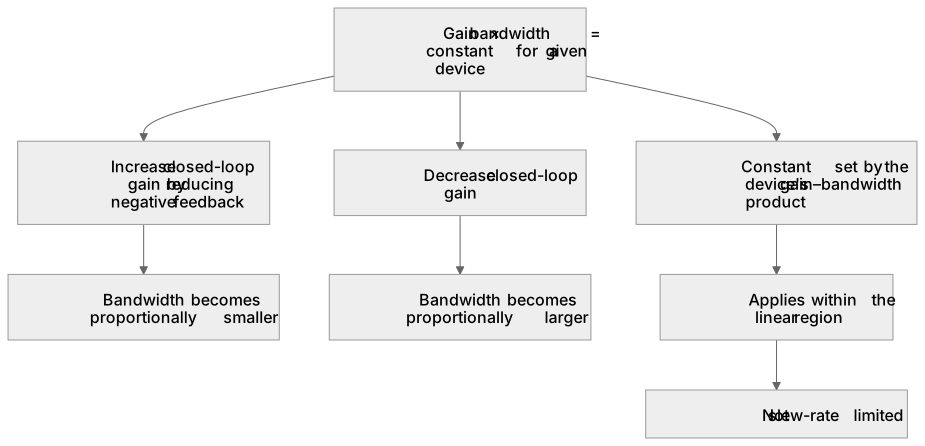
For a given operational amplifier, the product of voltage gain and bandwidth is approximately constant. This means that if you increase the closed-loop gain by reducing negative feedback, the bandwidth over which that gain is maintained becomes proportionally smaller, and vice versa. The constant is set by the device's gain–bandwidth product, often quoted in hertz. For example, an op-amp with a gain–bandwidth product of 1 × 10⁶ Hz gives a gain of 100 up to about 1 × 10⁴ Hz, or a gain of 10 up to about 1 × 10⁵ Hz. The relationship applies while the amplifier is operating within its linear region and is a useful design trade-off between amplification and frequency range.
What earns the marks
- The gain–bandwidth product is approximately constant for a given op-amp device.
- Increasing closed-loop gain reduces the available bandwidth in proportion.
- The constant may be found from the open-loop gain and the frequency at which gain has fallen by 3 dB.
- The relationship allows the bandwidth to be predicted for a chosen gain, or the gain to be predicted for a required bandwidth.
- The product is valid while the op-amp remains within its linear operating region and is not slew-rate limited.
- Typical units are hertz, since gain is a dimensionless ratio and bandwidth is a frequency.
Common mistakes and how to put them right
Adding gains and bandwidths instead of multiplying.
Put it right: Use the product gain × bandwidth and keep it constant.
Treating the constant as applying to all op-amps.
Put it right: Recognise that each device has its own gain–bandwidth product.
Using the signal frequency rather than the bandwidth limit.
Put it right: Identify the bandwidth as the range up to the 3 dB point.
Exam tips
- Write the relationship as gain × bandwidth = constant before substituting values.
- Check that the calculated bandwidth is a frequency and give the unit hertz.
- Use the relationship to compare two configurations of the same op-amp rather than comparing different devices.
Try the lesson
The start of the Real operational amplifiers (A-level only): gain × bandwidth = constant for a given device. lesson, made from checked teaching notes for this specification point.
Have a go first
For a given operational amplifier, the product of gain and bandwidth is constant. If the gain is increased, what happens to the bandwidth?
Listen
For a given operational amplifier, the product of voltage gain and bandwidth is approximately constant. This means that if you increase the closed-loop gain by reducing negative feedback, the bandwidth over which that gain is maintained becomes proportionally smaller, and vice versa. The constant is set by the device's gain–bandwidth product, often quoted in hertz. For example, an op-amp with a gain–bandwidth product of 1 × 10⁶ Hz gives a gain of 100 up to about 1 × 10⁴ Hz, or a gain of 10 up to about 1 × 10⁵ Hz. The relationship applies while the amplifier is operating within its linear region and is a useful design trade-off between amplification and frequency range. A strong answer earns marks for these points. The gain–bandwidth product is approximately constant for a given op-amp device. Increasing closed-loop gain reduces the available bandwidth in proportion. The constant may be found from the open-loop gain and the frequency at which gain has fallen by 3 dB. The relationship allows the bandwidth to be predicted for a chosen gain, or the gain to be predicted for a required bandwidth. A common slip: Adding gains and bandwidths instead of multiplying. Instead, use the product gain × bandwidth and keep it constant. Exam tip: Write the relationship as gain × bandwidth = constant before substituting values.
See it
Key words
Say what each word means before you turn the card.
Gain and bandwidth
Try answering aloud or in your head before turning the card.
Operational amplifier design trade-offs
Try answering aloud or in your head before turning the card.
Quantitative prediction
Try answering aloud or in your head before turning the card.
Frequency response
Try answering aloud or in your head before turning the card.
See every definition
- Gain and bandwidth
- For a given device, the product of voltage gain and bandwidth is approximately constant.
- Operational amplifier design trade-offs
- Increasing the closed-loop gain by reducing negative feedback makes the bandwidth over which that gain is maintained proportionally smaller, and vice versa.
- Quantitative prediction
- The relationship allows the bandwidth to be predicted for a chosen gain, or the gain to be predicted for a required bandwidth.
- Frequency response
- The bandwidth is the range up to the 3 dB point, and typical units are hertz since gain is a dimensionless ratio and bandwidth is a frequency.
Label the diagram
Some boxes have lost their names. Pick the right name for each number.
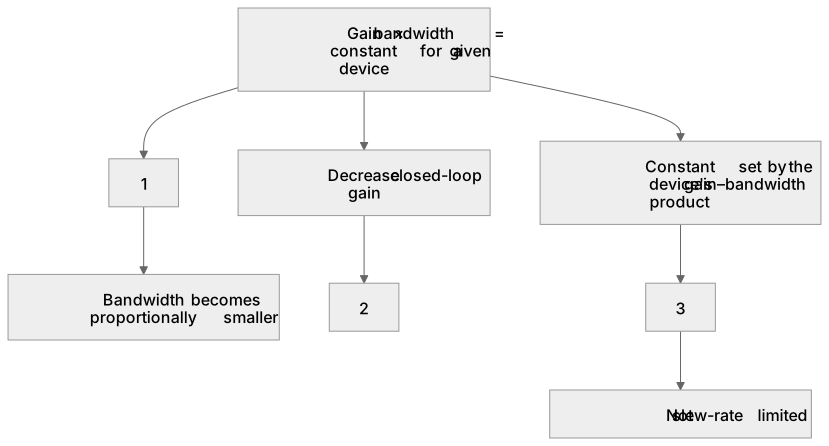
1Box 1
2Box 2
3Box 3
There is more to this lesson
The full lesson goes on to check your understanding and help you earn the marks. Create a free account to carry on, with your progress saved.
A week of Premium from your first lesson · Then the free plan continues · No card, no charge
Test your understanding of Real operational amplifiers (A-level only): gain × bandwidth = constant for a given device.
Active recall beats re-reading. Take an instant quiz now to test what you’ve learned and lock it into long-term memory.
A week of Premium from your first lesson · Then the free plan continues · No card, no charge