AQA · A-Level · Physics
Course version: 7408 · Version from Sept 2016
Applications eg to safe handling of radioactive sources.
Full specification wording
Rutherford scattering (A-level only): Applications eg to safe handling of radioactive sources.
This note covers radiation safety when handling radioactive sources.
Checked against the AQA 7408 specification (opens in a new tab) on .
- Point 5 of 8
- 3 key terms
Study notes
From the checked teaching notes for this specification point.
The idea
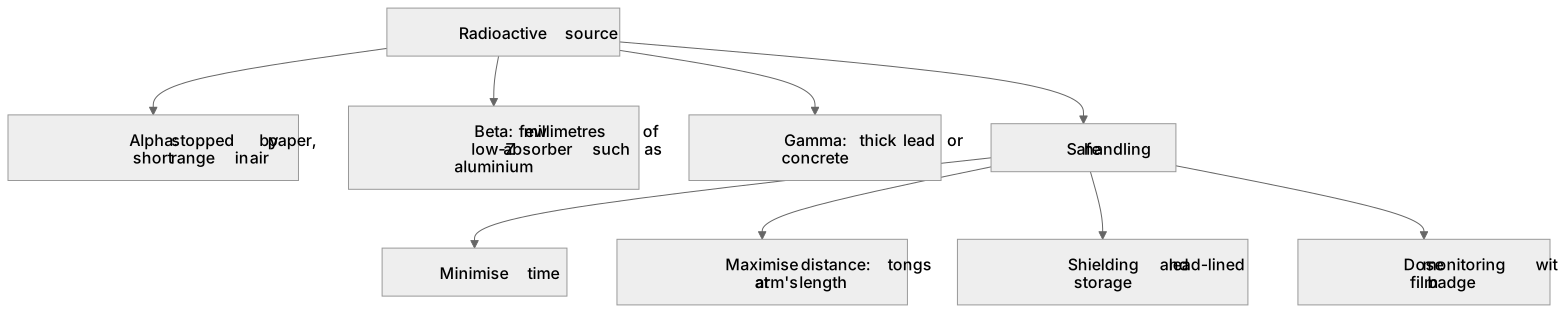
This note covers radiation safety when handling radioactive sources. Alpha particles are strongly ionising but travel only a few centimetres in air and are stopped by paper, so an alpha source is safe if kept outside the body. Beta particles need a few millimetres of a low-Z absorber like aluminium to minimise bremsstrahlung X-ray production, which high-Z materials like lead increase. Gamma rays need thick lead or concrete as they are highly penetrating. Safe handling uses time, distance and shielding: minimise exposure time, handle sources with tongs at arm's length, store them in lead-lined containers, and monitor dose with a film badge. These principles apply to all sources to prevent hazardous internal and external exposure.
What earns the marks
- Alpha particles are highly ionising but have a short range in air, so external exposure is low risk while internal exposure is serious.
- Beta particles require a few millimetres of a low-Z absorber such as aluminium or Perspex, as high-Z absorbers like lead produce more bremsstrahlung.
- Gamma rays are penetrating and need dense, thick shielding such as lead or concrete to attenuate them.
- Safe handling reduces dose by minimising time, maximising distance and using appropriate shielding.
- Sealed sources should be handled with tongs, stored in labelled containers and never pointed towards people.
- Dose monitoring with a film badge or Geiger–Müller tube provides evidence that exposure is being controlled.
Common mistakes and how to put them right
Thinking that any absorber stops all radiation.
Put it right: Is that alpha is stopped by paper, beta by a few millimetres of aluminium, and gamma is only attenuated by thick lead or concrete.
Believing distance does not matter because shielding is present.
Put it right: Is that intensity falls with distance, so tongs and remote handling reduce dose further.
Treating an alpha source as harmless because its range is short.
Put it right: Is that inhaled or swallowed alpha emitters deliver concentrated dose to living tissue and must be kept sealed.
Exam tips
- Name the radiation type and match it to a specific absorber with a reason, rather than writing 'lead stops radiation' for every case.
- Use the time–distance–shielding framework to structure safety answers and apply each factor to the source in the question.
- Remember that low-Z materials are preferred for shielding beta sources to minimise the production of penetrating bremsstrahlung X-rays.
Try the lesson
The start of the Rutherford scattering (A-level only): Applications eg to safe handling of radioactive sources. lesson, made from checked teaching notes for this specification point.
Have a go first
A teacher needs to transfer an unshielded gamma source from a lead-lined storage box to a demonstration bench. Which precaution most directly reduces the radiation dose received by the teacher?
Listen
This note covers radiation safety when handling radioactive sources. Alpha particles are strongly ionising but travel only a few centimetres in air and are stopped by paper, so an alpha source is safe if kept outside the body. Beta particles need a few millimetres of a low-Z absorber like aluminium to minimise bremsstrahlung X-ray production, which high-Z materials like lead increase. Gamma rays need thick lead or concrete as they are highly penetrating. Safe handling uses time, distance and shielding: minimise exposure time, handle sources with tongs at arm's length, store them in lead-lined containers, and monitor dose with a film badge. These principles apply to all sources to prevent hazardous internal and external exposure. A strong answer earns marks for these points. Alpha particles are highly ionising but have a short range in air, so external exposure is low risk while internal exposure is serious. Beta particles require a few millimetres of a low-Z absorber such as aluminium or Perspex, as high-Z absorbers like lead produce more bremsstrahlung. Gamma rays are penetrating and need dense, thick shielding such as lead or concrete to attenuate them. Safe handling reduces dose by minimising time, maximising distance and using appropriate shielding. A common slip: Thinking that any absorber stops all radiation. Instead, is that alpha is stopped by paper, beta by a few millimetres of aluminium, and gamma is only attenuated by thick lead or concrete. Exam tip: Name the radiation type and match it to a specific absorber with a reason, rather than writing 'lead stops radiation' for every case.
See it
Key words
Say what each word means before you turn the card.
Ionising radiation and penetration
Try answering aloud or in your head before turning the card.
Absorption and shielding
Try answering aloud or in your head before turning the card.
Dose reduction and safe practice
Try answering aloud or in your head before turning the card.
See every definition
- Ionising radiation and penetration
- Alpha particles are strongly ionising but travel only a few centimetres in air and are stopped by paper, while gamma rays are highly penetrating.
- Absorption and shielding
- Beta particles need a few millimetres of a low-Z absorber like aluminium, as high-Z materials like lead increase bremsstrahlung X-ray production; gamma rays need thick lead or concrete.
- Dose reduction and safe practice
- Minimise exposure time, handle sources with tongs at arm's length, store them in lead-lined containers, and monitor dose with a film badge.
Label the diagram
Some boxes have lost their names. Pick the right name for each number.
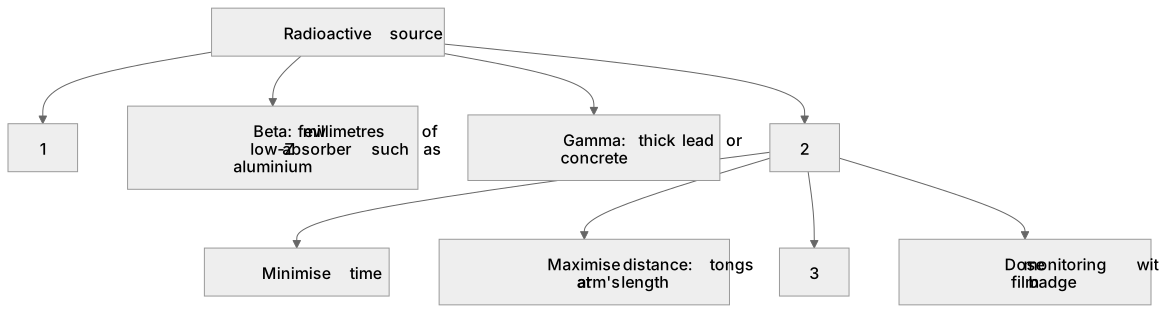
1Box 1
2Box 2
3Box 3
There is more to this lesson
The full lesson goes on to check your understanding and help you earn the marks. Create a free account to carry on, with your progress saved.
A week of Premium from your first lesson · Then the free plan continues · No card, no charge
Test your understanding of Rutherford scattering (A-level only): Applications eg to safe handling of radioactive sources.
Active recall beats re-reading. Take an instant quiz now to test what you’ve learned and lock it into long-term memory.
A week of Premium from your first lesson · Then the free plan continues · No card, no charge