AQA · A-Level · Physics
Course version: 7408 · Version from Sept 2016
Background radiation; examples of its origins and experimental elimination…
Full specification wording
Rutherford scattering (A-level only): Background radiation; examples of its origins and experimental elimination from calculations.
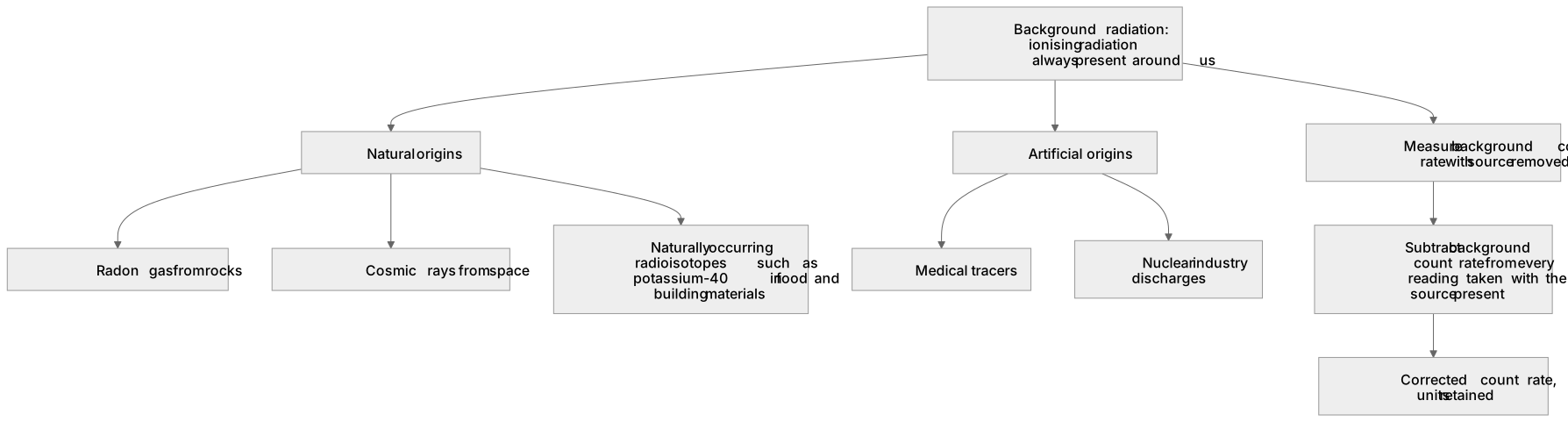
Background radiation is the ionising radiation always present around us.
Checked against the AQA 7408 specification (opens in a new tab) on .
- Point 6 of 8
- 4 key terms
Study notes
From the checked teaching notes for this specification point.
The idea
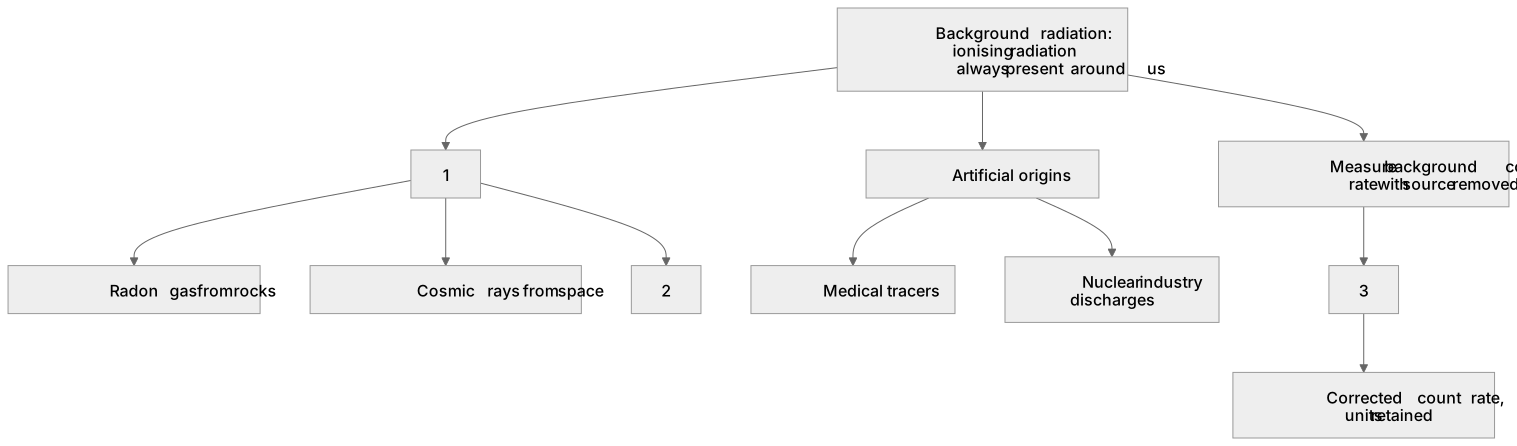
Background radiation is the ionising radiation always present around us. Its origins include radon gas from rocks, cosmic rays from space, naturally occurring radioisotopes such as potassium-40 in food and building materials, and artificial sources such as medical tracers and nuclear industry discharges. In any count-rate experiment, a detector records background counts even with no source present. To eliminate this from calculations, measure the background count rate with the source removed, then subtract it from every reading taken with the source present. For example, if a Geiger–Müller tube records 20 counts per minute with no source and 220 counts per minute with the source, the corrected count rate is 200 counts per minute. Repeating the background measurement and averaging reduces random variation, and using the same geometry and counting time keeps the comparison fair.
What earns the marks
- Background radiation is ionising radiation present in the environment when no source is deliberately introduced.
- Origins include radon gas, cosmic rays, naturally occurring radioisotopes such as potassium-40, and artificial sources such as medical or industrial use.
- A detector records background counts in addition to counts from the source, so raw readings overestimate source activity.
- The background count rate is measured with the source removed, ideally over the same counting time and repeated to average random fluctuations.
- Corrected count rate equals measured count rate minus background count rate, with units retained.
- Subtracting background improves the accuracy of half-life or absorption measurements by removing a constant offset.
Common mistakes and how to put them right
Forgetting to subtract background and reporting the raw count rate as the source count rate.
Put it right: Is to measure background with the source removed and subtract it from every reading.
Subtracting background only once from a total rather than from each individual reading.
Put it right: Is to subtract the background count rate from each measured count rate before plotting or averaging.
Assuming background is negligible because it is small.
Put it right: Is that background can be a large fraction of a weak source's count rate and must still be measured and subtracted.
Exam tips
- State clearly that background is measured with the source removed, then show the subtraction explicitly in your working.
- Keep units consistent, for example counts per minute minus counts per minute, and quote the corrected value with its unit.
- When describing improvements, mention repeating the background count and averaging to reduce the effect of random fluctuations.
Try the lesson
The start of the Rutherford scattering (A-level only): Background radiation; examples of its origins and experimental elimination from calculations. lesson, made from checked teaching notes for this specification point.
Have a go first
A Geiger-Müller tube placed in a laboratory with no radioactive sources nearby records a small count rate. Which of the following is a natural source of this background radiation?
Listen
Background radiation is the ionising radiation always present around us. Its origins include radon gas from rocks, cosmic rays from space, naturally occurring radioisotopes such as potassium-40 in food and building materials, and artificial sources such as medical tracers and nuclear industry discharges. In any count-rate experiment, a detector records background counts even with no source present. To eliminate this from calculations, measure the background count rate with the source removed, then subtract it from every reading taken with the source present. For example, if a Geiger–Müller tube records 20 counts per minute with no source and 220 counts per minute with the source, the corrected count rate is 200 counts per minute. Repeating the background measurement and averaging reduces random variation, and using the same geometry and counting time keeps the comparison fair. A strong answer earns marks for these points. Background radiation is ionising radiation present in the environment when no source is deliberately introduced. Origins include radon gas, cosmic rays, naturally occurring radioisotopes such as potassium-40, and artificial sources such as medical or industrial use. A detector records background counts in addition to counts from the source, so raw readings overestimate source activity. The background count rate is measured with the source removed, ideally over the same counting time and repeated to average random fluctuations. A common slip: Forgetting to subtract background and reporting the raw count rate as the source count rate. Instead, is to measure background with the source removed and subtract it from every reading. Exam tip: State clearly that background is measured with the source removed, then show the subtraction explicitly in your working.
See it
Key words
Say what each word means before you turn the card.
Background radiation
Try answering aloud or in your head before turning the card.
Corrected count rate
Try answering aloud or in your head before turning the card.
Random variation
Try answering aloud or in your head before turning the card.
Experimental accuracy in radioactivity
Try answering aloud or in your head before turning the card.
See every definition
- Background radiation
- Ionising radiation present in the environment when no source is deliberately introduced.
- Corrected count rate
- Measured count rate minus background count rate, with units retained.
- Random variation
- Fluctuation reduced by repeating the background measurement and averaging.
- Experimental accuracy in radioactivity
- Improved by subtracting background, removing a constant offset from half-life or absorption measurements.
Label the diagram
Some boxes have lost their names. Pick the right name for each number.
1Box 1
2Box 2
3Box 3
There is more to this lesson
The full lesson goes on to check your understanding and help you earn the marks. Create a free account to carry on, with your progress saved.
A week of Premium from your first lesson · Then the free plan continues · No card, no charge
Test your understanding of Rutherford scattering (A-level only): Background radiation; examples of its origins and experimental elimination from calculations.
Active recall beats re-reading. Take an instant quiz now to test what you’ve learned and lock it into long-term memory.
A week of Premium from your first lesson · Then the free plan continues · No card, no charge