AQA · A-Level · Physics
Course version: 7408 · Version from Sept 2016
Sensitivity and frequency response (A-level only): Definition of intensity.
Intensity is the power transferred per unit area perpendicular to the direction of energy flow, so I = P/A, measured in W m⁻².
Checked against the AQA 7408 specification (opens in a new tab) on .
- Point 3 of 3
- 3 key terms
Study notes
From the checked teaching notes for this specification point.
The idea
Intensity is the power transferred per unit area perpendicular to the direction of energy flow, so I = P/A, measured in W m⁻². It is a scalar describing how concentrated a wave's energy is, not the total energy emitted. For a point source radiating uniformly in three dimensions, the same power spreads over a sphere of area 4πr², giving I = P/(4πr²); doubling distance quarters intensity. In hearing contexts, intensity relates to loudness through the decibel scale, where a tenfold intensity increase corresponds to about 10 dB. When a surface is tilted, use the component of area perpendicular to the beam. Always identify the power and the area at right angles to the flow before substituting values.
What earns the marks
- States that intensity is power per unit area, with area measured perpendicular to the direction of energy transfer.
- Recalls the equation I = P/A and uses consistent units, typically W m⁻².
- Applies the inverse-square relationship I = P/(4πr²) for a point source radiating uniformly in all directions.
- Explains that intensity decreases with distance because the same power is spread over an increasing spherical surface area.
- Distinguishes intensity from total power: a source may emit constant power while intensity at a detector falls with distance.
- Uses the decibel relationship qualitatively or quantitatively to link intensity ratios to loudness changes.
Common mistakes and how to put them right
Using the total surface area of a sphere but forgetting the factor 4π, writing I = P/r².
Put it right: The corrected form is I = P/(4πr²).
Treating intensity as a vector and giving a direction.
Put it right: Intensity is a scalar, although energy flow has a direction.
Using the full area of a tilted surface rather than its component perpendicular to the beam.
Put it right: The corrected approach uses A cos θ.
Confusing intensity with amplitude.
Put it right: Intensity is proportional to amplitude squared for a given wave.
Exam tips
- Write the defining equation before substituting numbers so the power and perpendicular area are clearly identified.
- When a question mentions a point source, check whether the inverse-square law applies before calculating.
- Convert distances to metres and areas to square metres before evaluating intensity to avoid unit errors.
- Link any calculated intensity ratio to the decibel scale if the question asks about loudness or hearing.
Try the lesson
The start of the Sensitivity and frequency response (A-level only): Definition of intensity. lesson, made from checked teaching notes for this specification point.
Have a go first
Which quantity is defined as the power incident per unit area on a surface?
Listen
Intensity is the power transferred per unit area perpendicular to the direction of energy flow, so I = P/A, measured in W m⁻². It is a scalar describing how concentrated a wave's energy is, not the total energy emitted. For a point source radiating uniformly in three dimensions, the same power spreads over a sphere of area 4πr², giving I = P/(4πr²); doubling distance quarters intensity. In hearing contexts, intensity relates to loudness through the decibel scale, where a tenfold intensity increase corresponds to about 10 dB. When a surface is tilted, use the component of area perpendicular to the beam. Always identify the power and the area at right angles to the flow before substituting values. A strong answer earns marks for these points. States that intensity is power per unit area, with area measured perpendicular to the direction of energy transfer. Recalls the equation I = P/A and uses consistent units, typically W m⁻². Applies the inverse-square relationship I = P/(4πr²) for a point source radiating uniformly in all directions. Explains that intensity decreases with distance because the same power is spread over an increasing spherical surface area. Exam tip: Write the defining equation before substituting numbers so the power and perpendicular area are clearly identified.
See it
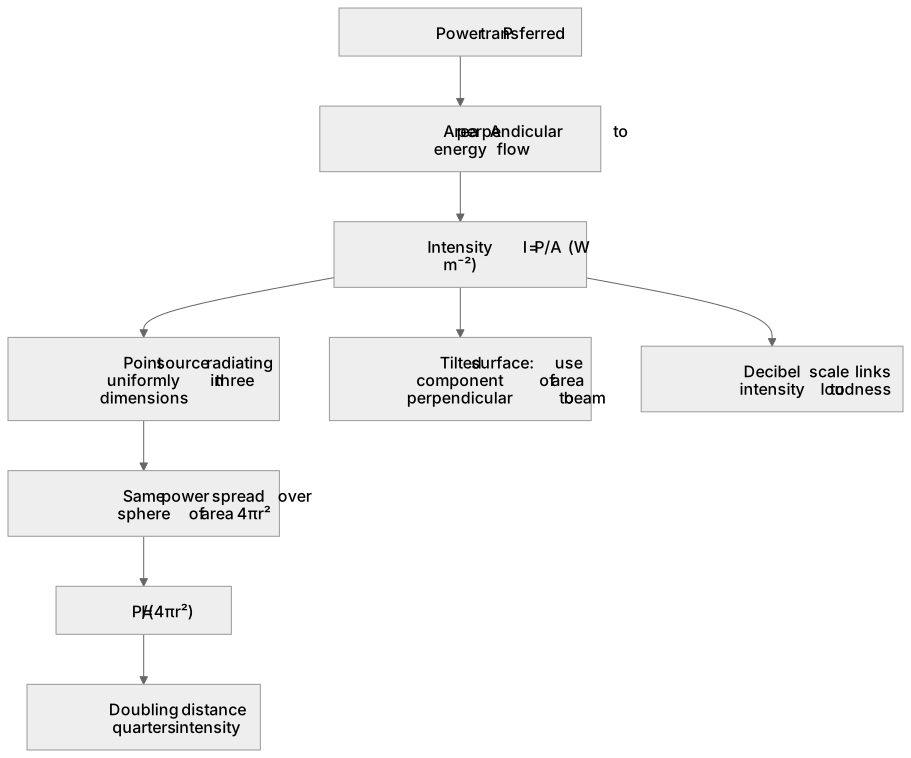
Key words
Say what each word means before you turn the card.
Intensity
Try answering aloud or in your head before turning the card.
Inverse-square relationship
Try answering aloud or in your head before turning the card.
Decibel scale
Try answering aloud or in your head before turning the card.
See every definition
- Intensity
- The power transferred per unit area perpendicular to the direction of energy flow, measured in W m⁻².
- Inverse-square relationship
- For a point source radiating uniformly in all directions, the same power spreads over a sphere of area 4πr², giving I = P/(4πr²).
- Decibel scale
- A scale relating intensity to loudness, where a tenfold intensity increase corresponds to about 10 dB.
Label the diagram
Some boxes have lost their names. Pick the right name for each number.
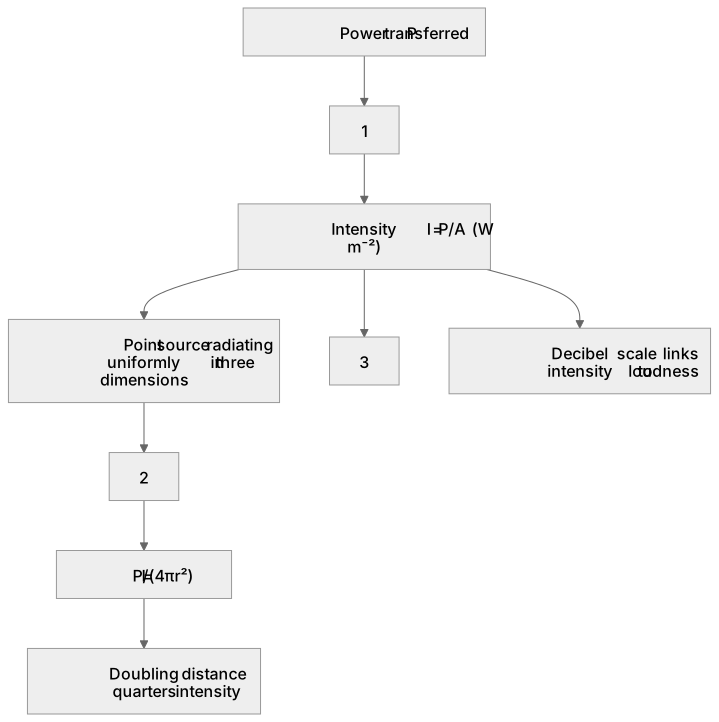
1Box 1
2Box 2
3Box 3
There is more to this lesson
The full lesson goes on to check your understanding and help you earn the marks. Create a free account to carry on, with your progress saved.
A week of Premium from your first lesson · Then the free plan continues · No card, no charge
Test your understanding of Sensitivity and frequency response (A-level only): Definition of intensity.
Active recall beats re-reading. Take an instant quiz now to test what you’ve learned and lock it into long-term memory.
A week of Premium from your first lesson · Then the free plan continues · No card, no charge