AQA · A-Level · Physics
Course version: 7408 · Version from Sept 2016
Human perception of relative intensity levels and the need for a…
Full specification wording
Sensitivity and frequency response (A-level only): Human perception of relative intensity levels and the need for a logarithmic scale to reflect this.
Human hearing responds to a very wide range of sound intensities, from about 1 × 10⁻¹² W m⁻² at the threshold to around 1 W m⁻² at the pain threshold, a ratio of about 10¹².
Checked against the AQA 7408 specification (opens in a new tab) on .
- Point 2 of 3
- 4 key terms
Study notes
From the checked teaching notes for this specification point.
The idea
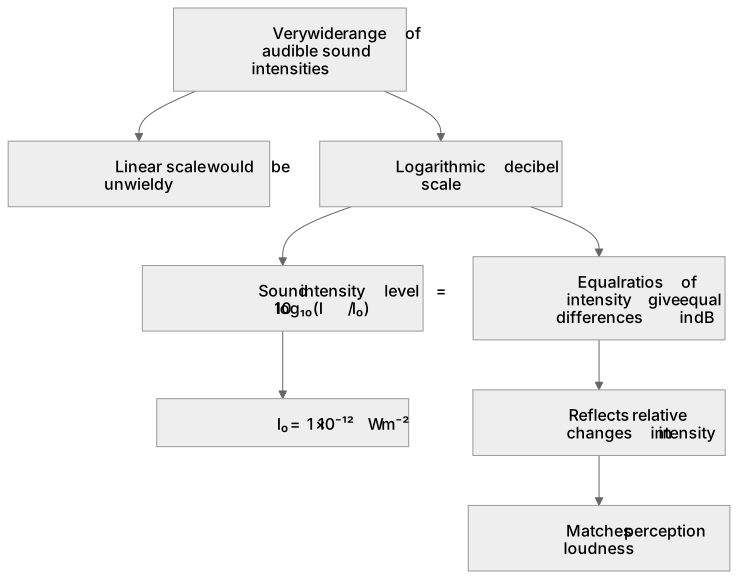
Human hearing responds to a very wide range of sound intensities, from about 1 × 10⁻¹² W m⁻² at the threshold to around 1 W m⁻² at the pain threshold, a ratio of about 10¹². A linear scale would compress most everyday sounds into a tiny part of the range and make comparisons awkward. The logarithmic decibel scale compresses this range: sound intensity level in dB is 10 log₁₀(I / I₀), where I₀ is 1 × 10⁻¹² W m⁻². Equal ratios of intensity correspond to equal differences in dB, which matches the way loudness is perceived: a sound must increase by roughly a factor of ten in intensity to be heard as about twice as loud. Thus the logarithmic scale reflects relative, rather than absolute, changes in intensity.
What earns the marks
- State that the ear detects sound intensities spanning many orders of magnitude, so a linear intensity scale would be unwieldy.
- Define sound intensity level using the logarithmic relationship 10 log₁₀(I / I₀), with I₀ equal to 1 × 10⁻¹² W m⁻².
- Explain that equal ratios of intensity produce equal differences in decibels, so the scale reflects relative changes in intensity.
- Relate the logarithmic scale to perception by noting that a tenfold increase in intensity corresponds to an increase of 10 dB and is heard as a modest change in loudness.
- Use the scale to compare sounds, for example recognising that 60 dB is 10³ times the intensity of 30 dB because the difference is 30 dB.
Common mistakes and how to put them right
Treating the decibel value as directly proportional to intensity.
Put it right by using the logarithmic relationship and noting that equal dB differences correspond to equal intensity ratios.
Using the wrong reference intensity or omitting I₀ when calculating sound intensity level.
Put it right by stating that I₀ is 1 × 10⁻¹² W m⁻².
Assuming a 10 dB increase doubles loudness.
Put it right by explaining that a tenfold intensity increase of 10 dB is perceived as only a moderate loudness change, often described as roughly a doubling of perceived loudness.
Exam tips
- Quote the logarithmic equation and the reference intensity when explaining why the decibel scale is used.
- Convert between intensity ratios and dB differences by using powers of ten, for example a 20 dB difference corresponds to an intensity ratio of 10².
- Link the mathematical compression of the scale to the everyday observation that very large intensity changes are heard as moderate loudness changes.
Try the lesson
The start of the Sensitivity and frequency response (A-level only): Human perception of relative intensity levels and the need for a logarithmic scale to reflect this. lesson, made from checked teaching notes for this specification point.
Have a go first
Why is a logarithmic scale used for sound intensity level rather than a linear scale of intensity?
Listen
Human hearing responds to a very wide range of sound intensities, from about 1 × 10⁻¹² W m⁻² at the threshold to around 1 W m⁻² at the pain threshold, a ratio of about 10¹². A linear scale would compress most everyday sounds into a tiny part of the range and make comparisons awkward. The logarithmic decibel scale compresses this range: sound intensity level in dB is 10 log₁₀(I / I₀), where I₀ is 1 × 10⁻¹² W m⁻². Equal ratios of intensity correspond to equal differences in dB, which matches the way loudness is perceived: a sound must increase by roughly a factor of ten in intensity to be heard as about twice as loud. Thus the logarithmic scale reflects relative, rather than absolute, changes in intensity. A strong answer earns marks for these points. State that the ear detects sound intensities spanning many orders of magnitude, so a linear intensity scale would be unwieldy. Define sound intensity level using the logarithmic relationship 10 log₁₀(I / I₀), with I₀ equal to 1 × 10⁻¹² W m⁻². Explain that equal ratios of intensity produce equal differences in decibels, so the scale reflects relative changes in intensity. Relate the logarithmic scale to perception by noting that a tenfold increase in intensity corresponds to an increase of 10 dB and is heard as a modest change in loudness. A common slip: Treating the decibel value as directly proportional to intensity. Instead, using the logarithmic relationship and noting that equal dB differences correspond to equal intensity ratios. Exam tip: Quote the logarithmic equation and the reference intensity when explaining why the decibel scale is used.
See it
Key words
Say what each word means before you turn the card.
Logarithmic scale
Try answering aloud or in your head before turning the card.
Sound intensity level
Try answering aloud or in your head before turning the card.
Loudness perception
Try answering aloud or in your head before turning the card.
Relative intensity
Try answering aloud or in your head before turning the card.
See every definition
- Logarithmic scale
- A scale that compresses the very wide range of sound intensities, so that equal ratios of intensity correspond to equal differences in decibels.
- Sound intensity level
- A quantity in dB given by 10 log₁₀(I / I₀), where I₀ is 1 × 10⁻¹² W m⁻².
- Loudness perception
- The way loudness is perceived, in which a sound must increase by roughly a factor of ten in intensity to be heard as about twice as loud.
- Relative intensity
- The comparison of intensity levels in which equal ratios of intensity produce equal differences in decibels, reflecting relative rather than absolute changes.
Label the diagram
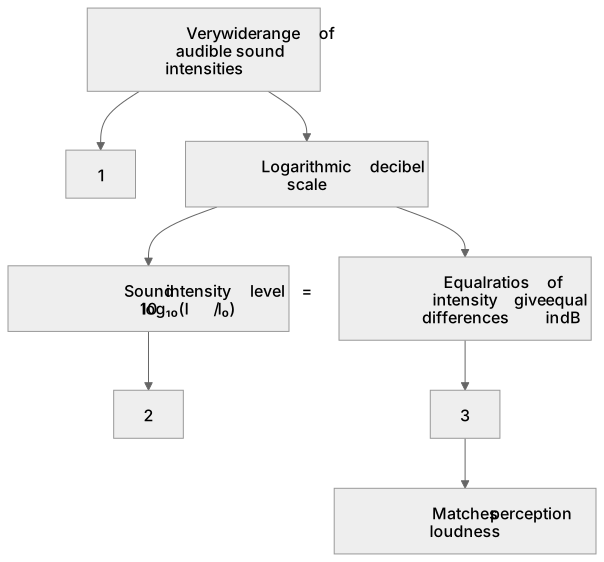
Some boxes have lost their names. Pick the right name for each number.
1Box 1
2Box 2
3Box 3
There is more to this lesson
The full lesson goes on to check your understanding and help you earn the marks. Create a free account to carry on, with your progress saved.
A week of Premium from your first lesson · Then the free plan continues · No card, no charge
Test your understanding of Sensitivity and frequency response (A-level only): Human perception of relative intensity levels and the need for a logarithmic scale to reflect this.
Active recall beats re-reading. Take an instant quiz now to test what you’ve learned and lock it into long-term memory.
A week of Premium from your first lesson · Then the free plan continues · No card, no charge