AQA · A-Level · Physics
Course version: 7408 · Version from Sept 2016
Comparison of energy output with total energy output of the Sun.
Full specification wording
Supernovae, neutron stars and black holes (A-level only): Comparison of energy output with total energy output of the Sun.
A supernova can briefly outshine a galaxy, so its energy output is often compared with the Sun's total energy output.
Checked against the AQA 7408 specification (opens in a new tab) on .
- Point 3 of 6
- 4 key terms
Study notes
From the checked teaching notes for this specification point.
The idea
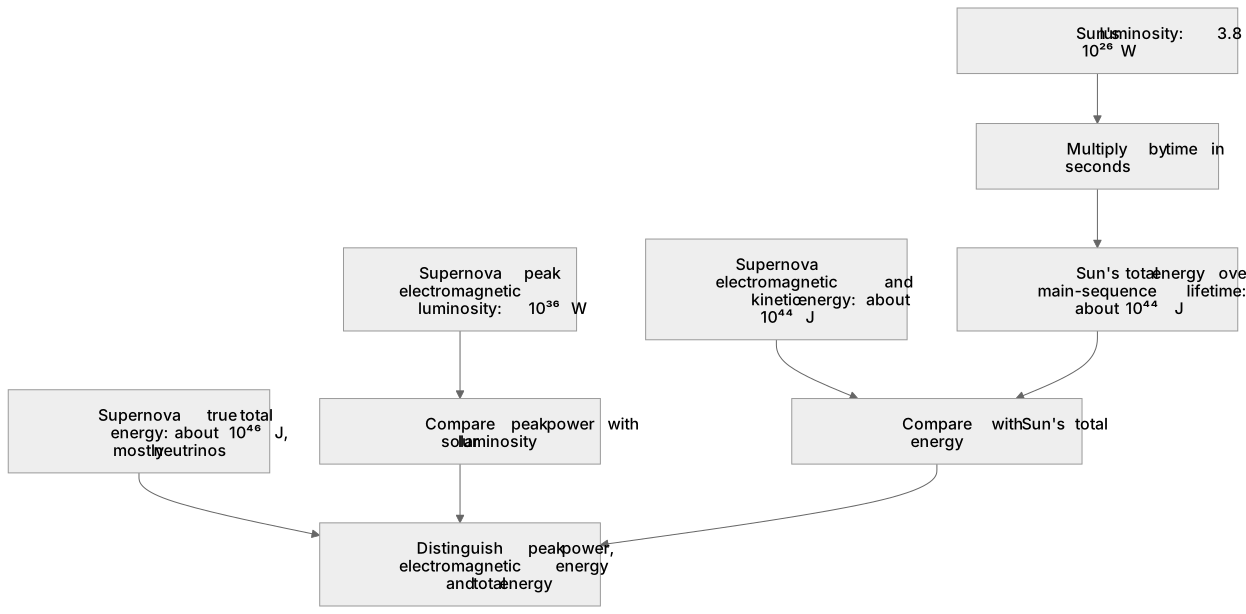
A supernova can briefly outshine a galaxy, so its energy output is often compared with the Sun's total energy output. The Sun's luminosity is about 3.8 × 10²⁶ W. To find the Sun's total energy output over its 10-billion-year main-sequence lifetime, use E = P t, yielding roughly 1.2 × 10⁴⁴ J. A core-collapse supernova reaches a peak electromagnetic luminosity of 10³⁶ W. The electromagnetic and kinetic energy released by a supernova is about 10⁴⁴ J, meaning a single explosion releases roughly the same amount of visible and kinetic energy as the Sun does over its entire lifetime. However, the true total energy released is much higher, approximately 10⁴⁶ J, mostly emitted as neutrinos over a few seconds. When comparing, always distinguish between peak power, electromagnetic energy, and total energy.
What earns the marks
- State that the Sun's luminosity (power) is approximately 3.8 × 10²⁶ W, which must be multiplied by time to find total energy.
- Calculate total energy output using E = P t, ensuring power is in watts and time is converted to seconds.
- Compare peak supernova luminosity (about 10³⁶ W) with solar luminosity, giving a power ratio of roughly 2.6 × 10⁹.
- Compare energy released: a supernova's electromagnetic and kinetic energy is about 10⁴⁴ J, matching the Sun's total energy output over its entire main-sequence lifetime.
- Recognise that a supernova's true total energy is approximately 10⁴⁶ J (mostly emitted as neutrinos), which is significantly larger than its electromagnetic output.
Common mistakes and how to put them right
Confusing power and energy.
Put it right: Multiply luminosity (power) by time in seconds to obtain total energy in joules.
Using inconsistent time units, such as years with watts, without converting to seconds.
Put it right: Convert all times to seconds before calculating E = P t.
Assuming a supernova's 10⁴⁴ J output represents its absolute total energy.
Put it right: 10⁴⁴ J is the electromagnetic and kinetic energy; the true total energy is roughly 10⁴⁶ J, mostly emitted as neutrinos.
Exam tips
- Show the equation E = P t explicitly and substitute values with units before forming any ratio.
- When asked to compare, state the ratio and interpret it in words, for example that the supernova's peak power is billions of times greater than the Sun's.
Try the lesson
The start of the Supernovae, neutron stars and black holes (A-level only): Comparison of energy output with total energy output of the Sun. lesson, made from checked teaching notes for this specification point.
Have a go first
Which statement correctly compares the energy released by a supernova with the energy output of the Sun?
Listen
A supernova can briefly outshine a galaxy, so its energy output is often compared with the Sun's total energy output. The Sun's luminosity is about 3.8 × 10²⁶ W. To find the Sun's total energy output over its 10-billion-year main-sequence lifetime, use E = P t, yielding roughly 1.2 × 10⁴⁴ J. A core-collapse supernova reaches a peak electromagnetic luminosity of 10³⁶ W. The electromagnetic and kinetic energy released by a supernova is about 10⁴⁴ J, meaning a single explosion releases roughly the same amount of visible and kinetic energy as the Sun does over its entire lifetime. However, the true total energy released is much higher, approximately 10⁴⁶ J, mostly emitted as neutrinos over a few seconds. When comparing, always distinguish between peak power, electromagnetic energy, and total energy. A strong answer earns marks for these points. State that the Sun's luminosity (power) is approximately 3.8 × 10²⁶ W, which must be multiplied by time to find total energy. Calculate total energy output using E = P t, ensuring power is in watts and time is converted to seconds. Compare peak supernova luminosity (about 10³⁶ W) with solar luminosity, giving a power ratio of roughly 2.6 × 10⁹. Compare energy released: a supernova's electromagnetic and kinetic energy is about 10⁴⁴ J, matching the Sun's total energy output over its entire main-sequence lifetime. A common slip: Confusing power and energy: quoting the Sun's luminosity in watts as if it were total energy. Instead, multiply luminosity (power) by time in seconds to obtain total energy in joules. Exam tip: Show the equation E = P t explicitly and substitute values with units before forming any ratio.
See it
Key words
Say what each word means before you turn the card.
Luminosity
Try answering aloud or in your head before turning the card.
Total energy output
Try answering aloud or in your head before turning the card.
Peak power
Try answering aloud or in your head before turning the card.
Electromagnetic and kinetic energy
Try answering aloud or in your head before turning the card.
See every definition
- Luminosity
- Power of about 3.8 × 10²⁶ W for the Sun, which must be multiplied by time to find total energy.
- Total energy output
- Found using E = P t, with power in watts and time converted to seconds, giving roughly 1.2 × 10⁴⁴ J for the Sun over its lifetime.
- Peak power
- A core-collapse supernova reaches a peak electromagnetic luminosity of 10³⁶ W, roughly 2.6 × 10⁹ times the solar luminosity.
- Electromagnetic and kinetic energy
- About 10⁴⁴ J released by a supernova, roughly the same as the Sun does over its entire lifetime.
Label the diagram
Some boxes have lost their names. Pick the right name for each number.
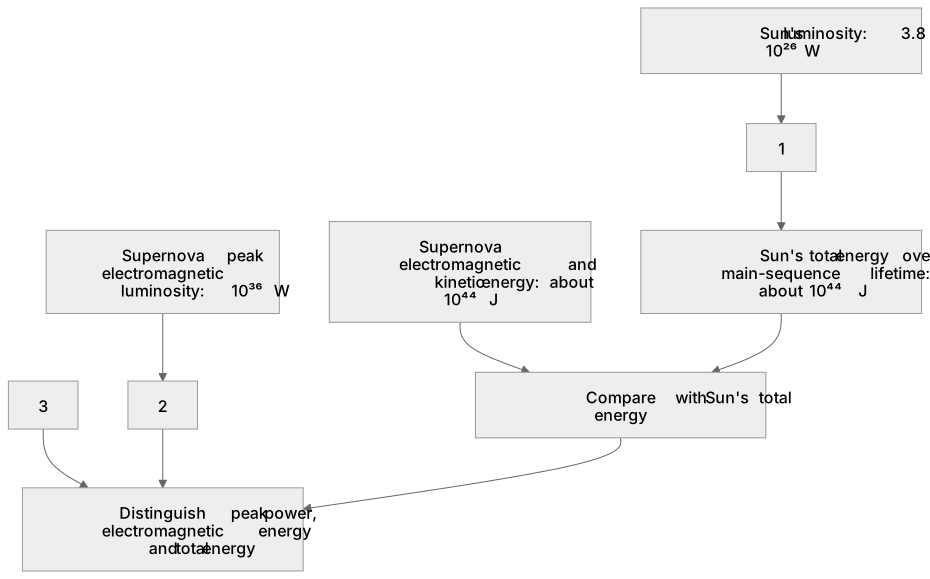
1Box 1
2Box 2
3Box 3
There is more to this lesson
The full lesson goes on to check your understanding and help you earn the marks. Create a free account to carry on, with your progress saved.
A week of Premium from your first lesson · Then the free plan continues · No card, no charge
Test your understanding of Supernovae, neutron stars and black holes (A-level only): Comparison of energy output with total energy output of the Sun.
Active recall beats re-reading. Take an instant quiz now to test what you’ve learned and lock it into long-term memory.
A week of Premium from your first lesson · Then the free plan continues · No card, no charge