AQA · A-Level · Physics
Course version: 7408 · Version from Sept 2016
Use of type 1a supernovae as standard candles to determine distances.…
Full specification wording
Supernovae, neutron stars and black holes (A-level only): Use of type 1a supernovae as standard candles to determine distances. Controversy concerning accelerating Universe and dark energy.
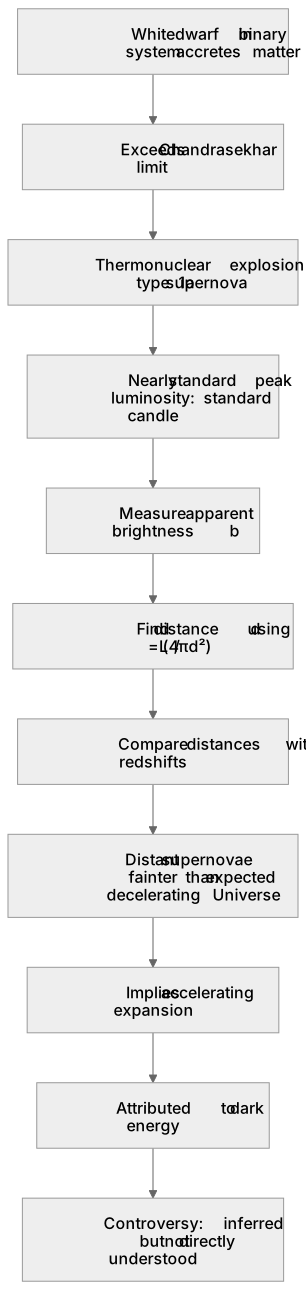
Type 1a supernovae occur when a white dwarf in a binary system accretes matter and exceeds the Chandrasekhar limit, triggering a thermonuclear explosion.
Checked against the AQA 7408 specification (opens in a new tab) on .
- Point 4 of 6
- 3 key terms
Study notes
From the checked teaching notes for this specification point.
The idea
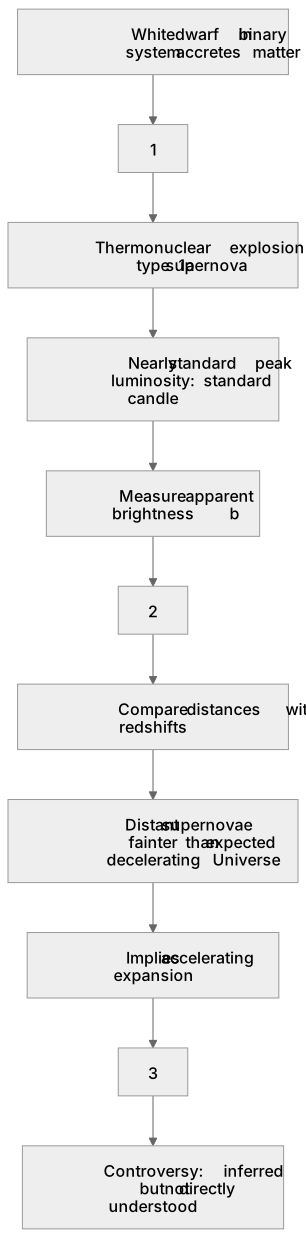
Type 1a supernovae occur when a white dwarf in a binary system accretes matter and exceeds the Chandrasekhar limit, triggering a thermonuclear explosion. Because the trigger mass is nearly the same, their peak luminosity is nearly standard, so they act as standard candles. Astronomers measure apparent brightness b and use b = L / (4πd²) to find distance d, or use the distance modulus m − M = 5 log₁₀(d / 10 pc). Comparing distances with redshifts shows that distant supernovae are fainter than expected in a decelerating universe, implying accelerated expansion. This is attributed to dark energy, a controversial component making up about 68% of the energy density of the Universe.
What earns the marks
- Explain that type 1a supernovae have a consistent peak luminosity because they explode at a similar trigger mass, the Chandrasekhar limit.
- Use the inverse-square law b = L / (4πd²) to relate apparent brightness to distance for a standard candle.
- Apply the distance modulus m − M = 5 log₁₀(d / 10 pc) to determine distance from apparent and absolute magnitudes.
- Describe how comparing supernova distances with their redshifts tests the expansion history of the Universe.
- Explain that observed dimming of distant supernovae indicates accelerating expansion, attributed to dark energy.
- Discuss the controversy: dark energy is inferred but not directly understood, and its nature remains an open problem in physics.
Common mistakes and how to put them right
Treating type 1a supernovae as perfectly identical in peak luminosity.
Put it right: Describe them as standardisable candles, since corrections for light-curve shape and colour reduce scatter.
Using the inverse-square law with luminosity in solar units and distance in parsecs without converting.
Put it right: Use SI units, converting parsecs to metres, or use the distance modulus consistently.
Claiming that dark energy has been directly detected.
Put it right: State that it is inferred from supernova data and other observations, and its nature is not yet known.
Exam tips
- State clearly that the standard candle assumption relies on a known absolute magnitude M before using the distance modulus.
- Show the rearrangement of b = L / (4πd²) to d = √(L / (4πb)) when calculating distance.
- When discussing dark energy, distinguish between observational evidence and theoretical interpretation.
Try the lesson
The start of the Supernovae, neutron stars and black holes (A-level only): Use of type 1a supernovae as standard candles to determine distances. Controversy concerning accelerating Universe and dark energy. lesson, made from checked teaching notes for this specification point.
Have a go first
Type 1a supernovae are used as standard candles in astronomy. What property makes them suitable for determining distances to distant galaxies?
Listen
Type 1a supernovae occur when a white dwarf in a binary system accretes matter and exceeds the Chandrasekhar limit, triggering a thermonuclear explosion. Because the trigger mass is nearly the same, their peak luminosity is nearly standard, so they act as standard candles. Astronomers measure apparent brightness b and use b = L / (4πd²) to find distance d, or use the distance modulus m − M = 5 log₁₀(d / 10 pc). Comparing distances with redshifts shows that distant supernovae are fainter than expected in a decelerating universe, implying accelerated expansion. This is attributed to dark energy, a controversial component making up about 68% of the energy density of the Universe. A strong answer earns marks for these points. Explain that type 1a supernovae have a consistent peak luminosity because they explode at a similar trigger mass, the Chandrasekhar limit. Use the inverse-square law b = L / (4πd²) to relate apparent brightness to distance for a standard candle. Apply the distance modulus m − M = 5 log₁₀(d / 10 pc) to determine distance from apparent and absolute magnitudes. Describe how comparing supernova distances with their redshifts tests the expansion history of the Universe. A common slip: Treating type 1a supernovae as perfectly identical in peak luminosity. Instead, describe them as standardisable candles, since corrections for light-curve shape and colour reduce scatter. Exam tip: State clearly that the standard candle assumption relies on a known absolute magnitude M before using the distance modulus.
See it
Key words
Say what each word means before you turn the card.
standard candles
Try answering aloud or in your head before turning the card.
dark energy
Try answering aloud or in your head before turning the card.
distance modulus
Try answering aloud or in your head before turning the card.
See every definition
- standard candles
- Type 1a supernovae have a nearly standard peak luminosity because they explode at a similar trigger mass, the Chandrasekhar limit, so they act as standard candles.
- dark energy
- A controversial component making up about 68% of the energy density of the Universe, to which accelerated expansion is attributed.
- distance modulus
- The relation m − M = 5 log₁₀(d / 10 pc), used to determine distance from apparent and absolute magnitudes.
Label the diagram
Some boxes have lost their names. Pick the right name for each number.
1Box 1
2Box 2
3Box 3
There is more to this lesson
The full lesson goes on to check your understanding and help you earn the marks. Create a free account to carry on, with your progress saved.
A week of Premium from your first lesson · Then the free plan continues · No card, no charge
Test your understanding of Supernovae, neutron stars and black holes (A-level only): Use of type 1a supernovae as standard candles to determine distances. Controversy concerning accelerating Universe and dark energy.
Active recall beats re-reading. Take an instant quiz now to test what you’ve learned and lock it into long-term memory.
A week of Premium from your first lesson · Then the free plan continues · No card, no charge