AQA · A-Level · Physics
Course version: 7408 · Version from Sept 2016
Piezoelectric devices Principles of generation and detection of ultrasound…
Full specification wording
Ultrasound imaging (A-level only): Piezoelectric devices Principles of generation and detection of ultrasound pulses.
A piezoelectric crystal, often lead zirconate titanate, changes shape when a voltage is applied and produces a voltage when deformed.
Checked against the AQA 7408 specification (opens in a new tab) on .
- Point 3 of 5
- 4 key terms
Study notes
From the checked teaching notes for this specification point.
The idea
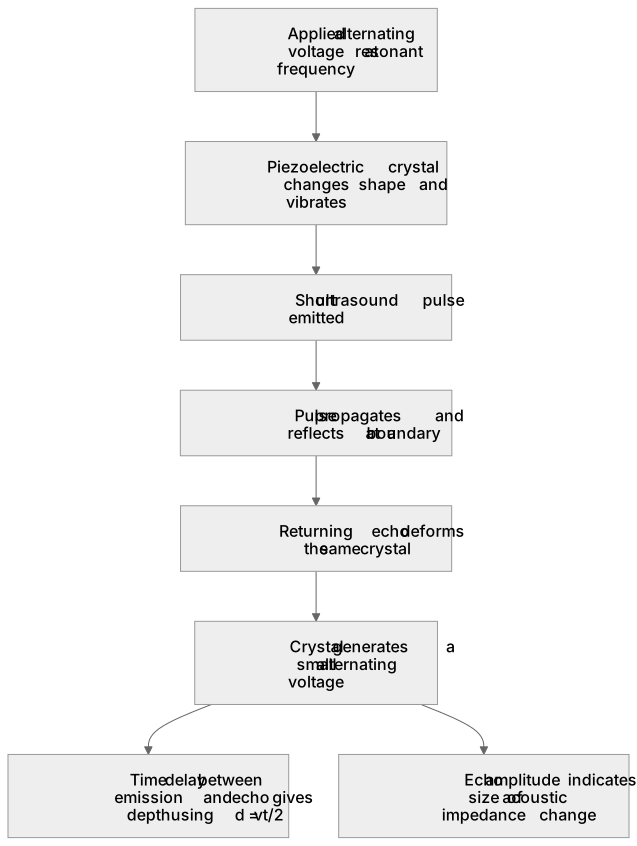
A piezoelectric crystal, often lead zirconate titanate, changes shape when a voltage is applied and produces a voltage when deformed. In an ultrasound transducer, a brief alternating voltage at the resonant frequency makes the crystal vibrate and emit a short ultrasound pulse. The same crystal then acts as a detector: returning echoes deform it and generate a small alternating voltage. A backing material damps vibrations so the pulse is short, improving axial resolution. The transducer is coupled to skin with gel to reduce reflection at the air boundary. The time between emission and echo gives depth using d = vt/2, and echo amplitude indicates the size of the acoustic impedance change.
What earns the marks
- A piezoelectric material converts an applied alternating voltage into mechanical vibration, generating an ultrasound pulse at the driving frequency.
- The same piezoelectric crystal detects returning echoes because incident sound deforms it and generates a small alternating voltage.
- The transducer is driven at its resonant frequency to produce maximum amplitude output, and damping shortens the pulse to improve resolution.
- Coupling gel excludes air between transducer and skin because the large acoustic impedance mismatch at an air boundary would reflect nearly all the ultrasound.
- The time delay between pulse emission and echo detection gives reflector depth using d = vt/2, where v is the speed of sound in the medium.
- Echo amplitude depends on the acoustic impedance difference at a boundary, so larger mismatches produce stronger echoes.
Common mistakes and how to put them right
Thinking a separate transmitter and receiver are always needed.
Put it right by explaining that one piezoelectric crystal can both generate and detect ultrasound.
Ignoring the factor of one half in depth calculations.
Put it right by using d = vt/2 because the pulse travels to the boundary and back.
Assuming coupling gel improves the piezoelectric effect.
Put it right by stating that gel provides acoustic coupling and reduces reflection at the air–skin boundary.
Exam tips
- Describe the sequence emission, propagation, reflection, detection and timing, so the role of the piezoelectric crystal is clear at each stage.
- When calculating depth, identify the total travel time and divide by two before multiplying by speed, or use d = vt/2 directly.
- Use the term acoustic impedance mismatch when explaining echo strength, and link it to reflection at tissue boundaries.
Try the lesson
The start of the Ultrasound imaging (A-level only): Piezoelectric devices Principles of generation and detection of ultrasound pulses. lesson, made from checked teaching notes for this specification point.
Have a go first
What is the function of a piezoelectric crystal in an ultrasound probe?
Listen
A piezoelectric crystal, often lead zirconate titanate, changes shape when a voltage is applied and produces a voltage when deformed. In an ultrasound transducer, a brief alternating voltage at the resonant frequency makes the crystal vibrate and emit a short ultrasound pulse. The same crystal then acts as a detector: returning echoes deform it and generate a small alternating voltage. A backing material damps vibrations so the pulse is short, improving axial resolution. The transducer is coupled to skin with gel to reduce reflection at the air boundary. The time between emission and echo gives depth using d = vt/2, and echo amplitude indicates the size of the acoustic impedance change. A strong answer earns marks for these points. A piezoelectric material converts an applied alternating voltage into mechanical vibration, generating an ultrasound pulse at the driving frequency. The same piezoelectric crystal detects returning echoes because incident sound deforms it and generates a small alternating voltage. The transducer is driven at its resonant frequency to produce maximum amplitude output, and damping shortens the pulse to improve resolution. Coupling gel excludes air between transducer and skin because the large acoustic impedance mismatch at an air boundary would reflect nearly all the ultrasound. A common slip: Thinking a separate transmitter and receiver are always needed. Instead, explaining that one piezoelectric crystal can both generate and detect ultrasound. Exam tip: Describe the sequence emission, propagation, reflection, detection and timing, so the role of the piezoelectric crystal is clear at each stage.
See it
Key words
Say what each word means before you turn the card.
Piezoelectric effect
Try answering aloud or in your head before turning the card.
Pulse-echo timing
Try answering aloud or in your head before turning the card.
Acoustic impedance and reflection
Try answering aloud or in your head before turning the card.
Transducer damping and coupling
Try answering aloud or in your head before turning the card.
See every definition
- Piezoelectric effect
- A material changes shape when a voltage is applied and produces a voltage when deformed.
- Pulse-echo timing
- The time between emission and echo gives depth using d = vt/2.
- Acoustic impedance and reflection
- Echo amplitude depends on the acoustic impedance difference at a boundary, so larger mismatches produce stronger echoes.
- Transducer damping and coupling
- A backing material damps vibrations so the pulse is short, and gel couples the transducer to skin to reduce reflection at the air boundary.
Label the diagram
Some boxes have lost their names. Pick the right name for each number.
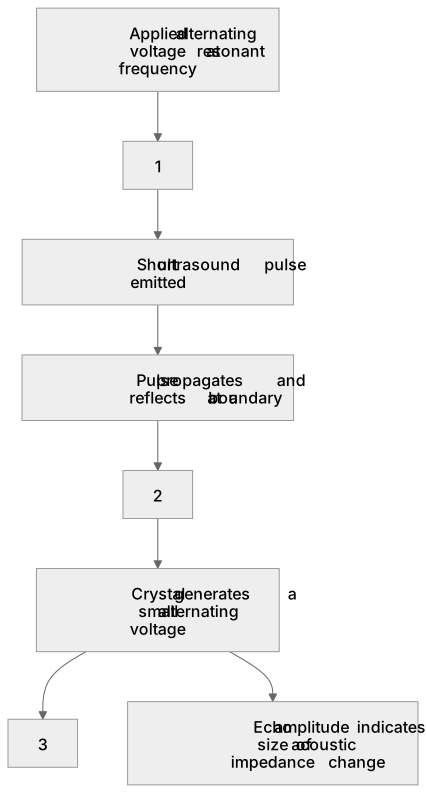
1Box 1
2Box 2
3Box 3
There is more to this lesson
The full lesson goes on to check your understanding and help you earn the marks. Create a free account to carry on, with your progress saved.
A week of Premium from your first lesson · Then the free plan continues · No card, no charge
Test your understanding of Ultrasound imaging (A-level only): Piezoelectric devices Principles of generation and detection of ultrasound pulses.
Active recall beats re-reading. Take an instant quiz now to test what you’ve learned and lock it into long-term memory.
A week of Premium from your first lesson · Then the free plan continues · No card, no charge